Word Analogies (Higher-Order)
Watch this topic in 60 seconds
Free preview · Lesson 1
Word Analogies (Higher-Order) (Foundational)
Word Analogies (Higher-Order) (Foundational)
Hey there, word sleuths! Get ready to dive into the fascinating world of word analogies. It's like being a detective for words, figuring out how they relate to each other!
What is an Analogy?
An analogy is a comparison between two things that are similar in some way. We use analogies all the time to understand new ideas by connecting them to things we already know.
In word analogies, we're looking for the same relationship between two pairs of words.
Understanding Word Relationships
To solve analogies, you need to identify the relationship between the first pair of words. Here are some common types:
- Synonyms: Words that mean the same thing (e.g., happy : joyful)
- Antonyms: Words that mean the opposite (e.g., hot : cold)
- Part to Whole: A part of something and the whole thing (e.g., finger : hand)
- Cause and Effect: One thing causes another (e.g., fire : smoke)
- Function: What something is used for (e.g., knife : cut)
How to Solve a Word Analogy
Let's break it down:
- Identify the Relationship: Figure out how the first two words are related.
- Apply the Relationship: Find a second pair of words that share the same relationship.
- Test Your Answer: Make sure the relationship works in both directions!
Example:
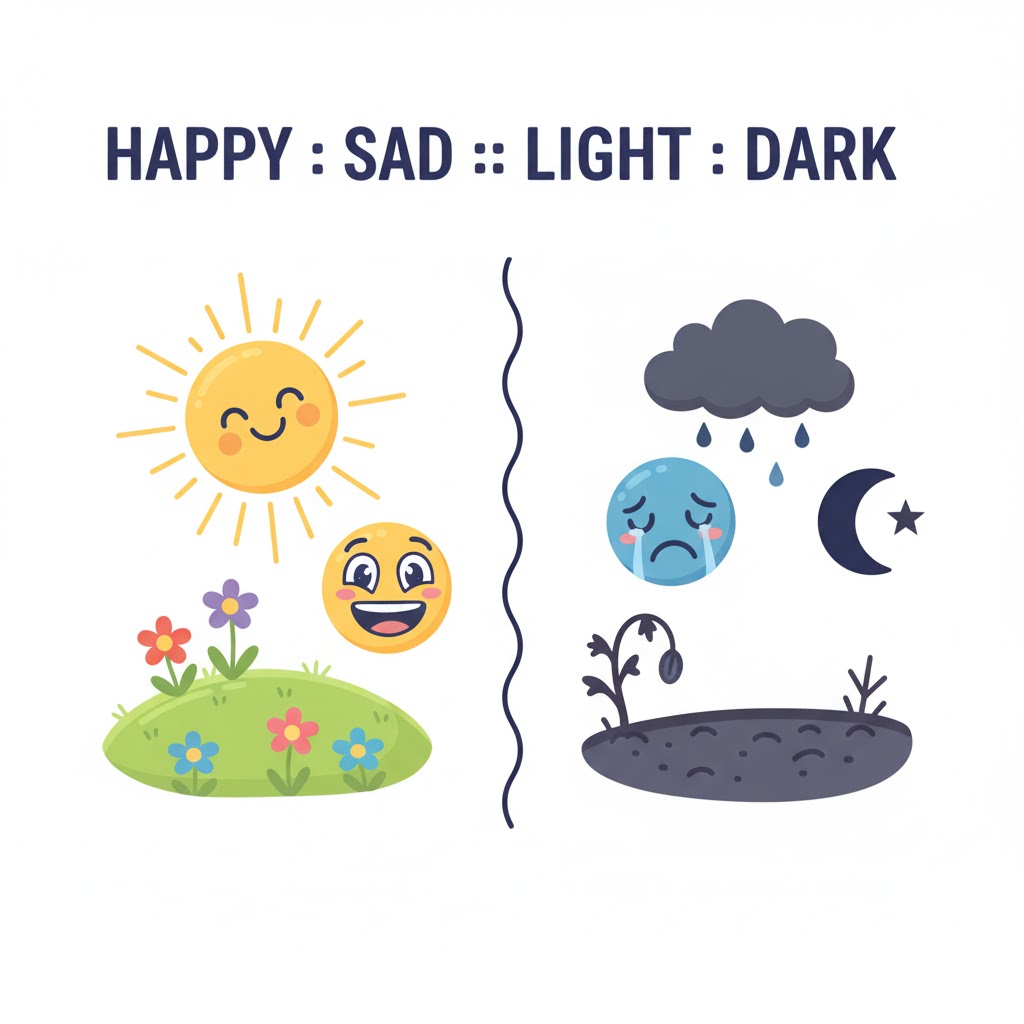
HAPPY : SAD :: LIGHT : ?
Happy is the opposite of Sad. So, we need the opposite of Light, which is DARK.
Therefore, the answer is: HAPPY : SAD :: LIGHT : DARK
 Practice Makes Perfect!
The more you practice, the better you'll become at spotting word relationships. Don't be afraid to try different relationships until you find the one that fits!
Keep learning, free
Create a free Syllabax account to unlock practice questions and games for this topic.
Visual Learning Enhanced! 🚀
To help you master this topic, we use Advanced Syllabax AI to generate detailed diagrams and visual models.
Note on Visuals: The AI sometimes makes spelling errors in image labels. Please refer to the lesson text for the correct terminology.