Ones and tens (Place Value )
Watch this topic in 60 seconds
Free preview · Lesson 1
Understanding Ones and tens (Place Value )
Understanding Ones and Tens: Building Blocks of Numbers!
Welcome, young learners, to the exciting world of numbers! Today, we're going on an adventure to discover the secret behind how we write numbers. It all starts with two special friends: the Ones and the Tens!
What are Ones?
Imagine you have a box of yummy candies. If you have just one candy, we call that 'one'. If you have two candies, we call that 'two'. We can keep counting: three, four, five, six, seven, eight, nine. These single, separate items are called ones. They are like the little building blocks that make up numbers.
Think of your fingers! Each finger you hold up by itself is like one. When you count from 1 to 9, you are counting groups of ones. The number 7 is made of seven separate, individual ones. The number 3 is made of three separate, individual ones.
In our number system, the ones place is the very first spot on the right side of a number. It tells us how many single, loose items we have.
What are Tens?
Now, imagine you get so many candies that you decide to tie them up into a little bundle of ten. That's a ten! A ten is a group of ten ones all together. It's like a super-bundle of our building blocks.
Think about when you count to ten. You've gathered ten ones! When you reach ten, you don't just keep saying 'nine ones and one more'. We have a special way to say it: one ten!
Let's use another analogy. Imagine building with LEGOs. A single LEGO brick is like a 'one'. If you stack ten LEGO bricks perfectly on top of each other to make a tall tower, that tower is like a 'ten'.
In our numbers, the tens place is the spot right next to the ones place, on its left. It tells us how many groups of ten we have.
Putting Ones and Tens Together: Making Bigger Numbers!
This is where the magic happens! When we combine ones and tens, we can make all sorts of numbers, even numbers bigger than 9!
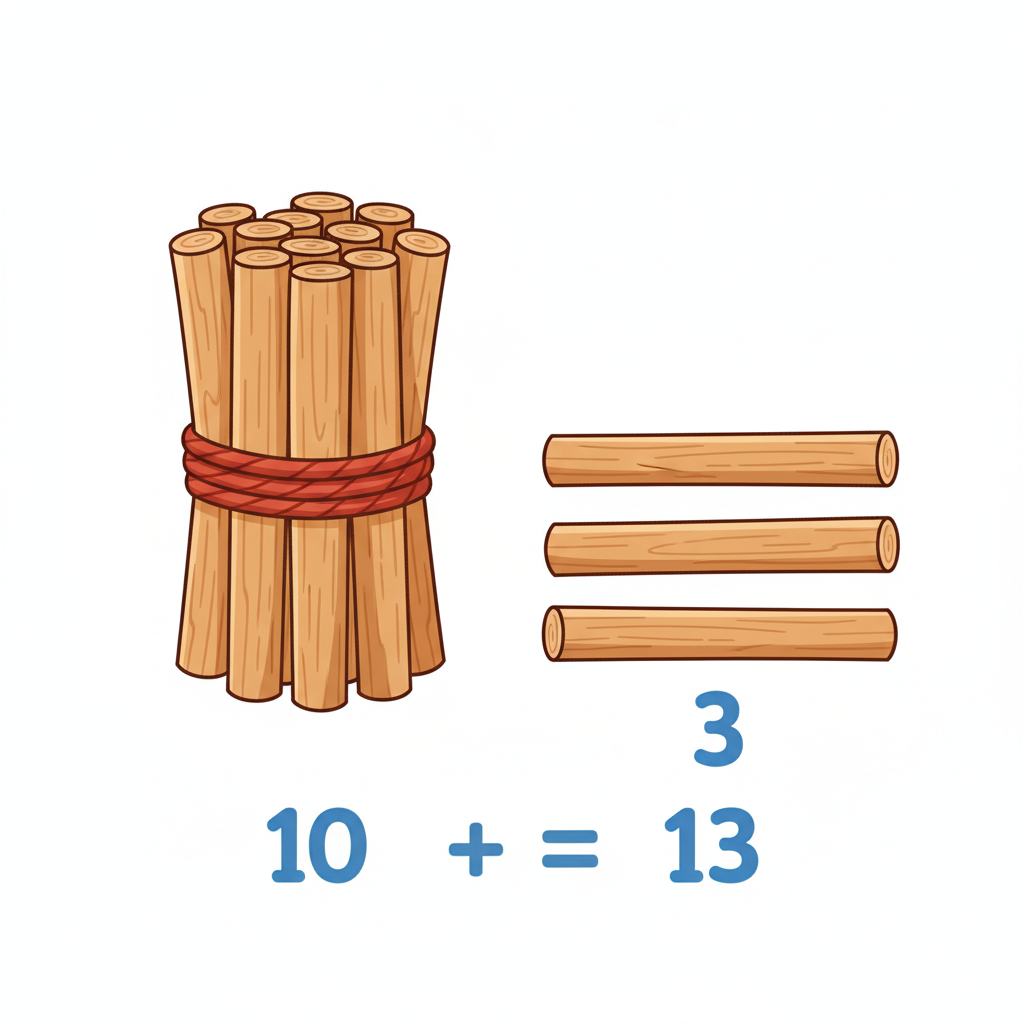
Let's say you have one bundle of ten candies and three loose candies. How many candies do you have in total?
You have 1 ten and 3 ones. We write this number as 13!
The '1' in 13 is in the tens place, meaning we have one group of ten. The '3' in 13 is in the ones place, meaning we have three single ones. So, 13 is ten plus one, plus one, plus one!
Let's try another one. What if you have two bundles of ten candies and five loose candies?
You have 2 tens and 5 ones. We write this number as 25!
The '2' is in the tens place (two groups of ten), and the '5' is in the ones place (five single ones). So, 25 is ten, plus ten, plus one, plus one, plus one, plus one, plus one!
 ⚠️ This picture may have spelling mistakes. Trust the words in the lesson.
The Place Value Chart
To help us organize our ones and tens, we use something called a place value chart. It's like a special table with boxes for each number's place.
For numbers up to 99, we usually have two boxes:
- The box on the right is for Ones.
- The box on the left is for Tens.
Let's put the number 13 into our chart:
| Tens | Ones |
|---|---|
| 1 | 3 |
The 1 goes in the Tens box, and the 3 goes in the Ones box. Easy peasy!
What about the number 47?
| Tens | Ones |
|---|---|
| 4 | 7 |
This means we have 4 tens (four bundles of ten) and 7 ones (seven single items). Altogether, that's 40 + 7 = 47!
Numbers with Zero
What happens if you have a bundle of ten candies, but no single candies left over?
That's 1 ten and 0 ones. We write this as 10!
In the number 10, the '1' is in the tens place, and the '0' is in the ones place. The zero tells us there are no single ones.
What about 30? That means 3 tens and 0 ones. Three bundles of ten, and no loose candies!
Summary: Your Number Superpowers!
Remember:
- Ones are single, individual items. They live in the rightmost spot in a number.
- Tens are groups of ten ones. They live in the spot to the left of the ones.
- We use ones and tens to build all the numbers we see!
- A place value chart helps us organize our ones and tens.
- Zero means 'none' – no ones or no tens in that spot.
You are now a number detective, ready to explore the world of ones and tens!
Keep learning, free
Create a free Syllabax account to unlock practice questions and games for this topic.
Visual Learning Enhanced! 🚀
To help you master this topic, we use Advanced Syllabax AI to generate detailed diagrams and visual models.
Note on Visuals: The AI sometimes makes spelling errors in image labels. Please refer to the lesson text for the correct terminology.