Learning Journey
Watch this topic in 60 seconds
Free preview · Lesson 1
Understanding Conservation strategies[BIOLOGY]
Conservation Strategies: Protecting Earth's Treasures
Welcome, future guardians of our planet! Imagine Earth as a giant, incredibly valuable piggy bank, filled not with coins, but with amazing living things – plants, animals, fungi, and tiny microbes. This incredible variety of life is called biodiversity. Just like you wouldn't want someone to break your piggy bank and lose all its contents, we don't want to lose the precious biodiversity of our Earth.
That's where conservation strategies come in! Conservation is simply the wise use and protection of natural resources and habitats. It's about making sure we don't 'spend' all our natural wealth and that future generations can also enjoy and benefit from Earth's amazing biodiversity.
What is Biodiversity and Why is it Important?
Think of biodiversity like a giant, complex puzzle. Each species, from the smallest bacterium to the largest whale, is a unique piece. When all the pieces are there, the picture is complete, beautiful, and strong. Each piece plays a role – some help pollinate plants, others clean water, and some provide food. If we start losing pieces, the puzzle becomes incomplete, weaker, and some parts might even collapse entirely. Biodiversity is crucial because:
- It provides us with food, medicine, and raw materials.
- It keeps ecosystems healthy (e.g., forests clean air, wetlands filter water).
- It offers recreational and aesthetic value (who doesn't love a beautiful natural landscape or fascinating animal?).
- It helps ecosystems adapt to changes, making them more resilient.
The Big Threats: Why Do We Need Conservation?
Unfortunately, many human activities are causing a rapid decline in biodiversity. These are like different kinds of 'attacks' on our planet's piggy bank:
1. Habitat Loss and Fragmentation
Imagine your home suddenly being torn down to build a shopping mall, or a highway being built right through your backyard, cutting you off from your friends and school. This is what habitat loss feels like for animals. It's like them losing their home address. When forests are cut down (deforestation), wetlands are drained, or natural areas are built upon, species lose their homes, food sources, and breeding grounds. Habitat fragmentation happens when habitats are broken into smaller, isolated pieces, making it harder for species to find mates or food.
2. Pollution
If someone started poisoning your drinking water well, you'd be in big trouble, right? That's what pollution does to ecosystems. Toxic chemicals from factories, plastics in oceans, pesticides on farms, and excessive fertilizers can harm or kill plants and animals, making their environments unhealthy or even deadly. Air pollution also contributes to acid rain and climate change, further damaging habitats.
3. Overexploitation
If you're at a party and there's a plate of delicious cookies, and you take too many cookies without thinking about others, soon there'll be none left. Similarly, overexploitation is when humans harvest plants or hunt animals faster than they can reproduce. Examples include overfishing, illegal poaching (hunting endangered animals), and excessive logging.
4. Climate Change
Imagine your house's thermostat going haywire, making it sometimes scorching hot and sometimes freezing cold. That's what climate change is doing to Earth. Caused mainly by increased greenhouse gases from human activities, it leads to rising global temperatures, extreme weather events, and changes in rainfall patterns. This can disrupt ecosystems, melt glaciers, raise sea levels, and force species to move or face extinction if they can't adapt quickly enough.
5. Invasive Species
Think about a classroom where uninvited guests suddenly appear and take over, outcompeting the original students for resources. Invasive species are plants, animals, or microbes introduced (often accidentally by humans) to a new area where they don't naturally belong. Without their natural predators or diseases, they can reproduce rapidly, outcompete native species for food and space, and disrupt entire ecosystems.
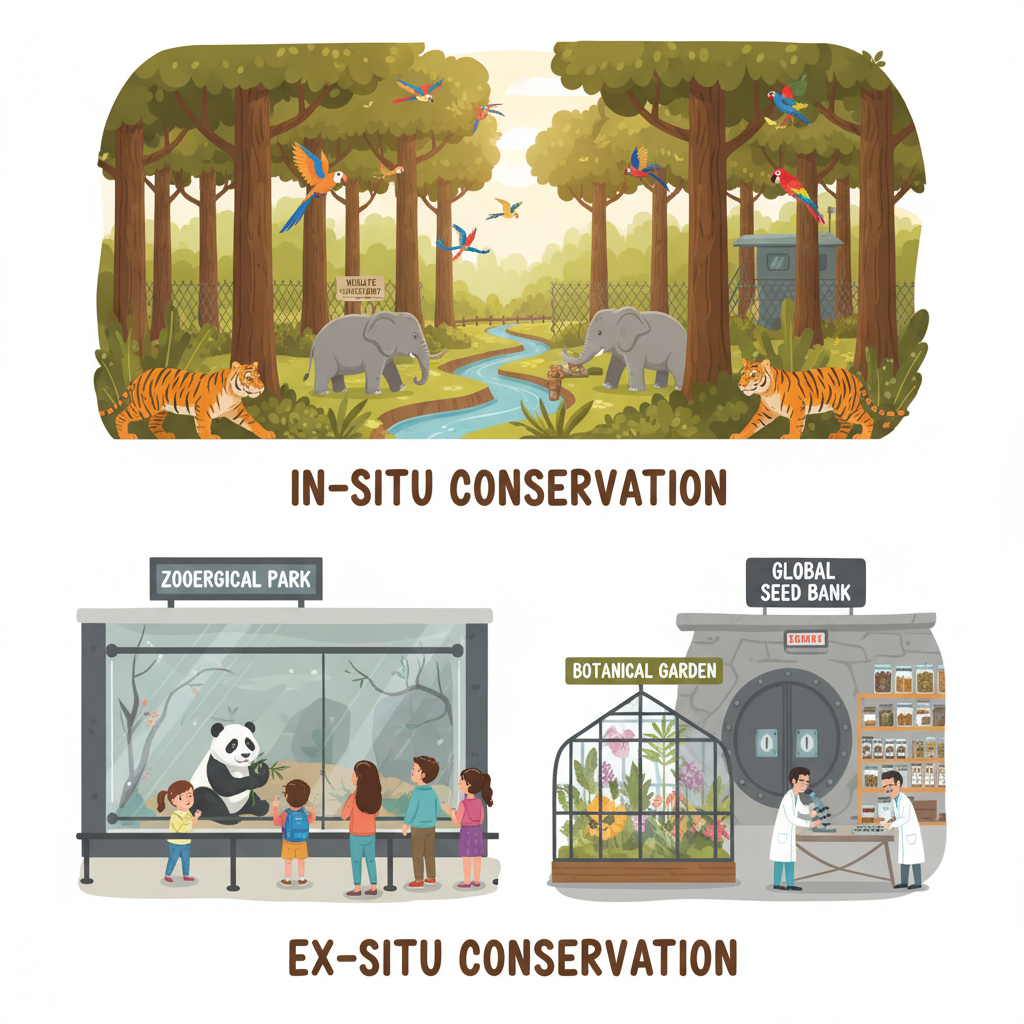 ⚠️ This picture may have spelling mistakes. Trust the words in the lesson.
Conservation Strategies: Our Solutions!
Now, let's look at the fantastic ways we're trying to fix these problems and protect our planet's biodiversity. Conservation strategies are broadly divided into two main categories:
A. In-situ Conservation (On-Site Protection)
This is like protecting a library by keeping the books right there on their shelves, in their natural environment. In-situ conservation means protecting species in their natural habitats. It's generally considered the best approach because it preserves the entire ecosystem, not just individual species.
Examples:
-
National Parks and Wildlife Sanctuaries: These are designated areas where human activities like hunting, logging, and development are restricted or prohibited. They act as safe havens for wild animals and plants. Think of them as giant 'no-trespassing' zones for nature.
-
Biosphere Reserves: These are special protected areas that aim to balance conservation with sustainable human use. They often have a core protected zone, a buffer zone, and a transition zone where local communities live and practice sustainable activities.
-
Sacred Groves and Lakes: In many cultures, certain natural areas are considered sacred and are traditionally protected by local communities due to religious or cultural beliefs. This is a very old and effective form of in-situ conservation.
B. Ex-situ Conservation (Off-Site Protection)
This is like protecting rare books by making copies and storing them in a special archive or museum, just in case something happens to the originals. Ex-situ conservation involves protecting species outside their natural habitats, often when their survival in the wild is too risky or impossible.
Examples:
-
Zoos and Aquariums: These institutions breed endangered animals under controlled conditions, aiming to eventually reintroduce them into the wild (though this is often very challenging). They also educate the public about conservation.
-
Botanical Gardens: Similar to zoos but for plants, they collect, cultivate, and display a wide range of plant species, often focusing on rare or endangered ones. They also conduct research.
-
Seed Banks: These are like massive libraries of plant seeds, stored at low temperatures and humidity to keep them viable for many years. If a plant goes extinct in the wild, its seeds might be used for reintroduction. The Svalbard Global Seed Vault is a famous example – a 'doomsday vault' for seeds!
-
Gene Banks: These store genetic material (like DNA, tissue samples, or reproductive cells) from plants and animals. They are a valuable resource for future breeding programs or scientific research.
C. Other Important Conservation Strategies
-
Sustainable Development: This is about meeting the needs of the present without compromising the ability of future generations to meet their own needs. It's like eating your cake, but saving some for later so others can enjoy it too. It balances economic growth, social equity, and environmental protection.
-
Reforestation and Afforestation: Reforestation is planting trees in areas where forests have been cleared, while afforestation is planting trees in areas that were not previously forested. This is like repairing a broken garden, bringing back lost habitats and helping to combat climate change.
-
Waste Management (Reduce, Reuse, Recycle): By producing less waste, reusing items, and recycling materials, we lessen the demand for new resources, reduce pollution, and save energy. This is about being a smart shopper and minimizing our environmental footprint.
-
Legislation and Policy: Governments create and enforce laws to protect endangered species, regulate pollution, and establish protected areas. These are like the rules for a game – they set boundaries and ensure fair play for nature.
-
Community Participation: Engaging local communities in conservation efforts is vital. When local people understand the value of biodiversity and are involved in decision-making, conservation projects are much more successful. It's like everyone helping in a group project; many hands make light work!
-
Education and Awareness: Informing people about environmental issues and the importance of conservation encourages responsible behavior. This is like spreading the word about a good cause – the more people know, the more they can help.
Your Role in Conservation
You don't have to be a scientist or live in a national park to contribute to conservation! Every action, big or small, makes a difference:
- Reduce your energy and water consumption.
- Walk or bike more often.
- Recycle and choose products with less packaging.
- Support sustainable businesses.
- Learn about local wildlife and habitats.
- Speak up for nature and educate others!
Conservation strategies are our best hope for a healthy planet. By understanding the threats and actively participating in solutions, we can ensure that Earth's incredible biodiversity, our 'piggy bank' of life, remains full and vibrant for all to enjoy.
Keep learning, free
Create a free Syllabax account to unlock practice questions and games for this topic.
Visual Learning Enhanced! 🚀
To help you master this topic, we use Advanced Syllabax AI to generate detailed diagrams and visual models.
Note on Visuals: The AI sometimes makes spelling errors in image labels. Please refer to the lesson text for the correct terminology.