Discrete vs. Continuous Data
Watch this topic in 60 seconds
Free preview · Lesson 1
Understanding Discrete vs. Continuous Data
Understanding Discrete vs. Continuous Data: A Foundational Guide for 9th Grade
Welcome, future data detectives! Have you ever noticed how some things can be counted precisely, like the number of students in a classroom, while other things are measured, like your height or the temperature outside? This fundamental difference is what we're going to explore today with 'Discrete' and 'Continuous' data. These aren't just fancy words; they're essential concepts that help us understand the world around us and organize information effectively. Think of it as classifying different kinds of 'stuff' we can gather about the world.
What is Discrete Data? Counting Things!
Let's start with Discrete Data. Imagine you have a basket of apples. You can count them one by one: 1 apple, 2 apples, 3 apples, and so on. You'll always have a whole number, and you can't have '2.5 apples' (unless you cut one, but then it's no longer a whole apple!). That's the core idea of discrete data:
- It represents items that can be counted.
- It usually takes on whole number values (integers), like 0, 1, 2, 3...
- There are clear, separate 'gaps' between possible values. You can't have a value in between two consecutive discrete values. For example, you can have 2 siblings or 3 siblings, but not 2.7 siblings.
- The values are distinct and separate.
Analogies for Discrete Data:
- Marbles in a Jar: You can count 1 marble, 2 marbles, 3 marbles. You can't have 1.37 marbles rolling around (unless it's broken, but then it's not a whole marble anymore!). Each marble is a distinct, separate item.
- Number of Cars in a Parking Lot: You count each car as a separate unit. You'll always get a whole number.
- The Pages in a Book: Page 1, Page 2, Page 3. There's no Page 1.5. Each page is a distinct, countable unit.
- Students in a Classroom: You can count exactly how many students are present. It will be a whole number.
So, whenever you're counting specific, individual items where there's no meaningful 'in-between' value, you're dealing with discrete data. It's like clicking a counter – click, click, click, for each whole unit.
What is Continuous Data? Measuring Things!
Now, let's switch gears to Continuous Data. Imagine measuring your height. You might say you're 160 cm tall. But if you get a super precise measuring tape, you might find you're 160.2 cm, or even 160.235 cm! Your height isn't limited to specific, whole numbers; it can take on any value within a certain range. That's the essence of continuous data:
- It represents items that are measured.
- It can take on any value within a given range, including fractions and decimals.
- There are no 'gaps' between possible values. Between any two values, it's theoretically possible to find an infinite number of other values. For example, between 160 cm and 161 cm, there are 160.1 cm, 160.01 cm, 160.001 cm, and so on.
- The precision of the measurement is only limited by the measuring tool itself.
Analogies for Continuous Data:
- Water in a Glass: You can measure the volume of water as 200 ml, 200.5 ml, 200.57 ml. The amount of water can continuously vary. It's not limited to whole 'drops' (though we might count drops, the *volume* itself is continuous).
- Temperature Outside: The temperature can be 25 degrees, 25.1 degrees, 25.05 degrees. It doesn't jump from 25 to 26; it passes through all the values in between.
- Time Taken to Run a Race: A runner might finish in 10 seconds, 10.3 seconds, 10.34 seconds. Time flows continuously; it doesn't just tick from one whole second to the next without passing through fractions of a second.
- Your Weight: Your weight isn't just 50 kg or 51 kg; it can be 50.7 kg, 50.75 kg, etc. It can be measured with increasing precision.
When you're measuring something that can have tiny, incremental changes and isn't restricted to specific steps, you're looking at continuous data. It's like sliding a ruler along a surface – you can stop it at any point, not just at the whole number markings.
Key Differences: Discrete vs. Continuous Data
To really nail this down, let's put them side-by-side. The biggest difference is how you get the data: do you count it, or do you measure it?
Discrete Data (Counting)
- Nature: Countable, separate, distinct.
- Values: Usually whole numbers (integers).
- Between values: Gaps exist.
- Tool: Your eyes and brain counting, a tally.
- Example: Number of pets you own.
Continuous Data (Measuring)
- Nature: Measurable, flowing, infinite possibilities.
- Values: Any value within a range (decimals, fractions).
- Between values: No gaps; infinitely divisible.
- Tool: Ruler, thermometer, stopwatch, scale.
- Example: The exact weight of your pet.
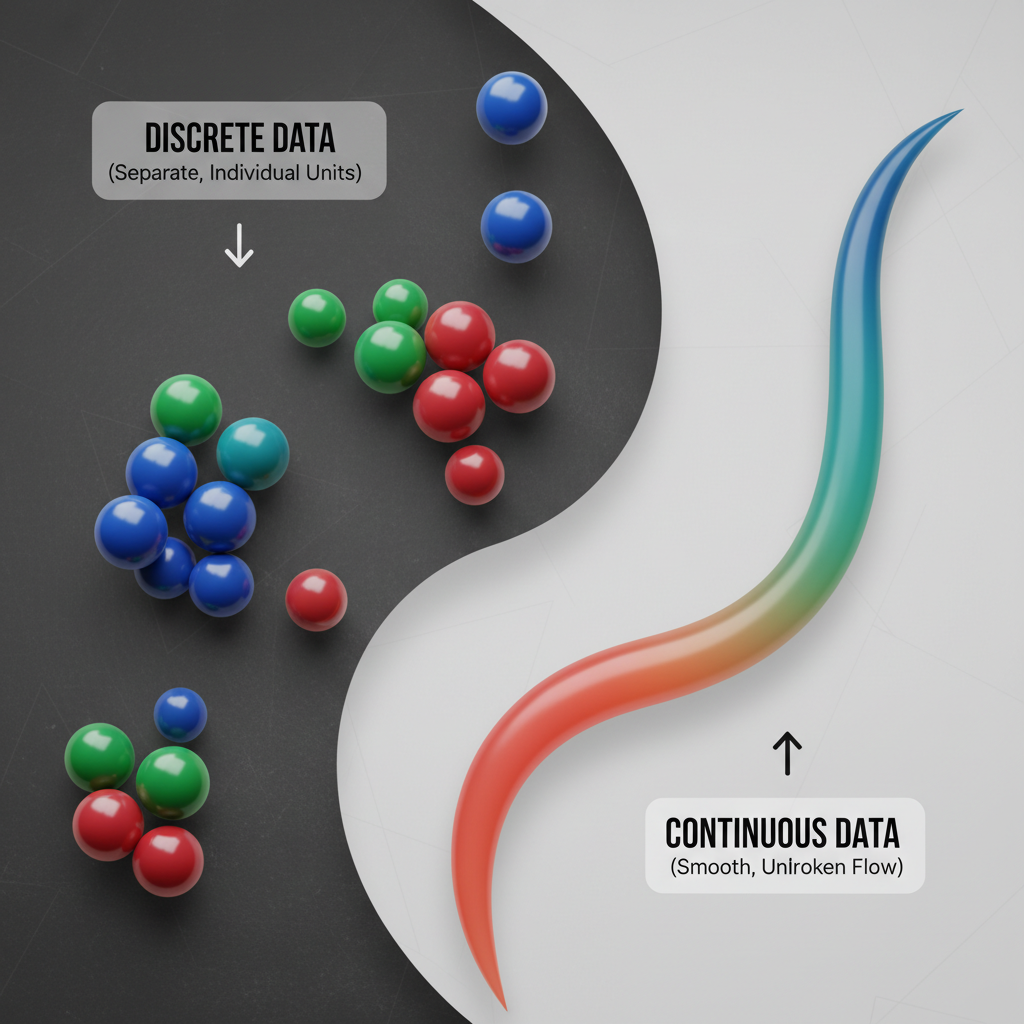 ⚠️ This picture may have spelling mistakes. Trust the words in the lesson.
Why Does This Matter?
Knowing whether data is discrete or continuous is super important for a few reasons:
- Choosing the Right Math: Different types of data require different statistical tools and graphs to analyze them correctly. You wouldn't use the same type of graph for 'number of students' as you would for 'average temperature.'
- Understanding Limitations: It helps you understand the limitations of your data. If you're counting something, you know you'll get exact whole numbers. If you're measuring, you know your precision depends on your tool.
- Making Sense of Information: This classification helps you think critically about the information you encounter daily. Is that statistic based on counting individuals or measuring an attribute? This distinction changes how you interpret it.
Let's Practice!
The best way to get good at this is to practice. For each scenario, ask yourself: Can I count distinct individual units? Or is it something I measure where there could be infinite values in between?
For instance, if I ask for 'the number of times a coin lands on heads in 10 flips,' that's discrete (you count 0, 1, 2... up to 10 heads). But if I ask for 'the time it takes for a coin to fall from a tall building,' that's continuous (it could be 2.5 seconds, 2.54 seconds, etc.).
Conclusion
You've just taken a big step in understanding how data works! The difference between discrete and continuous data is fundamental. Remember: if you're counting whole, separate items, it's likely discrete. If you're measuring something that can take on any value within a range, it's continuous. Keep practicing, and soon you'll be a master at classifying data, which is a powerful skill in our data-driven world!
Keep learning, free
Create a free Syllabax account to unlock practice questions and games for this topic.
Visual Learning Enhanced! 🚀
To help you master this topic, we use Advanced Syllabax AI to generate detailed diagrams and visual models.
Note on Visuals: The AI sometimes makes spelling errors in image labels. Please refer to the lesson text for the correct terminology.