Loudness and pitch (basic)[PHYSICS]
Watch this topic in 60 seconds
Free preview · Lesson 1
Understanding Loudness and pitch (basic)[PHYSICS]
Understanding Sound: Loudness and Pitch
Have you ever wondered what makes a whisper quiet and a shout loud? Or why a tiny bird's chirp sounds so different from a booming drum? It all comes down to two main properties of sound: loudness and pitch.
What is Sound?
Before we dive into loudness and pitch, let's quickly think about what sound is. Sound is created when something vibrates (wiggles back and forth really fast). Think about when you pluck a guitar string - it vibrates and makes a sound. When you clap your hands, the air vibrates. These vibrations travel through the air (or water, or solids) as waves, and when these waves reach our ears, we hear them!
Loudness: How Strong is the Sound?
Loudness is all about how strong or weak a sound is. We often describe sounds as loud or quiet (or soft). Think of it like this:
- A gentle breeze versus a strong wind: A gentle breeze makes a soft rustling sound, while a strong wind can howl and roar. The strong wind has more energy, just like a loud sound has more energy.
- A tiny pebble dropped in water versus a big splash: A small pebble makes a tiny 'plink,' but a big rock thrown into the water makes a huge 'SPLASH!' The splash is much louder because it's a bigger, more energetic event.
Scientifically, loudness is related to the amplitude of the sound wave. Amplitude is like the height of the wave. A taller wave means a louder sound, and a shorter wave means a quieter sound.
Imagine waves on the ocean:
- Small, gentle ripples have low amplitude. These are like quiet sounds.
- Big, crashing waves have high amplitude. These are like loud sounds.
So, to make a sound louder, you need to give it more energy. When you hit a drum harder, you make the drumhead vibrate more forcefully, creating a wave with a larger amplitude, and thus a louder sound. When you shout, your vocal cords vibrate with more energy, creating a louder sound than when you whisper.
We measure loudness in units called decibels (dB). A whisper might be around 30 dB, a normal conversation around 60 dB, and a very loud concert can be over 100 dB! It's important to protect our ears from very loud sounds because they can damage them.
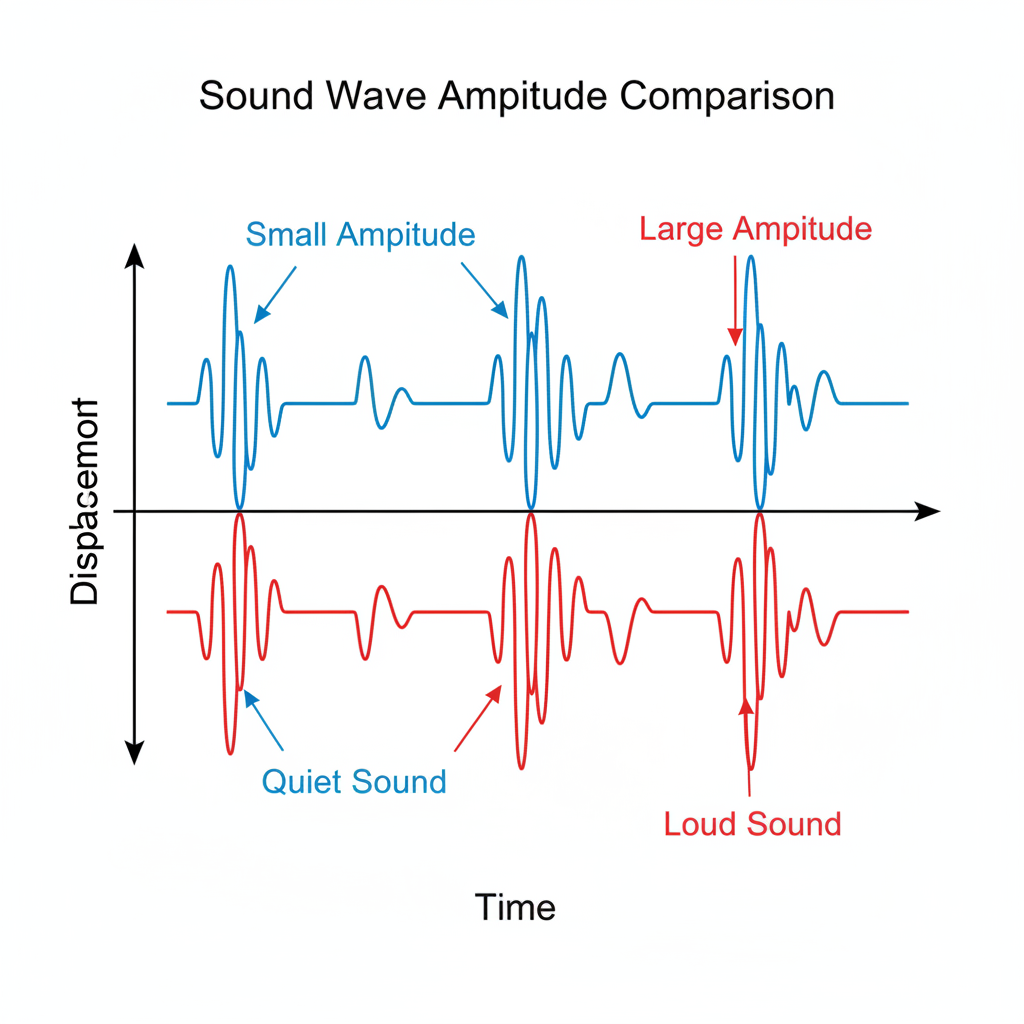 ⚠️ This picture may have spelling mistakes. Trust the words in the lesson.
Pitch: How High or Low is the Sound?
Pitch is what makes a sound seem high or low. Think about the difference between the squeaky voice of a mouse and the deep roar of a lion.
- A tiny mouse versus a giant elephant: The mouse's voice is high-pitched, like a tiny squeak. The elephant's trumpet is low-pitched, like a deep rumble.
- A tiny whistle versus a big foghorn: A small whistle makes a very high sound, while a foghorn makes a very low, booming sound.
Scientifically, pitch is related to the frequency of the sound wave. Frequency tells us how fast the sound wave is vibrating. We measure frequency in Hertz (Hz), which means cycles (vibrations) per second.
Imagine a skipping rope:
- Skipping the rope slowly (making fewer swings per second) is like a low-frequency sound, which has a low pitch.
- Skipping the rope very fast (making many swings per second) is like a high-frequency sound, which has a high pitch.
So, a sound with a high frequency has a high pitch (like a flute or a soprano singer). A sound with a low frequency has a low pitch (like a tuba or a bass singer).
How do we make sounds with different frequencies?
- String instruments (like guitars or violins): Thinner, shorter, or tighter strings vibrate faster, producing higher pitches. Thicker, longer, or looser strings vibrate slower, producing lower pitches.
- Wind instruments (like flutes or trombones): The length of the tube or how quickly you blow air through it can change the frequency.
- Our own voices: The size and tension of our vocal cords affect the pitch of our voice. When they are thin and tight, they vibrate faster, making a higher sound. When they are thick and loose, they vibrate slower, making a lower sound.
Putting It All Together: Loudness and Pitch
It's important to remember that loudness and pitch are different things. A sound can be both loud and high-pitched, or quiet and low-pitched, or any combination!
- A loud, high-pitched sound: Like a siren on an ambulance.
- A quiet, low-pitched sound: Like a cat's purr.
- A loud, low-pitched sound: Like a rumbling thunderclap.
- A quiet, high-pitched sound: Like a mosquito buzzing near your ear.
Understanding loudness and pitch helps us describe and appreciate all the different sounds around us!
Keep learning, free
Create a free Syllabax account to unlock practice questions and games for this topic.
Visual Learning Enhanced! 🚀
To help you master this topic, we use Advanced Syllabax AI to generate detailed diagrams and visual models.
Note on Visuals: The AI sometimes makes spelling errors in image labels. Please refer to the lesson text for the correct terminology.