Predicting Spinner Outcomes
Watch this topic in 60 seconds
Free preview · Lesson 1
Understanding Predicting Spinner Outcomes
Predicting Spinner Outcomes: What Will Happen Next?
Hello, young mathematicians and curious explorers! Have you ever played a board game with a spinner? You know, the colorful circle with an arrow in the middle that you flick? It spins around and lands on a color or a number. Today, we're going to become detectives and learn a super cool trick: how to predict what color the spinner is most likely to land on!
What Does "Predict" Mean?
To "predict" means to make a really good guess about what you think will happen next, even before it does! It's like looking at the sky and predicting it might rain because you see big, dark clouds. You're using clues to make your guess. With spinners, our clues are the different colored parts!
Meet Our Friend: The Spinner!
Imagine a spinner like a pie that's been cut into different pieces. Each piece has a color. When you flick the arrow, it whizzes around and then stops on one of those colored pieces. Sometimes, one color takes up a lot of the pie, and another color takes up only a tiny slice. This is our biggest clue!
The Big Secret: More Space, More Chance!
Here's the most important secret to predicting spinner outcomes: The more space a color takes up on the spinner, the more likely the arrow is to land on it! Think of it like a giant jar full of candy. If the jar has 100 blue candies and only 5 red candies, which color are you most likely to pick if you reach in without looking? Blue, right? Because there's a lot more blue!
Let's look at an example:
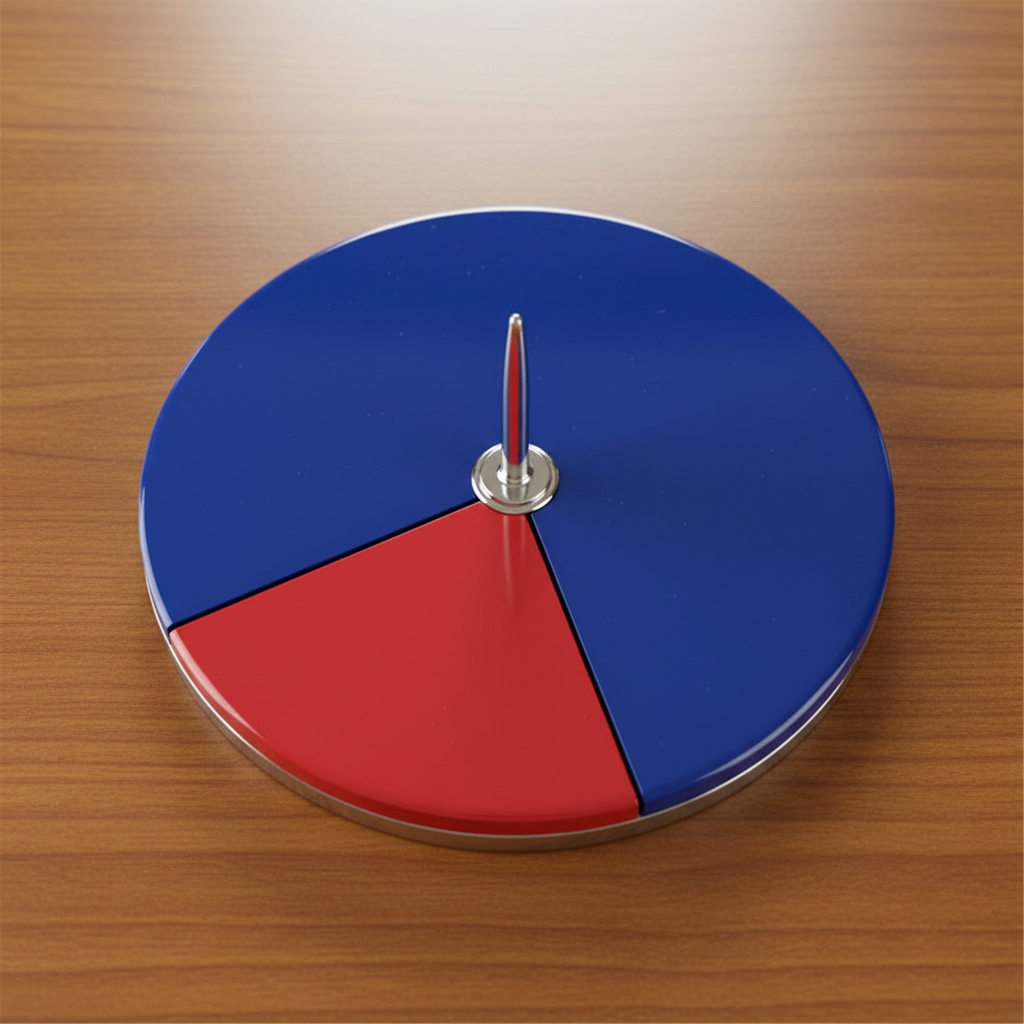 ⚠️ This picture may have spelling mistakes. Trust the words in the lesson.Look at this spinner! It has two colors: blue and red. Which color takes up more space? Yes, blue! The blue part is much, much bigger than the red part. So, if you were to spin this arrow, you would predict that it is most likely to land on blue. It's much less likely to land on red, because red has a tiny, tiny space.
Let's use another analogy: Imagine you have a really big playground and a very small sandbox. If a bird lands somewhere in the area, it's much more likely to land on the big playground than in the tiny sandbox, because the playground is so much bigger! It's the same idea with our spinner colors.
When Things Are "Equally Likely"
Sometimes, all the parts on a spinner are the exact same size. If a spinner is divided into four pieces and each piece is the same size and a different color (like red, blue, green, and yellow), then each color has an equally likely chance of being landed on. "Equally likely" means they all have the same fair chance.
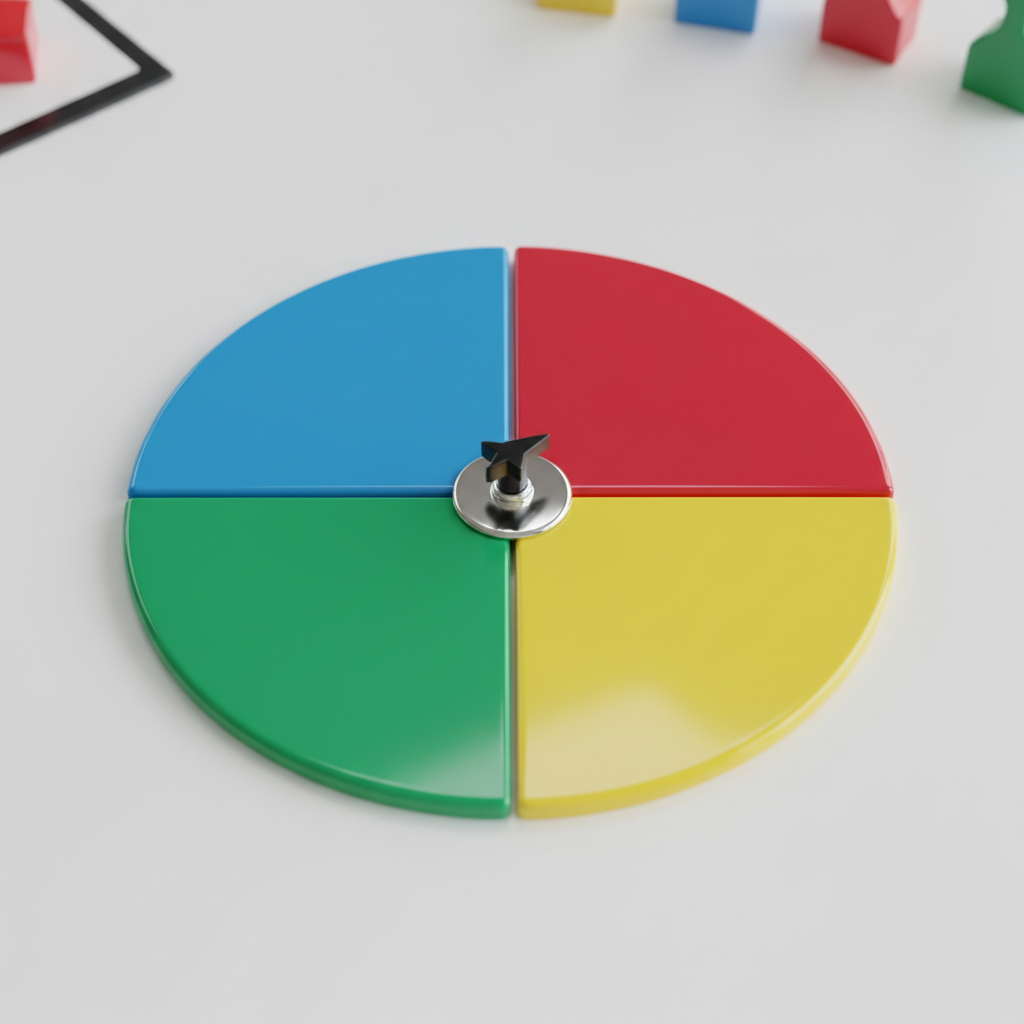 ⚠️ This picture may have spelling mistakes. Trust the words in the lesson.On this spinner, imagine each section is the same size. No one color has a "bigger playground" than another. So, it's just as likely to land on red as it is on blue, green, or yellow. They all have the same chance.
Important Words for Our Predictions:
- Likely: This means something has a good chance of happening. (Example: It's likely I'll eat dinner tonight.)
- Most Likely: This means it has the best chance of happening, more than anything else. (Example: If you have 9 blue crayons and 1 red crayon, you are most likely to pick a blue crayon.)
- Unlikely: This means something probably won't happen, or only has a small chance. (Example: It's unlikely I'll fly to the moon tomorrow.)
- Least Likely: This means it has the smallest chance of happening, less than anything else. (Example: With the crayons, you are least likely to pick a red crayon.)
- Equally Likely: This means every choice has the exact same chance of happening. (Example: When you flip a coin, it's equally likely to land on heads or tails.)
Let's Practice Our Detective Skills!
Imagine a spinner that is half green and half purple. Which color is the arrow most likely to land on?
Since both green and purple take up the exact same amount of space (half each), they are equally likely. Neither one has an advantage!
Now, what if a spinner is almost all yellow, with just a tiny sliver of orange?
It's most likely to land on yellow, because yellow takes up almost all the space! It's least likely to land on orange, because orange is super tiny.
Remember Our Secret!
When you see a spinner, just remember our secret: The bigger the part, the better its chance! The smaller the part, the smaller its chance. By looking carefully at the size of the colored sections, you can make fantastic predictions and impress all your friends with your amazing probability skills!
Keep learning, free
Create a free Syllabax account to unlock practice questions and games for this topic.
Visual Learning Enhanced! 🚀
To help you master this topic, we use Advanced Syllabax AI to generate detailed diagrams and visual models.
Note on Visuals: The AI sometimes makes spelling errors in image labels. Please refer to the lesson text for the correct terminology.