Identifying correct operations (Mixed Operations)
Watch this topic in 60 seconds
Free preview · Lesson 1
Understanding Identifying correct operations (Mixed Operations)
Learning to Choose the Right Math Operation!
Hello amazing mathematicians! Today, we're going on a super fun adventure to learn about choosing the right math operation. Think of math operations as special tools in your toolbox. Just like you wouldn't use a hammer to screw in a screw, you need to pick the right math tool for the right math problem!
What are Math Operations?
We already know about some fantastic math operations:
- Addition (+): This is like putting things together. Imagine you have 3 red apples and your friend gives you 2 more. You add them to find out how many apples you have in total! It's like collecting more treasures.
- Subtraction (-): This is like taking things away. If you had 5 cookies and ate 2, you would subtract to find out how many cookies are left. It's like giving some of your toys away to a friend.
- Multiplication (×): This is like adding the same number over and over again, but super fast! If you have 3 bags, and each bag has 4 candies, you can add 4+4+4, or you can multiply 3 groups of 4 candies. It's like getting sets of things!
- Division (÷): This is like sharing things equally. If you have 12 stickers and want to share them equally among your 3 friends, you would divide to see how many stickers each friend gets. It's like making sure everyone gets a fair share of the pizza!
Why is Choosing the Right Operation Important?
Imagine you're baking cookies, and the recipe calls for flour, sugar, and eggs. If you accidentally use salt instead of sugar, your cookies won't taste very good, will they? Math is the same! If you use the wrong operation, you won't get the right answer. Picking the correct operation is like following the recipe – it helps you get the yummy, correct answer!

How to Be a Math Operation Detective!
Being a math operation detective means looking for clues in the word problem. Let's look at some common clues for each operation:
Clues for Addition (+)
Addition is used when you want to find a total, a sum, or combine things. Look for words like:
- How many in all?
- What is the total?
- Combine
- Add
- Altogether
Analogy: Imagine you're collecting stickers. You have 5 stickers, and your friend gives you 3 more. You want to know how many stickers you have altogether. That's an addition problem!
Clues for Subtraction (-)
Subtraction is used when you want to find out how many are left, the difference, or when something is taken away. Look for words like:
- How many are left?
- How many more? (Sometimes this can be addition, but often if you're comparing amounts, it's subtraction)
- Take away
- Difference
- Less than
Analogy: You have 10 balloons, and 4 float away. You want to know how many balloons are left. That's a subtraction problem!
Clues for Multiplication (×)
Multiplication is used when you have several groups of the same size. Look for words like:
- Each
- In each group
- Times
- Product
- Sets of
Analogy: You're setting up chairs for a party. You have 5 rows, and each row has 6 chairs. You want to know the total number of chairs. Since each row has the same number of chairs, it's a multiplication problem (5 groups of 6).
Clues for Division (÷)
Division is used when you want to share equally, find out how many groups you can make, or see how many are in each group when you don't know. Look for words like:
- Share equally
- Divide
- Each (when you're trying to find out how many go into each group)
- How many groups?
- Fair share
Analogy: You have 20 cookies and want to give your 5 friends the same number of cookies. You need to share them equally. That's a division problem!
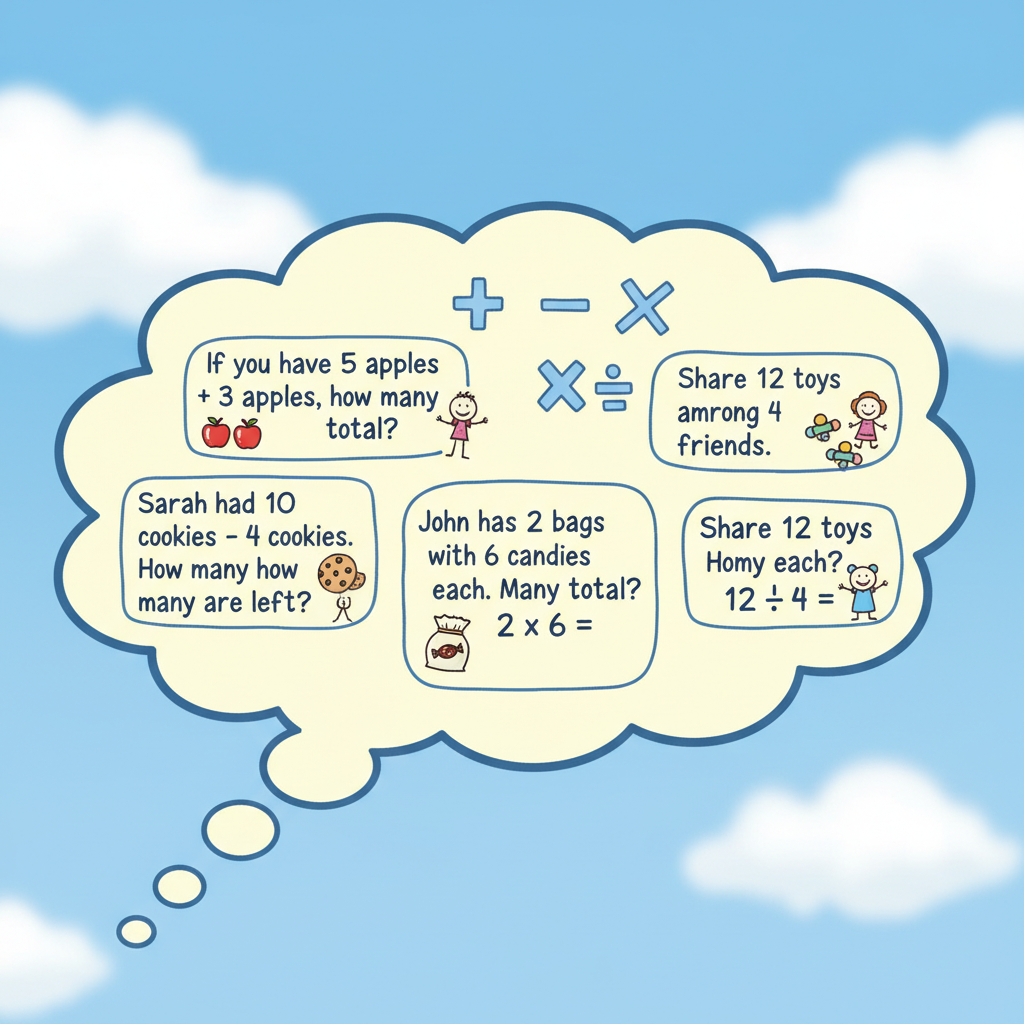 ⚠️ This picture may have spelling mistakes. Trust the words in the lesson.
Putting It All Together: Mixed Operations
Sometimes, a word problem might seem tricky because it asks you to do more than one thing! This is called a mixed operations problem. Don't worry, we can still be detectives!
Example: Sarah had 10 toy cars. Her dad bought her 3 more cars, and then she gave 2 cars to her friend. How many toy cars does Sarah have now?
Let's break it down:
- Step 1: What happened first? Sarah's dad bought her 3 more cars. This means we add. 10 + 3 = 13 cars.
- Step 2: What happened next? She gave 2 cars to her friend. This means we subtract. 13 - 2 = 11 cars.
So, Sarah has 11 toy cars now. We used two operations: addition and subtraction!
Tips for Success!
- Read carefully: Read the problem more than once.
- Look for keywords: Circle or underline words that hint at an operation.
- Draw a picture: Sometimes drawing helps you see what's happening.
- Ask yourself: Am I putting things together? Taking things away? Sharing equally? Making equal groups?
- Practice makes perfect! The more you practice, the easier it gets!
You are all becoming amazing math operation detectives!
Keep learning, free
Create a free Syllabax account to unlock practice questions and games for this topic.
Visual Learning Enhanced! 🚀
To help you master this topic, we use Advanced Syllabax AI to generate detailed diagrams and visual models.
Note on Visuals: The AI sometimes makes spelling errors in image labels. Please refer to the lesson text for the correct terminology.