Estimation & rounding off [Knowing Our Numbers]
Watch this topic in 60 seconds
Free preview · Lesson 1
Understanding Estimation & rounding off [Knowing Our Numbers]
Estimation and Rounding Off: Making Numbers Easier!
Welcome, super learners! Today, we're going on a mathematical adventure to explore something called estimation and rounding off. Don't let the big words scare you! They are simply smart ways to make big or tricky numbers into smaller, friendlier ones. Think of it like giving an approximate answer instead of an exact one. This is super useful when you want to get a general idea of something quickly, or when the exact number isn't really needed.
What is Estimation?
Imagine you're at a birthday party with lots of balloons. If someone asks, "How many balloons are there?" Do you count each one precisely? Probably not! You'd likely look at the room and say, "Oh, maybe around 50 balloons." That's estimation! You're making a sensible guess based on what you see.
In math, estimation is like making an educated guess about a number or a calculation. It helps us to:
- Get a quick idea: If you see a big pile of candies, you can estimate if there are "a lot" or "not too many" without counting every single one.
- Check our work: After doing a long calculation, we can estimate the answer to see if our final answer is reasonable. If we calculated 25 + 37 and got 1000, our estimate would tell us that's way too high!
- Simplify problems: Sometimes, exact numbers can be complicated. Estimation helps us deal with simpler, rounder numbers.
What is Rounding Off?
Rounding off is a special technique we use to make numbers simpler by changing them to the nearest "nice" number, usually a multiple of 10, 100, 1000, and so on. Think of it like smoothing out the bumps on a road to make the drive easier.
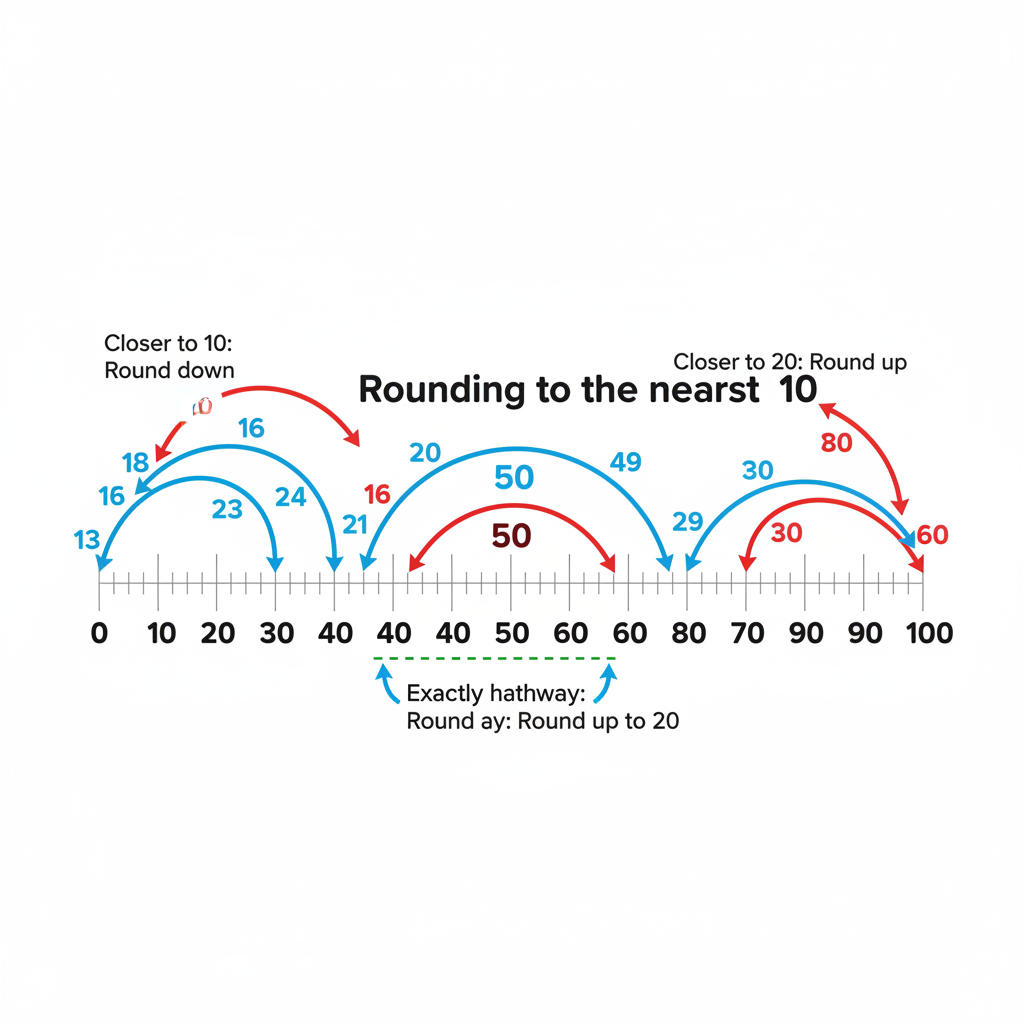
Rounding to the Nearest 10
Let's say you have the number 47. We want to round it to the nearest 10. The multiples of 10 around 47 are 40 and 50. Which one is 47 closer to?
- Distance from 47 to 40 is 7 (47 - 40 = 7).
- Distance from 47 to 50 is 3 (50 - 47 = 3).
Since 3 is smaller than 7, 47 is closer to 50. So, we round 47 up to 50.
What about 43?
- Distance from 43 to 40 is 3 (43 - 40 = 3).
- Distance from 43 to 50 is 7 (50 - 43 = 7).
Here, 3 is smaller than 7, so 43 is closer to 40. We round 43 down to 40.
The "Look Next Door" Rule for Rounding to the Nearest 10:
There's a super easy trick! To round a number to the nearest 10, we look at the digit in the ones place (the last digit).
- If the ones digit is 5, 6, 7, 8, or 9, we round up. This means we increase the tens digit by one and change the ones digit to 0.
- If the ones digit is 0, 1, 2, 3, or 4, we round down. This means we keep the tens digit the same and change the ones digit to 0.
Example 1: Round 78 to the nearest 10.
- The ones digit is 8.
- Since 8 is 5 or greater, we round up.
- The tens digit is 7. We increase it by 1, making it 8.
- We change the ones digit to 0.
- So, 78 rounded to the nearest 10 is 80.
Example 2: Round 73 to the nearest 10.
- The ones digit is 3.
- Since 3 is less than 5, we round down.
- The tens digit is 7. We keep it the same.
- We change the ones digit to 0.
- So, 73 rounded to the nearest 10 is 70.
What about numbers ending in 5? Like 75. The rule says if the digit is 5, we round up. So, 75 rounds up to 80. It's exactly in the middle, but the rule tells us to round up.
Rounding to the Nearest 100
This works the same way, but we look at the tens place to decide whether to round up or down.
- If the tens digit is 5, 6, 7, 8, or 9, we round up to the next hundred.
- If the tens digit is 0, 1, 2, 3, or 4, we round down to the current hundred.
Example 1: Round 345 to the nearest 100.
- We look at the tens digit, which is 4.
- Since 4 is less than 5, we round down.
- We keep the hundreds digit (3) the same.
- We change the tens and ones digits to 0.
- So, 345 rounded to the nearest 100 is 300.
Example 2: Round 378 to the nearest 100.
- We look at the tens digit, which is 7.
- Since 7 is 5 or greater, we round up.
- The hundreds digit is 3. We increase it by 1, making it 4.
- We change the tens and ones digits to 0.
- So, 378 rounded to the nearest 100 is 400.
Rounding to the Nearest 1000
And you guessed it! For rounding to the nearest 1000, we look at the digit in the hundreds place.
- If the hundreds digit is 5, 6, 7, 8, or 9, we round up to the next thousand.
- If the hundreds digit is 0, 1, 2, 3, or 4, we round down to the current thousand.
Example: Round 5620 to the nearest 1000.
- We look at the hundreds digit, which is 6.
- Since 6 is 5 or greater, we round up.
- The thousands digit is 5. We increase it by 1, making it 6.
- We change the hundreds, tens, and ones digits to 0.
- So, 5620 rounded to the nearest 1000 is 6000.
Why is Rounding Useful?
Let's go back to our balloon example. If you wanted to buy 50 balloons for a party, but the store sells them in packs of 10, you'd need to buy 5 packs. What if you needed "about" 47 balloons? You'd still need to buy 5 packs (50 balloons) because you can't buy parts of a pack. Rounding helps us make practical decisions!
Another example: Imagine a store owner wants to know if they sold "around"
 ⚠️ This picture may have spelling mistakes. Trust the words in the lesson.
Estimating Calculations
We can also use rounding to estimate the answer to a calculation before we do the exact math. This is like making a prediction!
Estimating Addition
Let's estimate 47 + 32.
- Round 47 to the nearest 10: 47 rounds to 50.
- Round 32 to the nearest 10: 32 rounds to 30.
- Now, add the rounded numbers: 50 + 30 = 80.
So, we estimate that 47 + 32 is around 80. (The exact answer is 79, which is very close to our estimate!)
Estimating Subtraction
Let's estimate 88 - 21.
- Round 88 to the nearest 10: 88 rounds to 90.
- Round 21 to the nearest 10: 21 rounds to 20.
- Now, subtract the rounded numbers: 90 - 20 = 70.
Our estimate for 88 - 21 is 70. (The exact answer is 67, which is close!)
Estimating Multiplication
Let's estimate 6 x 23.
- Round 23 to the nearest 10: 23 rounds to 20.
- Now, multiply: 6 x 20 = 120.
Our estimate for 6 x 23 is 120. (The exact answer is 138, which is a reasonable estimate!)
Key Rules to Remember:
- To round to the nearest 10, look at the ones digit.
- To round to the nearest 100, look at the tens digit.
- To round to the nearest 1000, look at the hundreds digit.
- If the digit you are looking at is 5 or more, round up.
- If the digit you are looking at is 4 or less, round down.
- Estimation is about getting a good guess, not the exact answer.
Keep practicing, and you'll become a rounding and estimation superstar!
Keep learning, free
Create a free Syllabax account to unlock practice questions and games for this topic.
Visual Learning Enhanced! 🚀
To help you master this topic, we use Advanced Syllabax AI to generate detailed diagrams and visual models.
Note on Visuals: The AI sometimes makes spelling errors in image labels. Please refer to the lesson text for the correct terminology.