Observational Studies vs. Experiments
Watch this topic in 60 seconds
Free preview · Lesson 1
Understanding Observational Studies vs. Experiments
Understanding Research: Observational Studies vs. Experiments (Grade 10)
Have you ever wondered how scientists, doctors, or even marketing experts figure out what works and what doesn't? How do they know if a new medicine is effective, or if a certain type of exercise helps people lose weight, or if a particular teaching method improves student grades? The answer lies in two fundamental approaches to research: Observational Studies and Experiments. While both are super important for gathering information, they work in very different ways and, crucially, lead to different kinds of conclusions.
The Big Picture: Asking Questions and Finding Answers
Imagine you're a detective. When you're trying to solve a mystery, you have different tools. Sometimes you just watch what people do, listen to conversations, and piece together clues that are already there. Other times, you might set up a trap or create a situation to see how someone reacts. In the world of science and data, these two detective methods are a lot like observational studies and experiments.
Part 1: The 'Watch and Learn' Approach – Observational Studies
What is an Observational Study?
An observational study is exactly what it sounds like: you observe. In this type of study, researchers collect data without changing or interfering with anything. They simply watch what's happening naturally and record information. Think of it like being a fly on the wall, or a birdwatcher patiently observing birds in their natural habitat without disturbing them.
Key Characteristics of Observational Studies:
- No Intervention: Researchers do not actively manipulate any variables or assign treatments. They don't tell people what to do or give them special items.
- Natural Settings: Data is often collected in real-world environments, reflecting how things truly operate.
- Finding Associations: Observational studies are great for discovering relationships or connections between different things. For example, they might show that people who eat more vegetables tend to have lower blood pressure.
Analogies to Help You Understand Observational Studies:
Analogy 1: The Detective Who Arrives After the Crime. Imagine a detective arriving at a crime scene. They don't try to change anything; they just meticulously observe everything that's already there: footprints, fingerprints, how things are arranged. They gather clues and try to build a story based on what they *see* happened, not what they *made* happen.
Analogy 2: Ice Cream and Shark Attacks. This is a classic example! Imagine a study shows that as ice cream sales go up, so do the number of shark attacks. Does eating ice cream cause shark attacks? Of course not! Both are associated with hot weather – when it's hot, more people buy ice cream and more people go swimming, increasing the chance of shark encounters. This highlights a crucial point: association does not equal causation. Observational studies can show you that two things are linked, but they can't tell you if one *causes* the other.
Analogy 3: Studying Study Habits. A teacher wants to know if students who take notes by hand perform better on tests than those who type their notes. If the teacher simply observes their current classes, noting who uses which method and then comparing their test scores, that's an observational study. The teacher isn't *forcing* anyone to take notes a certain way; they're just watching what naturally occurs.
Pros and Cons of Observational Studies:
Pros:
- Real-world Relevance: They often reflect natural conditions because nothing is being manipulated.
- Ethical: Sometimes it's unethical or impossible to conduct an experiment (e.g., studying the effects of smoking on health – you can't ethically ask people to start smoking for a study).
- Good for Exploration: Excellent for identifying potential relationships that might be worth investigating further with an experiment.
Cons:
- Cannot Prove Cause and Effect: This is the biggest limitation! Because researchers don't control variables, there might be other unseen factors (called 'confounding variables') influencing the results, just like hot weather was the confounding variable for ice cream and shark attacks.
- Bias: It can be hard to control for biases when you're just observing.
Part 2: The 'Make It Happen' Approach – Experiments
What is an Experiment?
An experiment is a study where researchers actively intervene and manipulate one or more variables to see if they cause a change in another variable. In an experiment, the researcher is like a chef actively changing one ingredient in a recipe to see how it affects the final taste.
Key Characteristics of Experiments:
- Intervention/Treatment: Researchers deliberately do something to a group of participants. This 'something' is called a 'treatment'. For example, giving a new medicine, trying a new teaching method, or using a different type of fertilizer.
- Control Group: A crucial part of many experiments is having a control group. This group does *not* receive the treatment, or receives a standard/placebo treatment. They serve as a baseline for comparison.
- Random Assignment: Participants are randomly assigned to either the treatment group or the control group. This is SUPER important because it helps ensure that the groups are as similar as possible at the start, reducing the chance that other factors are causing the observed effects.
- Proving Cause and Effect: The main goal of an experiment is to establish a cause-and-effect relationship.
Analogies to Help You Understand Experiments:
Analogy 1: The Science Lab. Think of a typical science experiment in a lab. You might have two plants. You give one plant a special new fertilizer (treatment group) and the other plant gets regular water (control group). You control all other conditions (light, temperature) to make sure any difference in growth is due to the fertilizer. Here, you are actively *doing* something to one group to see its *effect*.
Analogy 2: The Taste Test. Imagine a company wants to know if a new chocolate chip cookie recipe is better than their old one. They gather 100 people. They randomly give 50 people the new cookie (treatment group) and 50 people the old cookie (control group). They ask everyone to rate the taste. Because they *assigned* which cookie each person got randomly, they can be more confident that any difference in average ratings is due to the new recipe, not just different preferences of the people in each group.
Analogy 3: The Light Switch. If you flip a light switch and the light comes on, you know the switch *caused* the light to come on (assuming the power works and the bulb isn't broken). You intervened (flipped the switch) and observed a direct effect. Experiments aim for this kind of direct, causal link.
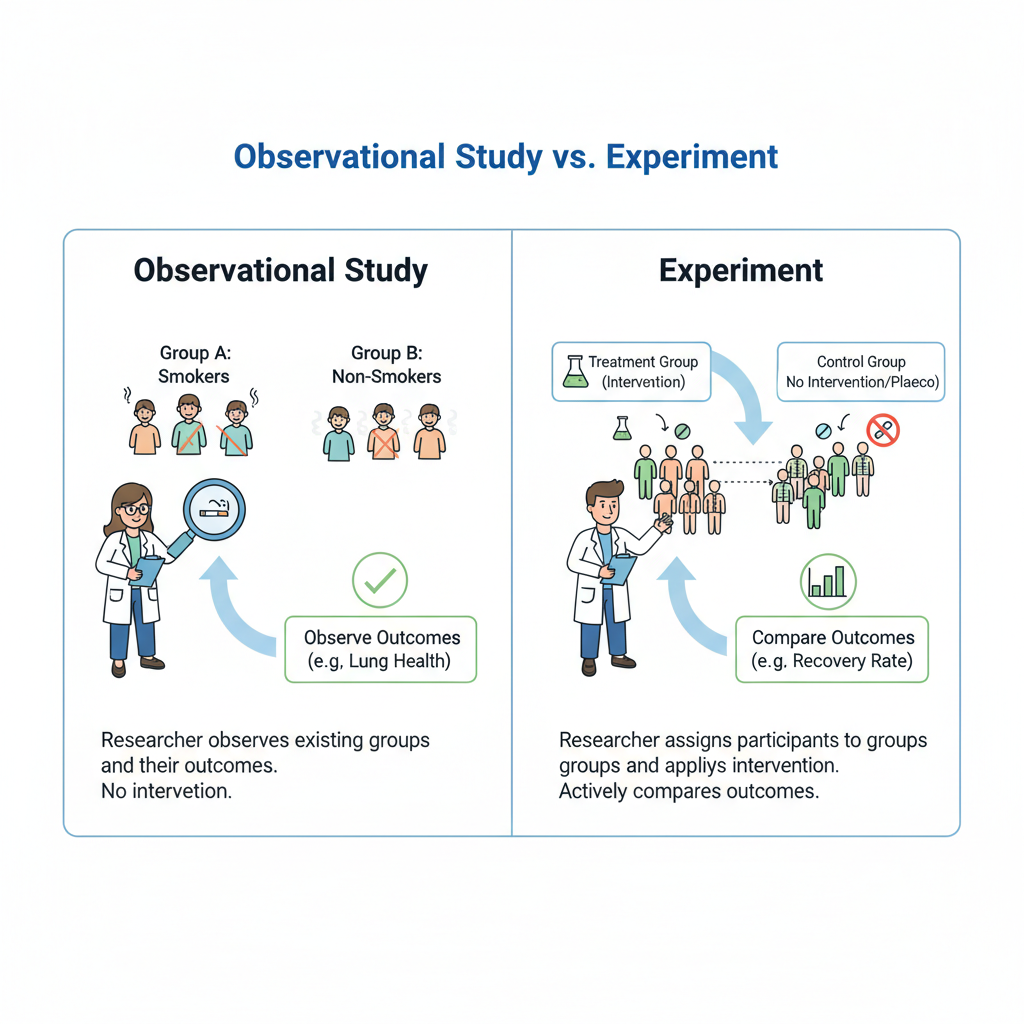 ⚠️ This picture may have spelling mistakes. Trust the words in the lesson.
The Critical Difference: Cause and Effect
This is the most important takeaway: Experiments can establish cause-and-effect relationships, while observational studies can only identify associations or correlations.
- When an experiment is properly designed (especially with random assignment), you can say, "Because we did X, Y happened."
- With an observational study, you can only say, "We noticed that when X is present, Y often also occurs." You can't be sure X *causes* Y, because there might be other hidden factors at play.
Why is 'Random Assignment' so important in experiments?
Imagine you're testing a new diet pill. If you let people *choose* whether they want to take the pill or not, you'd likely find that people who choose to take the pill are already more motivated to lose weight, or perhaps healthier to begin with. So, if the pill-takers lose more weight, is it because of the pill or because they were more motivated? Random assignment takes away this problem. By randomly putting people into the 'pill' group or the 'no pill' group, you make both groups roughly equal in motivation, health, age, etc., from the start. This way, any significant difference you see at the end can be confidently attributed to the pill itself.
When Do We Use Which?
The choice between an observational study and an experiment depends on your research question and practical/ethical considerations.
- Choose an Experiment when:
- You want to establish a cause-and-effect relationship.
- It's ethical and practical to intervene and assign treatments.
- You can control other variables to isolate the effect of your treatment.
- Example: Testing if a new drug lowers blood pressure.
- Example: Determining if a new teaching method improves test scores.
- Choose an Observational Study when:
- It's unethical or impossible to randomly assign people to a 'treatment' (e.g., studying the effects of smoking, living near a toxic waste dump).
- You are exploring a new topic and looking for potential relationships to investigate further.
- You want to describe a population or phenomenon as it naturally occurs.
- You want to study rare outcomes or exposures.
- Example: Studying the link between air pollution levels and asthma rates in a city.
- Example: Investigating dietary patterns and the incidence of certain diseases over time.
Conclusion: Be a Smart Consumer of Information
Understanding the difference between observational studies and experiments is crucial for being a smart, critical thinker, especially when you encounter news stories or social media posts claiming "X causes Y." If someone says a certain food causes a particular disease, ask yourself: Was this based on an experiment or an observational study? If it was observational, remember that it only shows a link, not a direct cause. True cause-and-effect conclusions usually require well-designed experiments.
Both types of studies provide valuable insights, but knowing their limitations and strengths allows you to interpret findings correctly and make informed decisions.
Keep learning, free
Create a free Syllabax account to unlock practice questions and games for this topic.
Visual Learning Enhanced! 🚀
To help you master this topic, we use Advanced Syllabax AI to generate detailed diagrams and visual models.
Note on Visuals: The AI sometimes makes spelling errors in image labels. Please refer to the lesson text for the correct terminology.