Newton’s 1st, 2nd, 3rd laws[PHYSICS]
Watch this topic in 60 seconds
Free preview · Lesson 1
Understanding Newton’s 1st, 2nd, 3rd laws[PHYSICS]
Understanding Newton's Laws of Motion: The Basics
Welcome, future physicists! Have you ever wondered why a soccer ball stops rolling, or why it's harder to push a full grocery cart than an empty one? The answers lie in some of the most fundamental principles of the universe, discovered by a brilliant scientist named Isaac Newton over 300 years ago. These are called Newton's Laws of Motion, and they explain how objects move (or don't move!) in response to forces.
Don't worry, we'll break down these powerful ideas into simple terms, using lots of everyday examples to make them crystal clear. By the end of this lesson, you'll be looking at the world around you with a new, more scientific perspective!
Newton's First Law: The Law of Inertia (An Object's Stubbornness)
Imagine you're sitting still on a couch, perfectly comfortable. Do you suddenly just start flying around the room for no reason? No, of course not! You stay put. Now, imagine you're riding a bike on a perfectly flat, smooth road, and you stop pedaling. Does the bike immediately halt? Not instantly. It keeps rolling for a while before friction and air resistance bring it to a stop.
What it Means:
Newton's First Law states: "An object at rest stays at rest, and an object in motion stays in motion with the same speed and in the same direction, unless acted upon by an unbalanced force."
- "An object at rest stays at rest": This part is easy. If something isn't moving, it won't start moving unless a force pushes or pulls it. Think of a book on a table. It will stay there forever unless someone picks it up or something knocks it off.
- "An object in motion stays in motion with the same speed and in the same direction": This part can be a bit trickier because in our everyday lives, things that move tend to slow down. Why? Because of forces like friction (the rubbing between surfaces) and air resistance. If we could eliminate all these "stopping" forces, a ball thrown in space would literally keep going forever in a straight line, at the same speed!
Key Concept: Inertia
The "stubbornness" of an object to resist changes in its state of motion is called inertia. All objects have inertia. The more mass an object has (the more "stuff" it's made of), the more inertia it has. This means it's harder to get a heavy object moving, and harder to stop it once it is moving.
Analogies for the First Law:
- The Unbuckled Passenger: If a car suddenly slams on its brakes, your body wants to continue moving forward. Without a seatbelt, you'd lurch forward, maybe even hit the dashboard. That's inertia in action!
- Kicking a Ball: A soccer ball sitting on the grass won't move until you kick it (an unbalanced force). Once it's rolling, it would keep going if not for the friction from the grass and air resistance.
- The Tablecloth Trick: When a magician quickly pulls a tablecloth from under dishes, the dishes (due to their inertia) tend to stay in place, appearing to "magically" remain on the table. The force applied by the tablecloth isn't strong enough or long enough to overcome their inertia significantly.
Newton's Second Law: The Law of Acceleration (Force, Mass, and Motion)
You've probably noticed that it takes more effort to push a heavy box than a light one. Or that if you push something harder, it moves faster. Newton's Second Law brings these observations together with a very famous equation.
What it Means:
Newton's Second Law states: "The acceleration of an object is directly proportional to the net force acting on it and inversely proportional to its mass."
In simpler terms, this means:
- More Force = More Acceleration: If you push an object with more force, it will speed up (accelerate) more quickly. Think of kicking a soccer ball gently versus kicking it hard.
- More Mass = Less Acceleration (for the same force): If an object is heavier (has more mass), it's harder to make it speed up. Imagine trying to push an empty shopping cart versus a cart piled high with groceries. Pushing with the same effort, the empty cart accelerates much more.
The Famous Formula: F = ma
This law is often expressed with the equation: F = ma
- F stands for Force (measured in Newtons, N). This is the "net" force, meaning the total, unbalanced force acting on the object.
- m stands for mass (measured in kilograms, kg). This is how much "stuff" the object is made of.
- a stands for acceleration (measured in meters per second squared, m/s²). This is the rate at which the object's velocity changes (how quickly it speeds up, slows down, or changes direction).
So, Force = mass × acceleration. If you apply a force to an object, it will accelerate. How much it accelerates depends on how big the force is and how heavy the object is.
Analogies for the Second Law:
- Shopping Cart Dilemma: Pushing an empty shopping cart (low mass) requires little force to get it moving quickly (high acceleration). Pushing a full shopping cart (high mass) requires much more force to achieve the same acceleration.
- Throwing a Ball: You can throw a tennis ball (low mass) very fast (high acceleration) with a moderate force. To throw a bowling ball (high mass) even a little bit fast, you need to exert a huge amount of force.
- Pedaling a Bicycle: When you pedal harder (increase force), your bicycle speeds up faster (increases acceleration). If you had a heavier bike (more mass), you'd have to pedal even harder to get the same speed increase.
Newton's Third Law: The Law of Action-Reaction (Every Push Has a Push Back)
Have you ever jumped off a small boat onto a dock? What happens to the boat? It pushes away from the dock! Or if you push against a wall, you feel the wall pushing back on you. These are examples of Newton's Third Law.
What it Means:
Newton's Third Law states: "For every action, there is an equal and opposite reaction."
This means that forces always come in pairs. When one object exerts a force on a second object, the second object simultaneously exerts an equal and opposite force on the first object. These two forces are called an "action-reaction pair."
- "Equal": The magnitude (strength) of the action force is exactly the same as the magnitude of the reaction force.
- "Opposite": The direction of the action force is exactly opposite to the direction of the reaction force.
It's important to remember that these two forces always act on different objects. The action force acts on one object, and the reaction force acts on the *other* object.
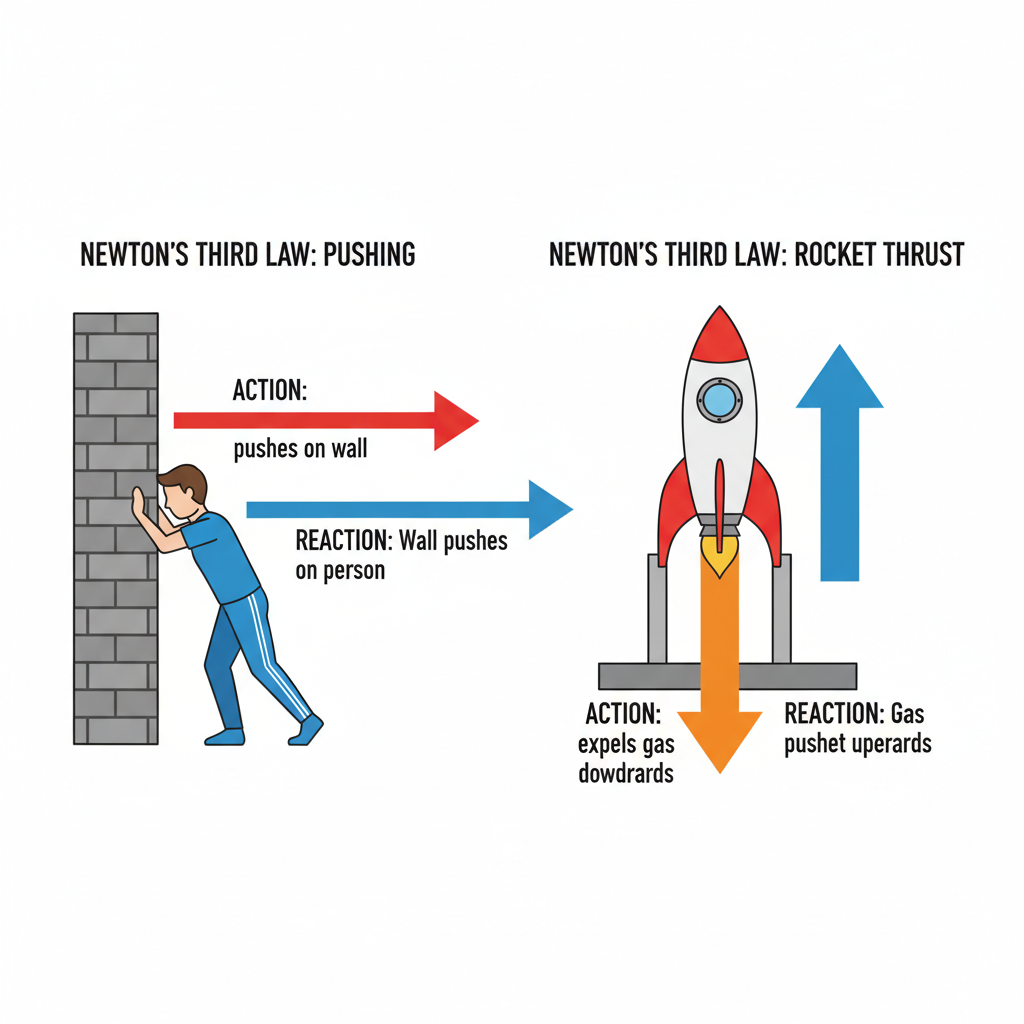 ⚠️ This picture may have spelling mistakes. Trust the words in the lesson.
Analogies for the Third Law:
- Walking: When you walk, your foot pushes backward on the ground (action). The ground pushes forward on your foot (reaction), propelling you forward. Without this reaction force, you couldn't move!
- Rocket Launch: A rocket works by expelling hot gases downward (action). The gases, in turn, push the rocket upward (reaction), lifting it into space.
- Bouncing a Ball: When you drop a ball, it hits the floor (action force from ball on floor). The floor exerts an upward force on the ball (reaction force from floor on ball), causing it to bounce back up.
- Pushing a Wall: If you push a wall with 100 Newtons of force, the wall pushes back on you with 100 Newtons of force in the opposite direction. That's why pushing a wall doesn't move it, but if you push hard enough, you might feel tired!
Putting It All Together
These three laws might seem separate, but they are deeply connected and work together to explain all kinds of motion around us:
- Newton's First Law tells us what happens when forces are balanced (nothing changes state of motion).
- Newton's Second Law tells us what happens when forces are unbalanced (acceleration occurs, and F=ma tells us how much).
- Newton's Third Law reminds us that forces always come in pairs, never alone, and that these pairs act on different objects.
From the smallest atom to the largest galaxy, these laws are the bedrock of classical physics, helping us understand everything from how a car drives to how planets orbit the sun.
Conclusion
Congratulations! You've just taken your first big step into understanding the fundamental laws that govern motion. You now know:
- An object's inertia makes it resist changes in its motion (First Law).
- Force, mass, and acceleration are linked by F=ma (Second Law).
- Forces always come in equal and opposite action-reaction pairs acting on different objects (Third Law).
Keep observing the world around you and try to spot Newton's Laws in action – you'll find them everywhere!
Keep learning, free
Create a free Syllabax account to unlock practice questions and games for this topic.
Visual Learning Enhanced! 🚀
To help you master this topic, we use Advanced Syllabax AI to generate detailed diagrams and visual models.
Note on Visuals: The AI sometimes makes spelling errors in image labels. Please refer to the lesson text for the correct terminology.