Directions & mapping [Logical Reasoning (Olympiad Mandatory Section)]
Watch this topic in 60 seconds
Free preview · Lesson 1
Understanding Directions & mapping [Logical Reasoning (Olympiad Mandatory Section)]
Navigating Our World: Understanding Directions and Mapping
Imagine you're a pirate, searching for buried treasure! How would you find it? You'd need a treasure map, right? Maps are amazing tools that help us understand where things are. They use special language, and one of the most important parts of that language is understanding directions.
The Four Cardinal Directions: Your Compass Rose
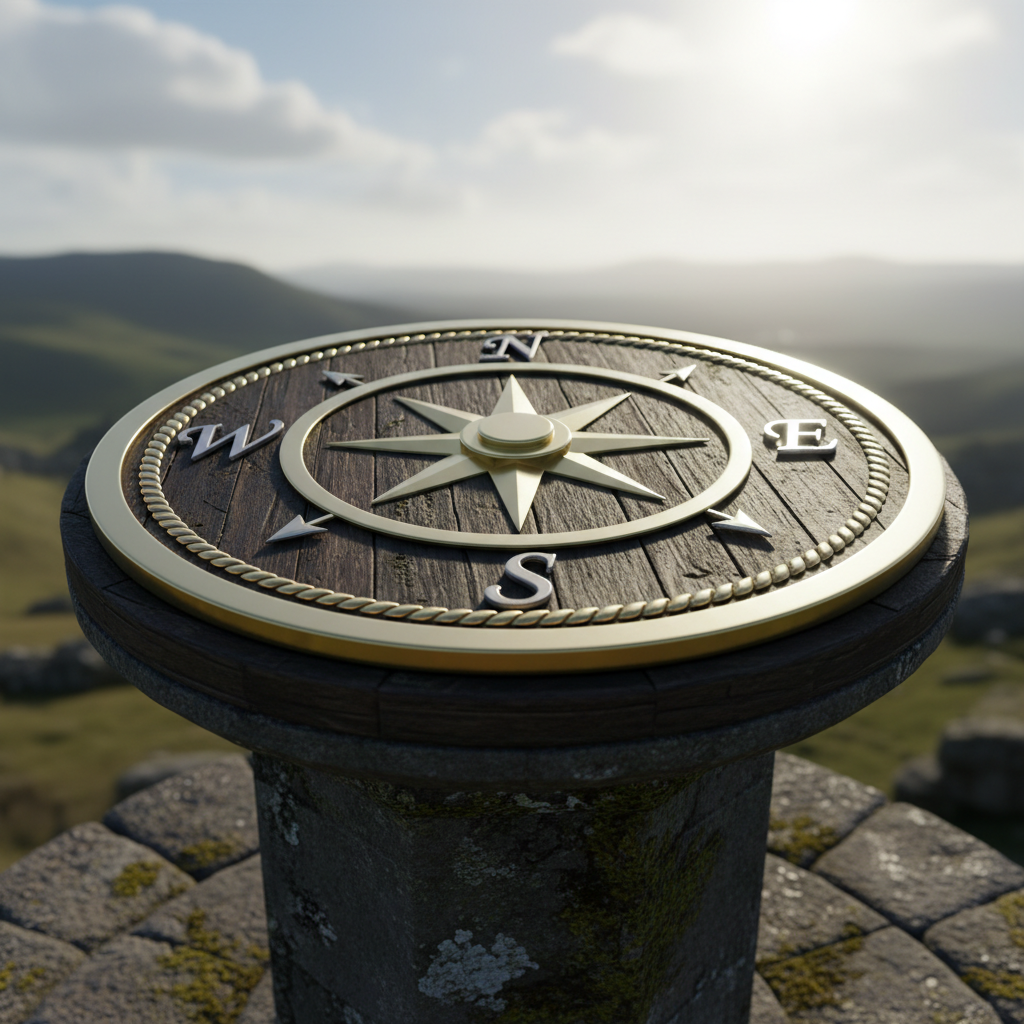
Think of the world like a giant playground. To explore it, we need some basic directions. The most important ones are like the four main points on a compass: North (N), South (S), East (E), and West (W). These are called the cardinal directions.
Let's make it super easy to remember:
- North: Imagine you're standing at the North Pole, the very top of our Earth. Everything 'up' from there, or towards the top of a map, is North.
- South: Now imagine you're at the South Pole, the very bottom of the Earth. Everything 'down' from there, or towards the bottom of a map, is South.
- East: This is the direction the sun rises every morning! Think of waking up and seeing the first rays of light – that's the East.
- West: This is the direction the sun sets every evening, painting the sky with beautiful colors. Think of going to bed and watching the last light fade – that's the West.
We often see these directions arranged in a circle on maps, like the spokes of a wheel. This arrangement is called a compass rose. It's like a guide helping you point the way!
Putting Directions to Use: Following Instructions
Understanding these four directions helps us follow instructions and describe where things are. If someone tells you to walk 5 steps North, you know exactly which way to go!
Analogy: Playing 'Simon Says'
Think about playing 'Simon Says'. When the leader says, 'Simon Says, take two steps forward,' you know exactly what to do. Directions on a map are similar! 'Walk 10 steps East' is like a command telling you which way to move.
Relative Directions: Left, Right, Forward, Backward
Besides the main cardinal directions, we also use directions that depend on where *you* are facing. These are relative directions.
- Forward/Ahead: The direction you are currently looking or moving.
- Backward/Behind: The opposite of forward.
- Left: If you are facing North, your left is West.
- Right: If you are facing North, your right is East.
Your left and right change depending on which way you are facing! If you turn around to face South, your left hand will now point East, and your right hand will point West. It's like the steering wheel of a car – the direction you turn affects where you go.
Maps: Pictures of Places
A map is a drawing of an area, like your neighborhood, a city, or even the whole world. Maps help us see:
- What is there: Buildings, roads, parks, rivers.
- Where things are: How far apart things are and in what direction.
Analogy: Your Bedroom Floor Plan
Imagine you drew a simple picture of your bedroom, showing where your bed, desk, and closet are. That's like a small map of your room! You can use it to tell someone, 'My bed is to the left of my desk.'
Map Features: Keys and Symbols
Maps often have special marks called symbols. These are like little pictures that stand for real things. For example, a little drawing of a tree might mean there's a park or a group of trees. A blue line might represent a river or a road.
To understand what these symbols mean, maps usually have a key (or legend). The key is like a secret codebook that tells you what each symbol represents. If you see a symbol for a bed on your bedroom floor plan, the key would tell you, 'This symbol means bed.' Without the key, those symbols would just be confusing drawings!
Putting It All Together: Finding Your Way
When you combine directions and maps, you can become a super navigator!
- Read a map: Use the compass rose to know which way is North.
- Understand symbols: Use the key to know what things on the map represent.
- Follow directions: Use cardinal and relative directions to move from one place to another.
Analogy: A Scavenger Hunt
A scavenger hunt is a perfect example! You get a series of clues. The first clue might say, 'Start at the big oak tree. Walk 15 steps East.' You find the oak tree, use your knowledge of East, and take 15 steps. Then you find the next clue, and so on, until you find the treasure!
Understanding directions and how to read maps is a skill that helps you in many ways, from finding your way around your school to exploring new places.
Keep learning, free
Create a free Syllabax account to unlock practice questions and games for this topic.
Visual Learning Enhanced! 🚀
To help you master this topic, we use Advanced Syllabax AI to generate detailed diagrams and visual models.
Note on Visuals: The AI sometimes makes spelling errors in image labels. Please refer to the lesson text for the correct terminology.