Learning Journey
Watch this topic in 60 seconds
Free preview · Lesson 1
Understanding Reflex action[BIOLOGY]
Understanding Reflex Action: Your Body's Lightning-Fast Response System
Have you ever accidentally touched something hot and pulled your hand back even before you realized what happened? Or perhaps a doctor tapped your knee with a small hammer, and your leg automatically kicked out? These quick, automatic responses are not magic; they are examples of something incredible called a reflex action. In biology, especially for Grade 10, understanding reflex actions is key to appreciating how your nervous system keeps you safe and functioning without you even having to think about it.
What Exactly is a Reflex Action?
Imagine your body has an emergency 'auto-pilot' system. That's essentially what a reflex action is! A reflex action is an involuntary, rapid, and automatic response to a stimulus. 'Involuntary' means you don't consciously decide to do it; it just happens. 'Rapid' means it's super fast, often occurring in a fraction of a second. 'Automatic' means it's a pre-programmed response, like an instant reaction without any thought involved.
Think of it like this: If your house has a fire alarm, it doesn't wait for you to wake up, think, and decide to make noise. The moment it detects smoke (the stimulus), it blares loudly (the response) – automatically and instantly. Your body's reflexes work in a very similar way, protecting you from harm before your brain even fully processes the danger.
Why Do We Need Reflex Actions? The Body's Built-in Bodyguard
The primary purpose of reflex actions is protection and survival. If you touch a hot stove, your hand needs to move away immediately to prevent serious burns. If something flies towards your eye, your eyelids need to shut instantly to protect your delicate eyes. These actions are too critical to wait for your brain to analyze the situation, make a decision, and then send a command. Reflexes cut out the 'thinking' part to save precious time.
Consider your reflex actions as your body's personal bodyguards, always on alert, always ready to act instantly when danger lurks, even if you're not paying attention.
The Reflex Arc: The Pathway of a Reflex
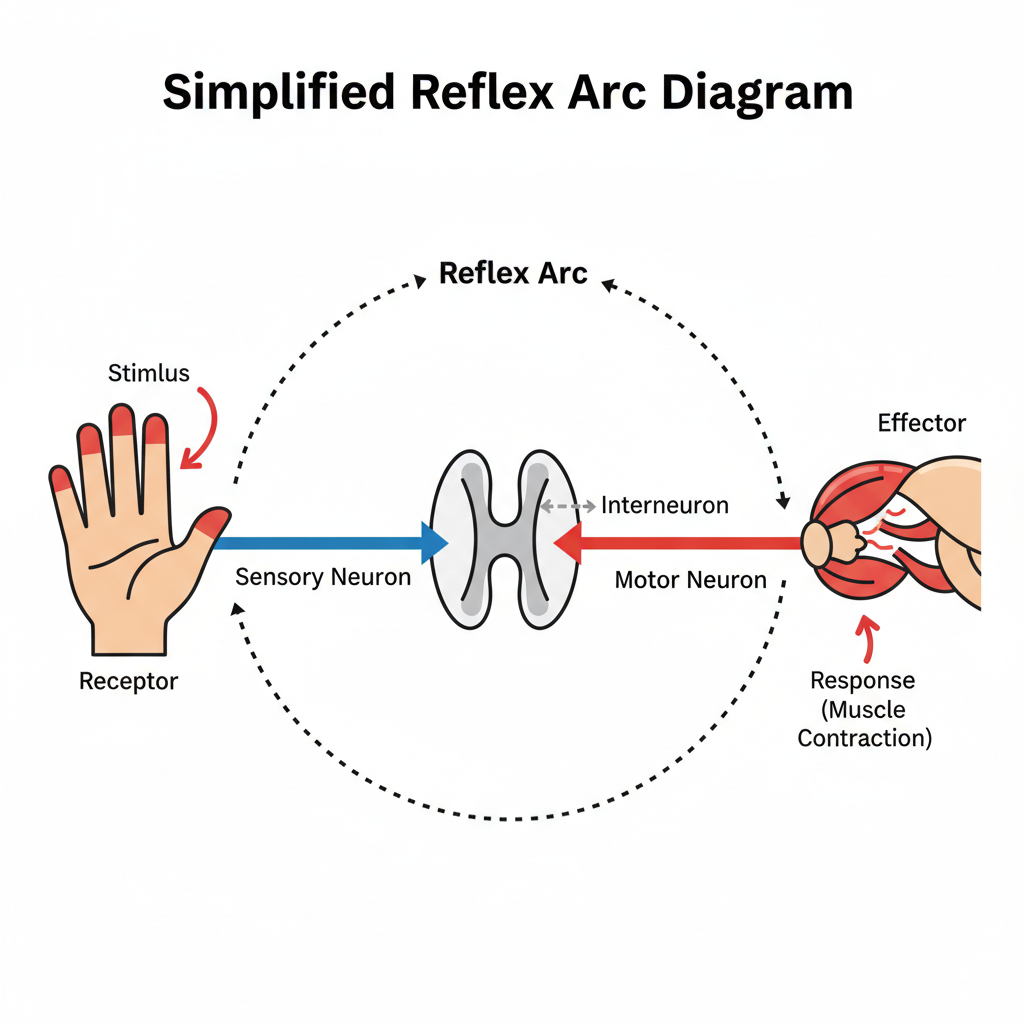
For every reflex action to occur, there's a specific neural pathway involved. This pathway is called a reflex arc. It's like a special, direct electrical circuit in your body designed for speed. Unlike voluntary actions (like deciding to pick up a pen), which involve your brain's higher centers for conscious thought and decision-making, a reflex action usually bypasses the conscious part of your brain and primarily involves the spinal cord.
Let's break down the components of this amazing reflex arc:
1. The Receptor: The 'Sensor'
- Definition: Specialized cells or nerve endings that detect a specific type of stimulus (e.g., heat, pressure, light, pain).
- Analogy: Imagine a smoke detector in your house. It's the first thing to 'sense' something is wrong (the smoke). Similarly, receptors are the 'sensors' in your skin, eyes, ears, etc., that pick up changes in the environment.
- Example: Pain receptors in your fingertip when you touch a thorn.
2. The Sensory Neuron (Afferent Neuron): The 'Messenger'
- Definition: A nerve cell that carries the nerve impulse (electrical signal) from the receptor towards the central nervous system (CNS), specifically the spinal cord.
- Analogy: Once the smoke detector goes off, it sends a signal through wires to a central alarm panel. The sensory neuron is like that wire, carrying the urgent message from the sensor to the control center.
- Example: The nerve fiber that carries the pain signal from your finger to your spinal cord.
3. The Spinal Cord (and often an Interneuron): The 'Quick Decision Maker'
- Definition: The spinal cord acts as the primary processing center for many reflexes. Within the spinal cord, an interneuron (or relay neuron) often connects the sensory neuron directly to the motor neuron. This bypasses the brain, making the response much faster.
- Analogy: Instead of sending the smoke alarm signal all the way to a distant fire station (your brain) for a complex decision, it's like an immediate local alarm bell ringing and a sprinkler system (the effector) turning on right there in your house. The interneuron is like a quick switchboard operator in the spinal cord, immediately connecting the incoming message to the outgoing command.
- Note: In some very simple reflexes (like the knee-jerk reflex), the sensory neuron directly synapses with the motor neuron without an interneuron, making it even faster.
4. The Motor Neuron (Efferent Neuron): The 'Action Sender'
- Definition: A nerve cell that carries the nerve impulse from the central nervous system (spinal cord) to an effector organ (muscle or gland).
- Analogy: This is the wire that carries the command from the alarm panel (spinal cord) to the sprinkler system or emergency lights (the effectors). It's telling the muscle, 'Move now!'
- Example: The nerve fiber that carries the command from your spinal cord to the muscles in your arm.
5. The Effector: The 'Performer'
- Definition: A muscle or gland that receives the command from the motor neuron and carries out the response.
- Analogy: This is the sprinkler system actually spraying water, or the emergency lights turning on. It's the part that 'does' the action.
- Example: The muscles in your arm and hand that contract to pull your hand away from the hot object.
Here's a visual representation of this pathway:
Putting It All Together: The Hot Stove Example
Let's trace what happens when you accidentally touch a hot stove:
- Stimulus: The heat from the stove.
- Receptor: Heat/pain receptors in your skin detect the extreme temperature.
- Sensory Neuron: An electrical signal (nerve impulse) is generated and sent along the sensory neuron to your spinal cord.
- Spinal Cord (Interneuron): Inside the spinal cord, the sensory neuron quickly passes the message to an interneuron, which then immediately passes it to a motor neuron.
- Motor Neuron: This motor neuron carries the command from the spinal cord to the muscles in your arm.
- Effector: The muscles in your arm and hand contract powerfully, causing you to jerk your hand away from the stove.
All of this happens in milliseconds. Only after your hand is already moving away does the message continue up to your brain, allowing you to consciously feel the pain and realize what happened. It's a perfect example of your body acting first, thinking second for your safety!
Common Examples of Reflex Actions
- Withdrawal Reflex: Pulling your hand away from something hot or sharp.
- Knee-jerk Reflex (Patellar Reflex): When the tendon below your kneecap is tapped, your lower leg kicks forward. Doctors use this to check nervous system health.
- Blinking Reflex: Rapidly closing your eyelids when something approaches your eye or a bright light flashes.
- Pupillary Reflex: Your pupils constrict (get smaller) in bright light and dilate (get larger) in dim light, automatically controlling the amount of light entering your eye.
- Coughing/Sneezing Reflex: Expelling irritants from your airways.
Reflex Actions vs. Voluntary Actions
It's important to differentiate between reflex actions and voluntary actions:
| Feature | Reflex Action | Voluntary Action |
|---|---|---|
| Control | Involuntary (no conscious thought) | Voluntary (requires conscious thought) |
| Speed | Very rapid (milliseconds) | Slower (requires processing by brain) |
| Brain Involvement | Mainly spinal cord; brain receives information *after* the action. | Involves conscious parts of the brain (cerebrum) for decision-making. |
| Purpose | Protection, survival, maintaining homeostasis. | Intentional movement, learning, complex tasks. |
| Pathway | Simple reflex arc (often spinal cord only). | Complex neural pathways involving the brain. |
Think of it as two different roads. The reflex arc is like an emergency express lane, bypassing heavy traffic to get the urgent message and action delivered instantly. A voluntary action is like taking the main highway, which allows for more scenic views (conscious thought) but takes longer to reach the destination.
The Importance of Reflexes
Reflex actions are vital for our everyday existence. They not only protect us from immediate danger but also help maintain our body's internal balance (homeostasis). From regulating your breathing and heartbeat (though these are often controlled by the brainstem, a lower part of the brain, they share characteristics of involuntary actions) to maintaining posture, reflexes are constantly at work, keeping you safe and stable without you ever having to consciously direct them. They are truly one of the most remarkable and efficient systems in the human body!
Keep learning, free
Create a free Syllabax account to unlock practice questions and games for this topic.
Visual Learning Enhanced! 🚀
To help you master this topic, we use Advanced Syllabax AI to generate detailed diagrams and visual models.
Note on Visuals: The AI sometimes makes spelling errors in image labels. Please refer to the lesson text for the correct terminology.