Simple Probability: Dice Rolls
Watch this topic in 60 seconds
Free preview · Lesson 1
Understanding Simple Probability: Dice Rolls
Understanding Simple Probability: Rolling the Dice!
Hey there, future probability wizards! Have you ever wondered about the chances of something happening? Like, "What are the chances it will rain tomorrow?" or "What are the chances I'll pick my favorite snack from a mystery bag?" That's exactly what probability helps us figure out!
What is Probability? (It's Like Predicting the Future, But With Math!)
Imagine you're trying to guess if your friend will wear a red shirt or a blue shirt today. You don't know for sure, right? But maybe your friend has more blue shirts, so you might guess blue. Probability is a way to measure how likely something is to happen. It's like having a special superpower that tells you the odds! We express probability as a number between 0 and 1, or as a percentage between 0% and 100%.
- If something has a probability of 0 (or 0%), it means it's impossible. Like, rolling an 8 on a standard 6-sided die!
- If something has a probability of 1 (or 100%), it means it's certain. Like, the sun rising tomorrow (usually!).
- If something has a probability of 0.5 (or 50%), it means it's equally likely to happen or not happen. Like flipping a coin and getting heads.
Our Star Player: The Six-Sided Die!
Today, our main example for understanding probability will be something you've probably seen in board games: a standard six-sided die! A die (the singular of "dice") is a small cube with dots or numbers on each of its six sides, usually from 1 to 6. When you roll a die, it lands on one of these sides.
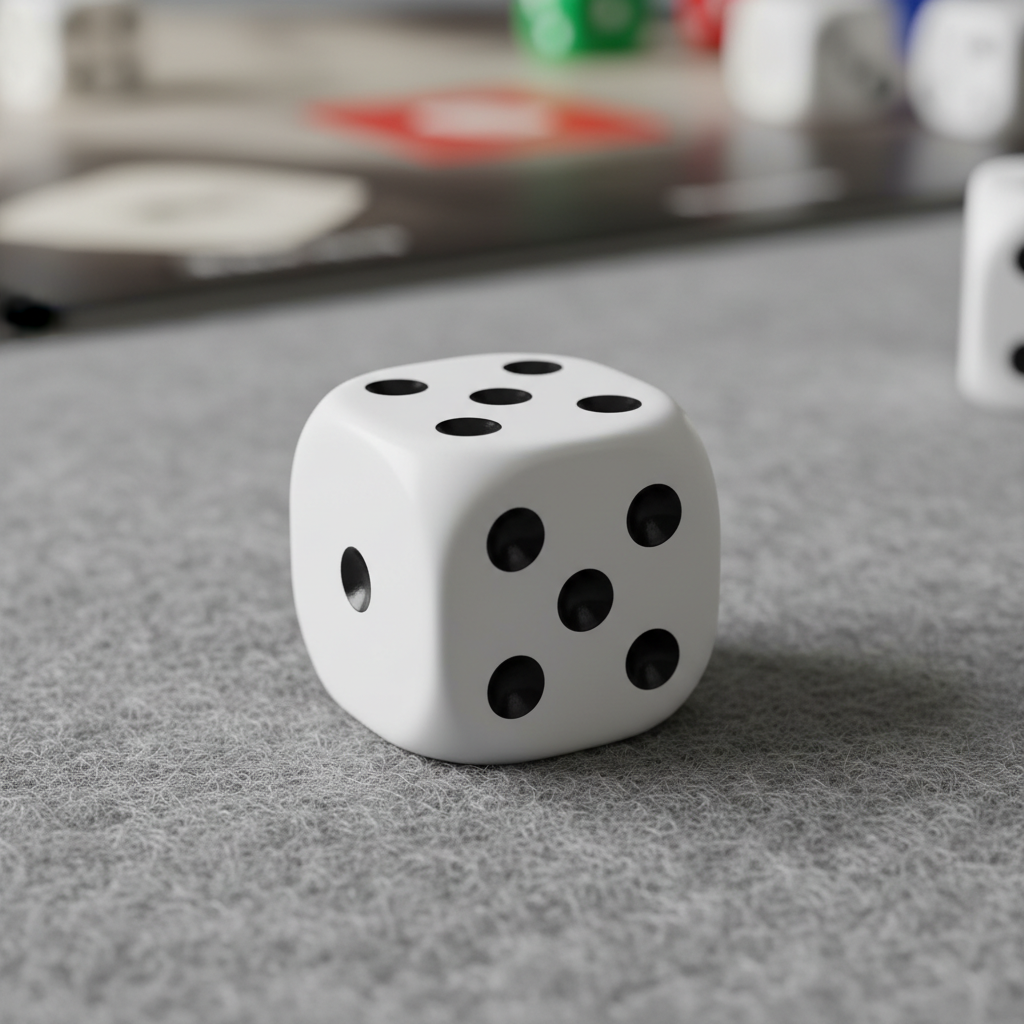 ⚠️ This picture may have spelling mistakes. Trust the words in the lesson.
Key Words to Know: Your Probability Toolkit!
1. Outcome: What Can Happen?
Think of "outcomes" like all the different items on a menu at your favorite restaurant. If you're at a pizza place, the outcomes could be a pepperoni pizza, a cheese pizza, a veggie pizza, and so on. When you roll a single die, what are all the different numbers it could possibly land on?
Possible Outcomes for one die roll: 1, 2, 3, 4, 5, 6.
2. Sample Space: The Full Menu!
The "sample space" is simply a list of all possible outcomes. It's like looking at the entire menu and seeing every single dish available. For a single die roll, the sample space is {1, 2, 3, 4, 5, 6}. This tells us there are 6 total possible outcomes.
3. Event: What Are We Interested In?
An "event" is a specific outcome or a group of outcomes that you are interested in. It's like deciding you want to order "pepperoni pizza" from the menu. When you roll a die, an event could be "rolling a 3," or "rolling an even number," or "rolling a number greater than 4."
The Magic Formula: How to Calculate Simple Probability!
Ready for the secret recipe? It's super simple! To find the probability of an event happening, you use this formula:
Probability of an Event = (Number of Favorable Outcomes) / (Total Number of Possible Outcomes)
Let's break this down:
- Favorable Outcomes: These are the outcomes that match your "event." If you want to roll a 3, then rolling a 3 is your one favorable outcome. If you want to roll an even number, then 2, 4, and 6 are your favorable outcomes.
- Total Possible Outcomes: This is the total number of items in your sample space. For a single die, it's always 6.
Let's Roll! Examples with a Single Die
Example 1: What is the probability of rolling a 3?
- Event: Rolling a 3.
- Favorable Outcomes: {3} (There's only one way to roll a 3). So, the number of favorable outcomes is 1.
- Total Possible Outcomes: {1, 2, 3, 4, 5, 6} (There are 6 possible numbers).
- Probability: P(rolling a 3) = 1 / 6
This means out of 6 rolls, you'd expect to roll a 3 about once. It's like having one red marble in a bag of six marbles – the chance of picking the red one is 1 out of 6.
Example 2: What is the probability of rolling an even number?
- Event: Rolling an even number.
- Favorable Outcomes: Even numbers on a die are {2, 4, 6}. So, the number of favorable outcomes is 3.
- Total Possible Outcomes: {1, 2, 3, 4, 5, 6} (Still 6 total).
- Probability: P(rolling an even number) = 3 / 6 = 1 / 2
A probability of 1/2 or 50% means it's equally likely to happen or not happen! Just like flipping a coin and getting heads.
Example 3: What is the probability of rolling a number greater than 4?
- Event: Rolling a number greater than 4.
- Favorable Outcomes: Numbers greater than 4 on a die are {5, 6}. So, the number of favorable outcomes is 2.
- Total Possible Outcomes: {1, 2, 3, 4, 5, 6} (Still 6 total).
- Probability: P(rolling a number greater than 4) = 2 / 6 = 1 / 3
This means you have a 1 in 3 chance of rolling a number greater than 4. Imagine you have a basket with 3 different types of fruit, and 1 of them is an apple. Your chance of picking an apple is 1 out of 3.
Example 4: What is the probability of rolling a 7?
- Event: Rolling a 7.
- Favorable Outcomes: Are there any 7s on a standard die? No! So, the number of favorable outcomes is 0.
- Total Possible Outcomes: {1, 2, 3, 4, 5, 6} (Still 6 total).
- Probability: P(rolling a 7) = 0 / 6 = 0
As we learned, a probability of 0 means it's impossible! You can't roll a 7 on a 6-sided die, just like you can't magically grow wings and fly away (unless you're a superhero!).
Example 5: What is the probability of rolling a number less than 7?
- Event: Rolling a number less than 7.
- Favorable Outcomes: Numbers less than 7 on a die are {1, 2, 3, 4, 5, 6}. So, the number of favorable outcomes is 6.
- Total Possible Outcomes: {1, 2, 3, 4, 5, 6} (Still 6 total).
- Probability: P(rolling a number less than 7) = 6 / 6 = 1
A probability of 1 means it's certain! You will always roll a number less than 7 on a standard die. It's like being certain that if you drop a ball, it will fall to the ground (thanks, gravity!).
Putting it All Together: The Big Picture
Probability helps us understand the world around us, from games to weather forecasts. Remember these simple steps:
- Figure out ALL the possible things that can happen (the "sample space").
- Figure out the specific things you're interested in (the "favorable outcomes" for your "event").
- Divide the number of favorable outcomes by the total number of possible outcomes.
Keep practicing, and you'll be a probability pro in no time! Every time you play a game with dice, you're doing math!
Keep learning, free
Create a free Syllabax account to unlock practice questions and games for this topic.
Visual Learning Enhanced! 🚀
To help you master this topic, we use Advanced Syllabax AI to generate detailed diagrams and visual models.
Note on Visuals: The AI sometimes makes spelling errors in image labels. Please refer to the lesson text for the correct terminology.