Like fractions (Fractions)
Watch this topic in 60 seconds
Free preview · Lesson 1
Understanding Like fractions (Fractions)
Understanding Like Fractions: Sharing is Caring!
Imagine you have a yummy pizza, and you want to share it equally with your friends. Fractions are a super cool way to talk about parts of a whole, like slices of pizza! Today, we're going to learn about a special kind of fraction called like fractions. They're like best friends in the world of fractions because they have something very important in common!
What is a Fraction?
Before we dive into like fractions, let's remember what a fraction is. A fraction has two parts:
- Numerator: This is the top number. It tells us how many parts we have or are talking about. Think of it as the number of pizza slices you're holding.
- Denominator: This is the bottom number. It tells us how many equal parts the whole thing is divided into. Think of it as the total number of slices the pizza was cut into.
We write fractions like this: Numerator / Denominator. For example, if a pizza is cut into 8 slices and you have 3 slices, you have 3/8 of the pizza.
Introducing Like Fractions: The Best of Friends!
Now, let's meet our special friends: like fractions. Like fractions are fractions that have the same denominator. They are like siblings who share the same last name – they are part of the same family!
Let's use our pizza example again. If you have a pizza cut into 8 slices, and your friend also has a pizza cut into 8 slices, then any fraction of your pizza (like 2/8 or 5/8) and any fraction of your friend's pizza (like 1/8 or 7/8) are like fractions. Why? Because both denominators are 8! They are comparing parts of equally sized wholes.
Why Are Like Fractions Important?
Like fractions make it much easier to compare and add or subtract fractions. Imagine trying to compare how much pizza you have if one pizza is cut into 8 slices and another is cut into 12 slices. It gets tricky! But if both pizzas are cut into the same number of slices (say, 8), it's much simpler to see who has more.
Comparing Like Fractions
When fractions have the same denominator, we only need to look at the numerators to compare them. The fraction with the larger numerator is the larger fraction.
Analogy: The Candy Jar Race!
Imagine two candy jars, each holding 10 candies (so the denominator is 10 for both).
- Jar A has 3 candies. This is 3/10.
- Jar B has 7 candies. This is 7/10.
Which jar has more candy? Jar B, because 7 is bigger than 3. So, 7/10 is greater than 3/10. The denominators (10) are the same, so we just compare the numerators (7 and 3).
Let's try another one:
- You ate 2/5 of a chocolate bar.
- Your sister ate 4/5 of the same sized chocolate bar.
Since both fractions have a denominator of 5, they are like fractions. Who ate more chocolate? Your sister did, because 4 is greater than 2. So, 4/5 is greater than 2/5.
Visualizing Like Fractions
Sometimes, seeing is believing! Let's picture these fractions:
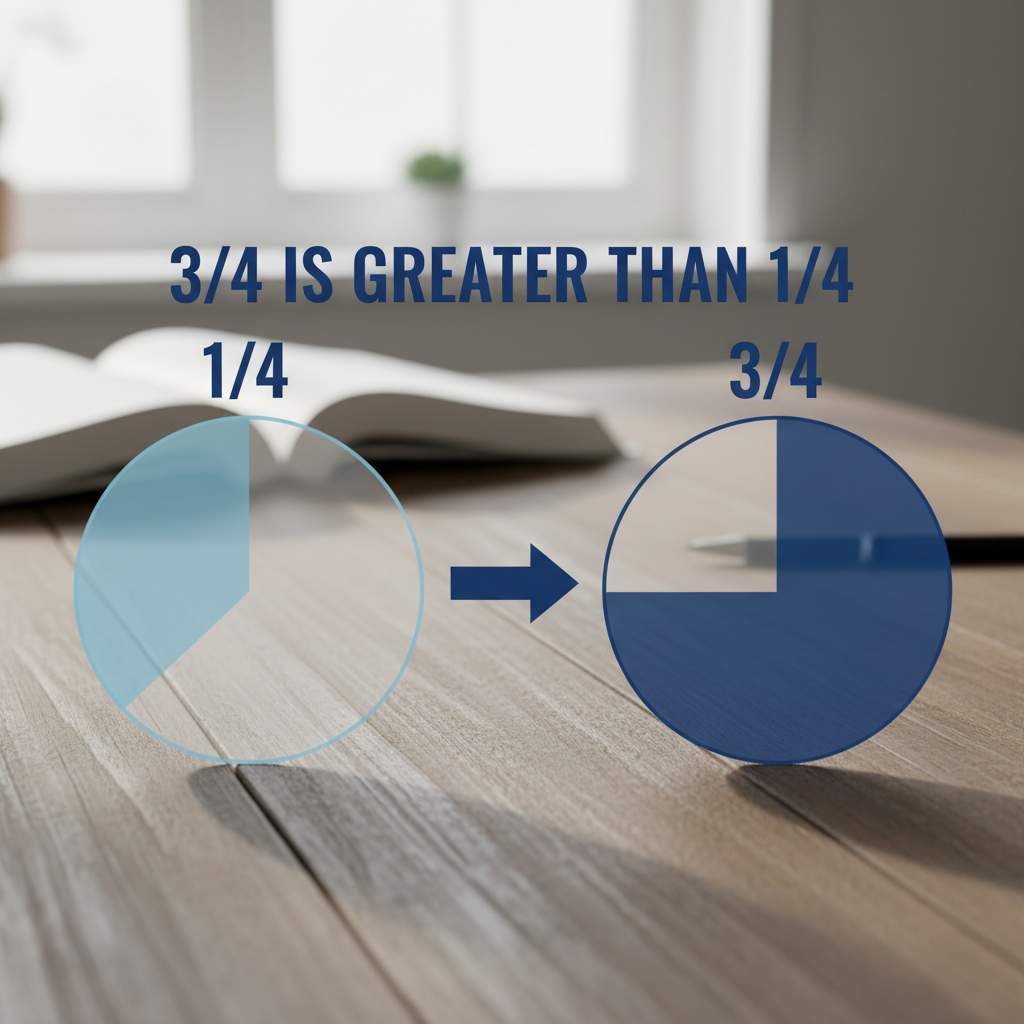
Consider the fractions 1/4 and 3/4. Both fractions have a denominator of 4, meaning the whole is divided into 4 equal parts.
- 1/4 means we have 1 out of those 4 equal parts.
- 3/4 means we have 3 out of those 4 equal parts.
If you draw a rectangle and divide it into 4 equal columns, coloring in 1 column gives you 1/4. Coloring in 3 columns gives you 3/4. It's clear that 3 columns is more than 1 column.
Adding Like Fractions
Adding like fractions is like combining groups of the same thing. If you have 2 apples and get 3 more apples, you have 5 apples. You don't change the 'apples' part, you just add the numbers.
With like fractions, you keep the denominator the same and add the numerators.
Analogy: Building with Blocks!
Imagine you have red building blocks. Each block represents 1/10 of a tower.
- You have 2 red blocks (2/10 of the tower).
- Your friend gives you 3 more red blocks (3/10 of the tower).
How many red blocks do you have in total? You have 2 + 3 = 5 red blocks. So, you have 5/10 of the tower.
The calculation is: 2/10 + 3/10 = (2+3)/10 = 5/10.
The denominator (10) stayed the same because we were always talking about 'tenths' of the tower. We just added how many 'tenths' we had.
Subtracting Like Fractions
Subtracting like fractions is like taking away some of the same things. If you had 5 cookies and ate 2, you'd have 3 cookies left.
With like fractions, you keep the denominator the same and subtract the numerators.
Analogy: Eating Pizza Slices!
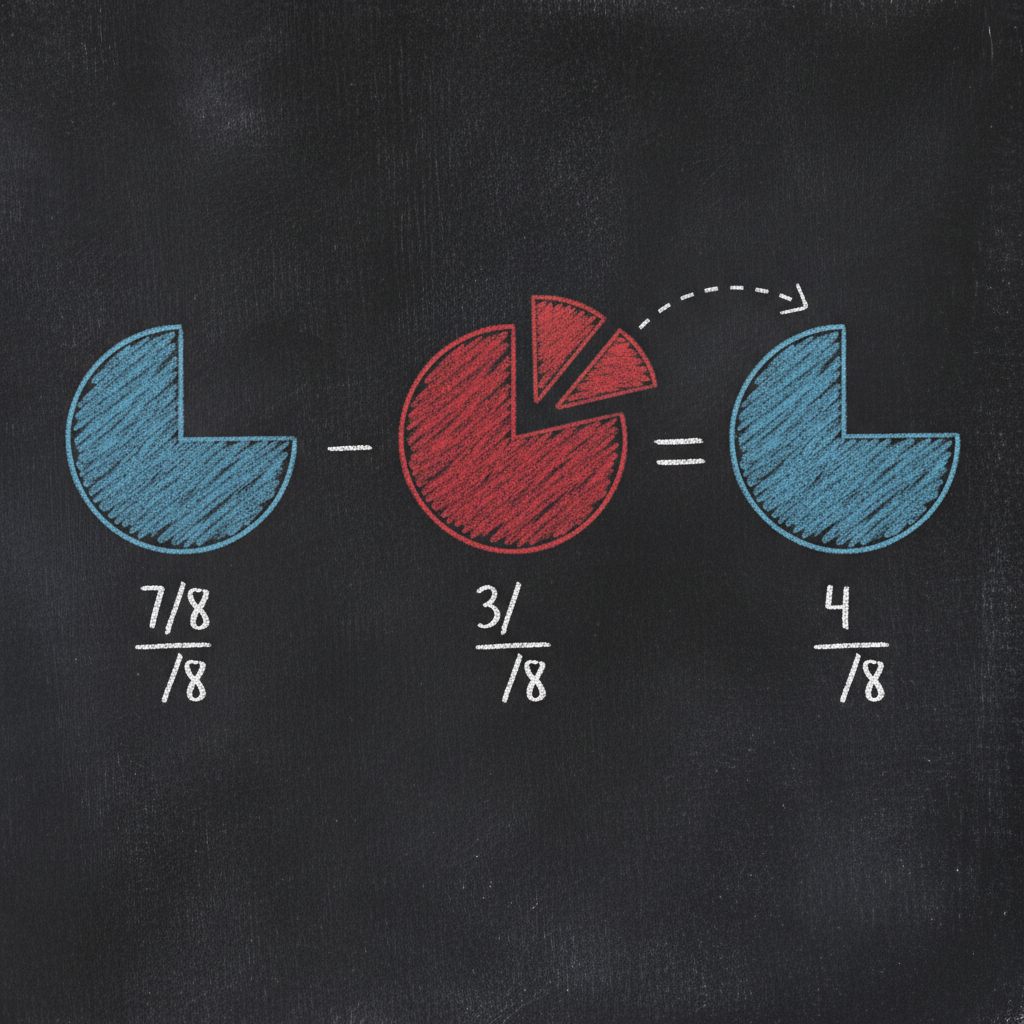
Let's go back to our pizza cut into 8 slices.
- You start with 7 slices of pizza (7/8 of the pizza).
- You and your friends eat 3 slices (3/8 of the pizza).
How many slices are left? You started with 7 slices and ate 3, so you have 7 - 3 = 4 slices left. That means you have 4/8 of the pizza left.
The calculation is: 7/8 - 3/8 = (7-3)/8 = 4/8.
Again, the denominator (8) stayed the same because we were always talking about 'eighths' of the pizza. We just subtracted how many 'eighths' were eaten.
Key Things to Remember About Like Fractions:
- They have the same denominator.
- When comparing, look at the numerators. The bigger numerator means the bigger fraction.
- When adding or subtracting, keep the denominator the same and add or subtract the numerators.
Like fractions are your first step to becoming a fraction superstar! Keep practicing, and soon you'll be sharing and comparing fractions like a pro!
Keep learning, free
Create a free Syllabax account to unlock practice questions and games for this topic.
Visual Learning Enhanced! 🚀
To help you master this topic, we use Advanced Syllabax AI to generate detailed diagrams and visual models.
Note on Visuals: The AI sometimes makes spelling errors in image labels. Please refer to the lesson text for the correct terminology.