Parliament: Law-making Process (detailed) – Indian Civics
Watch this topic in 60 seconds
Free preview · Lesson 1
Parliament: Law-making Process (detailed) – Indian Civics (Foundational)
Parliament: Law-making Process in India (Foundational)
Welcome to a foundational understanding of how laws are made in India through our Parliament. This lesson will explain the law-making process in a simple and easy-to-understand manner.
What is Parliament?
Parliament is the main law-making body in India. Think of it as a group of elected representatives who come together to discuss, debate, and create laws for the country. It is made up of two houses: the Lok Sabha (House of the People) and the Rajya Sabha (Council of States), and the President.
Why Do We Need Laws?
Laws are important because they help maintain order, protect our rights, and ensure fairness in society. They tell us what we can and cannot do. Without laws, there would be chaos and confusion.
The Law-Making Process: Simplified
Here’s a simplified breakdown of how a law is made in India:
- Idea for a Law (Bill): Someone (a minister or a private member of parliament) has an idea for a new law or wants to change an existing one. This idea is written down in a document called a 'Bill'.
- Introduction in Parliament: The Bill is introduced in either the Lok Sabha or the Rajya Sabha (except for money bills which must originate in the Lok Sabha). This means the Bill is presented to the members of that house.
- Debate and Discussion: The members of the house discuss the Bill, suggest changes (amendments), and vote on it. There are usually several readings or stages of debate.
- Passing in One House: If a majority of the members present and voting agree (vote 'yes'), the Bill is passed in that house.
- Sent to the Other House: If the Bill passes in one house, it is sent to the other house for review and approval.
- Debate and Discussion in the Second House: The other house also debates, suggests changes, and votes on the Bill.
- Agreement or Disagreement:
- If the second house also passes the Bill without changes, it's sent to the President.
- If the second house makes changes, the Bill goes back to the first house. The houses must agree on the same version of the Bill. If they cannot agree, a joint sitting of both houses is called.
- President's Approval: Once both houses agree on the Bill, it is sent to the President of India. The President must sign the Bill for it to become a law (Act).
- Becomes a Law (Act): After the President signs the Bill, it becomes a law and is published in the Gazette of India. Now, it is applicable to all citizens.
Types of Bills
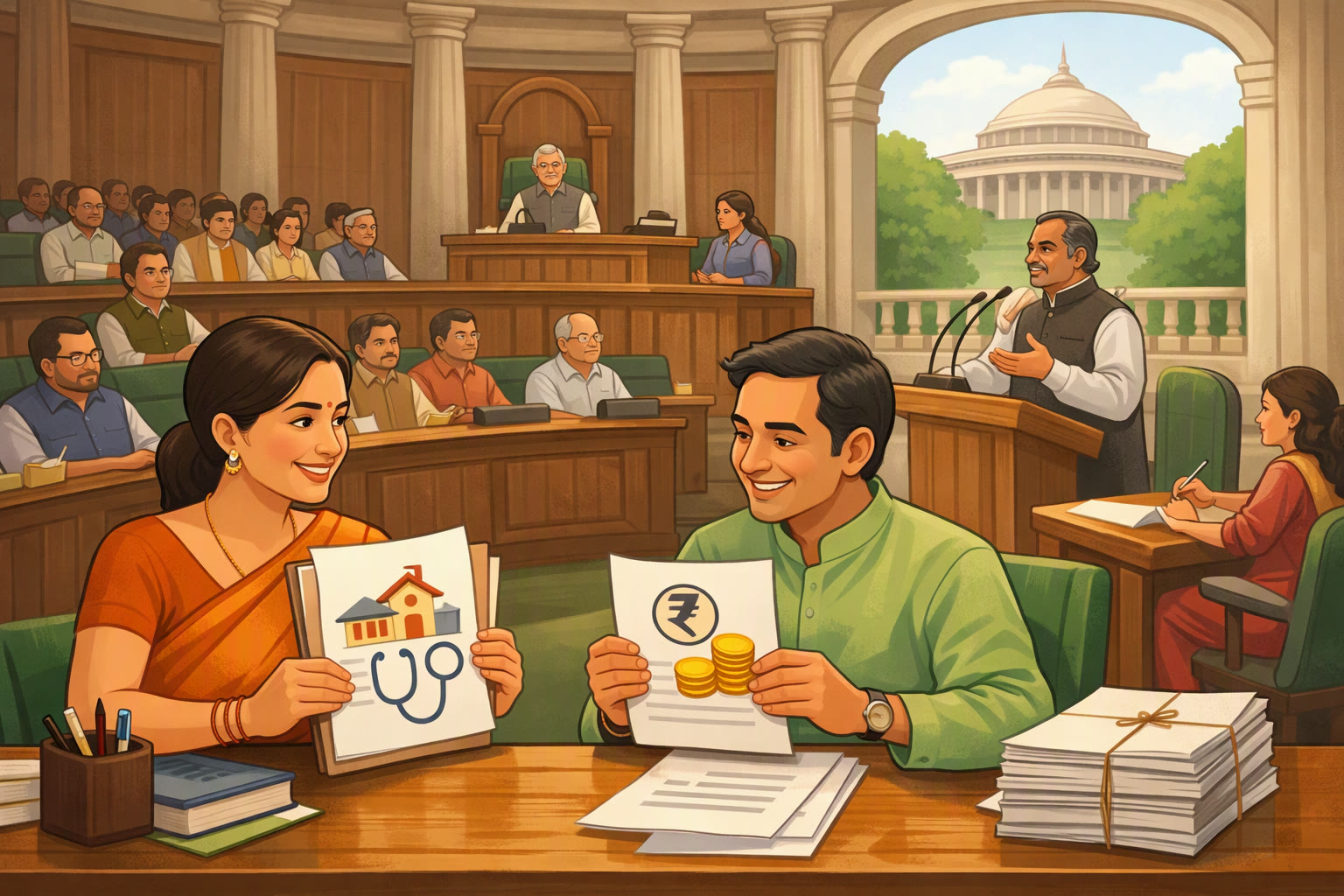
There are mainly two types of bills:
- Ordinary Bills: These relate to general matters like education, health, etc.
- Money Bills: These deal with financial matters like taxes, government spending, etc.
Keep learning, free
Create a free Syllabax account to unlock practice questions and games for this topic.
Visual Learning Enhanced! 🚀
To help you master this topic, we use Advanced Syllabax AI to generate detailed diagrams and visual models.
Note on Visuals: The AI sometimes makes spelling errors in image labels. Please refer to the lesson text for the correct terminology.