Learning Journey
Watch this topic in 60 seconds
Free preview · Lesson 1
Understanding Understanding Independent Events
Understanding Independent Events: What Does 'Independent' Really Mean?
Welcome, 7th graders, to an exciting journey into the world of probability! Today, we're going to unravel a super important concept called 'Independent Events.' Don't let the big words scare you; it's actually quite simple and fun, like solving a puzzle!
What is an 'Event' Anyway?
Before we jump into 'independent events,' let's clarify what an 'event' is in the world of probability. Think of an event as something that can happen. It's a specific outcome or a set of outcomes from an experiment or observation.
- Flipping a coin: Landing on Heads is an event. Landing on Tails is another event.
- Rolling a dice: Rolling a '3' is an event. Rolling an even number (2, 4, or 6) is also an event.
- Picking a card from a deck: Picking the Ace of Spades is an event. Picking any red card is another event.
See? An event is just a specific result we're looking at.
Introducing Independent Events: No Strings Attached!
Now, imagine you have two different events. When we say these events are independent, it means that what happens in one event has absolutely NO effect on what happens in the other event. They don't influence each other AT ALL. They're like two separate islands, minding their own business!
Analogy 1: The Two Coin Flips
Let's say you flip a coin. It lands on Heads. Does that change the chances of what will happen the next time you flip the coin? No, right? Each coin flip is a fresh start. The coin doesn't 'remember' what happened before. The first flip landing on Heads doesn't make the second flip any more or less likely to be Heads or Tails.
So, the first coin flip and the second coin flip are independent events. One doesn't 'tell' the other what to do.
Analogy 2: Rolling a Die and Picking a Card
Imagine you roll a standard six-sided die. You get a '4'. Now, at the exact same time (or right after), your friend picks a card from a shuffled deck of 52 cards. Do you think your '4' roll changes the chances of your friend picking, say, a King of Hearts? Absolutely not! These two actions are completely unrelated.
Rolling the die and picking a card are independent events because the outcome of one has no bearing on the outcome of the other.
Analogy 3: Picking Marbles (with replacement)
You have a bag with 3 red marbles and 2 blue marbles. You reach in and pick a red marble. You look at it, and then—this is the important part—you PUT IT BACK into the bag. Now you shake the bag and pick another marble. What are the chances of picking a red marble the second time?
Since you put the first marble back, the bag is exactly the same as it was before your first pick! The number of red and blue marbles hasn't changed. So, your first pick (even though it was red) doesn't change the probability of your second pick.
This is another example of independent events because the first event didn't alter the conditions for the second event.
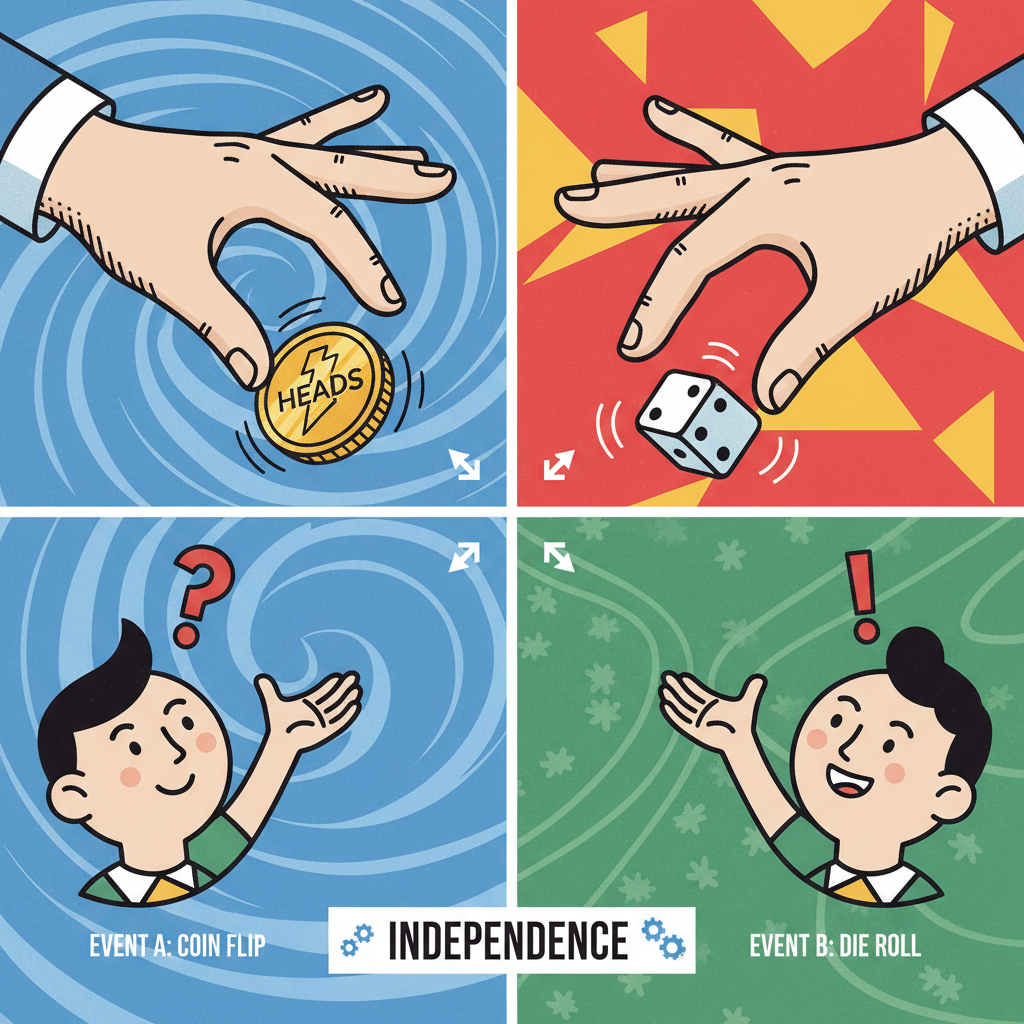
The Big Idea: No Influence!
The core concept of independent events is no influence. One event does not 'touch' or change the chances of the other event happening. They happen separately, without interacting with each other's probabilities.
What About Dependent Events? (Just a Peek!)
To really understand independent events, it's sometimes helpful to briefly peek at what they are NOT. Events that ARE NOT independent are called dependent events. In dependent events, the outcome of the first event *does* change the probability of the second event.
Think back to our marble example. What if you didn't put the first red marble back? Now the bag has fewer red marbles, and fewer total marbles. This changes the probability of picking a red marble the second time! That's a dependent event – but we'll save the deeper dive into those for another day.
How Do We Find the Probability of Two Independent Events Happening?
When you want to know the probability of TWO independent events both happening, it's super easy! You just multiply their individual probabilities together.
Let's say:
- Event A: The probability of flipping a coin and getting Heads is 1/2.
- Event B: The probability of rolling a die and getting a '6' is 1/6.
What's the probability of flipping a Heads AND rolling a '6'? Since they are independent, you multiply:
P(Heads AND 6) = P(Heads) × P(6)
P(Heads AND 6) = (1/2) × (1/6) = 1/12
So, there's a 1 in 12 chance of both those things happening together. It's like combining two separate chances into one combined chance.
Let's Review!
Independent events are like two friends who live in different cities – what one does has no effect on what the other does. They are separate, they don't communicate about their probabilities, and their outcomes don't influence each other.
Mastering this concept is a foundational step in understanding probability, and you've just taken a big leap!
Keep learning, free
Create a free Syllabax account to unlock practice questions and games for this topic.
Visual Learning Enhanced! 🚀
To help you master this topic, we use Advanced Syllabax AI to generate detailed diagrams and visual models.
Note on Visuals: The AI sometimes makes spelling errors in image labels. Please refer to the lesson text for the correct terminology.