Total Items (Adding Data)
Watch this topic in 60 seconds
Free preview · Lesson 1
Understanding Total Items (Adding Data)
Understanding 'Total Items' by Adding Data!
Hey Super Learners! Today, we're going on an exciting adventure to become super detectives of 'Total Items'! Have you ever wondered how many yummy cookies are on two different plates? Or how many colorful crayons you have in two separate boxes? That's what finding the 'total items' is all about! It means putting things together to find out how many there are all together.
What Does 'Total Items' Mean?
Imagine you have a basket of shiny red apples and another basket of crunchy green apples. If you want to know how many apples you have in all, you're trying to find the 'total items'! The word 'total' just means the answer when you put two or more groups of things together.
How Do We Find the Total? By Adding Data!
To find the total, we use a superpower called adding! Adding means bringing two or more groups of things together to make one bigger group. Think of it like a puzzle where you fit pieces together to see the whole picture. When we 'add data', it means we are putting together information (like how many apples are in each basket) to get new information (the total number of apples).
Let's use an analogy: Imagine you have two towers of building blocks. One tower has 3 blocks, and the other tower has 2 blocks. If you want to know the total number of blocks you have for both towers, you would add them together! 3 blocks + 2 blocks = 5 blocks total!
Here’s another way to think about it: You have a collection of superhero stickers. You got 4 new stickers yesterday and 3 more new stickers today. To find your total new stickers, you just put the two days' stickers together: 4 + 3 = 7 stickers! Adding helps us combine different counts to get one big count.

Our Super Adding Tools:
We have lots of cool tools to help us add:
- Your Fingers! Your fingers are fantastic counters. If you have 2 cookies and then get 3 more, you can count 1, 2, then 3, 4, 5 on your fingers to find the total!
- Real Objects! Use anything you can touch: blocks, toys, candies, coins, or even small rocks! Put them in two groups, then push them together and count them all.
- Pictures! Draw circles or tally marks for each item. If you have 4 red balloons and 2 blue balloons, draw 4 circles, then 2 more circles. Then count all the circles you drew!
- Number Lines! A number line is like a super long ruler with numbers on it. You can start at one number and 'hop' forward for the second number to find your total. For 3 + 2, start at 3 and hop 2 times: 4, 5! You land on 5!
- Numbers Themselves! Once you get good, you can just add numbers in your head or write them down. Like 5 + 4 = 9!
Important Words to Remember (Vocabulary Detectives!):
- Add: To put two or more numbers or groups together.
- Sum: The answer you get when you add numbers together. It's another word for 'total'!
- Total: The whole amount; how many there are altogether.
- Plus: The symbol '+' means 'add'. When you see 3 + 2, it means '3 plus 2'.
- Altogether / In All: These words often tell you to add to find the total!
- Combine: To put things together.
Let's Try an Example Together!
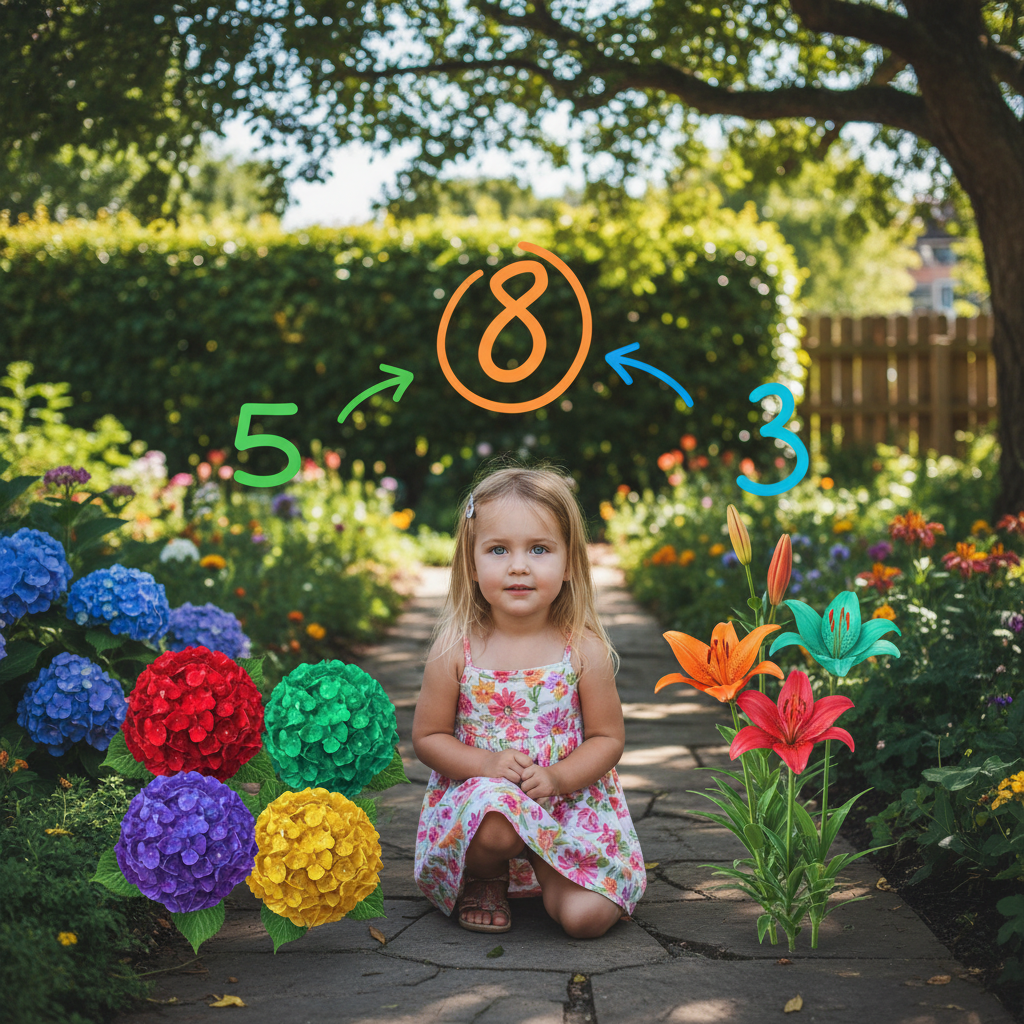
Imagine your friend Mia has 5 beautiful flowers in her garden. Her friend Tom gives her 3 more beautiful flowers to plant. How many flowers does Mia have in total now?
- Step 1: Identify the groups. Mia has one group of 5 flowers. Tom gave her another group of 3 flowers.
- Step 2: Decide what to do. The question asks 'how many in total', which tells us to ADD!
- Step 3: Put them together! We can write this as a number sentence: 5 + 3 = ?
- Step 4: Count them up! You can count on your fingers: 5 (then 6, 7, 8). Or draw 5 circles, then 3 more circles, and count them all.
- Step 5: Find the Total (Sum)! 5 + 3 = 8! Mia has 8 flowers in total. Great job!
Why Is Finding the Total Important?
Knowing how to find the total by adding helps us every single day! When you're sharing toys, counting how many snacks you have, figuring out how many pages you've read, or even helping your grown-up count groceries, adding is super useful. It helps us understand the world around us by combining different pieces of information to get a bigger, more complete picture.
So, whenever you see different groups of things and need to know 'how many altogether' or 'how many in total', remember your adding superpower! You're now a total item detective!
Keep learning, free
Create a free Syllabax account to unlock practice questions and games for this topic.
Visual Learning Enhanced! 🚀
To help you master this topic, we use Advanced Syllabax AI to generate detailed diagrams and visual models.
Note on Visuals: The AI sometimes makes spelling errors in image labels. Please refer to the lesson text for the correct terminology.