Computational Thinking Skills
Watch this topic in 60 seconds
Free preview · Lesson 1
Understanding Computational Thinking Skills
Unlocking Your Inner Problem-Solver: An Introduction to Computational Thinking
Hello, future innovators and super-thinkers! Have you ever looked at a really big, complicated problem and wished you had a superpower to solve it? Guess what? You already have one! It's called Computational Thinking, and it's a way of thinking that helps us break down big problems, find patterns, focus on what's important, and create step-by-step solutions. And the best part? It's not just for computer scientists; it's a skill you use every day, whether you realize it or not!
Think of Computational Thinking as a superpower that helps you tackle challenges like a pro, whether you're organizing your backpack, planning a party, or even learning a new dance move. It's about approaching problems in a logical and organized way, just like a computer would, but using your amazing human brain!
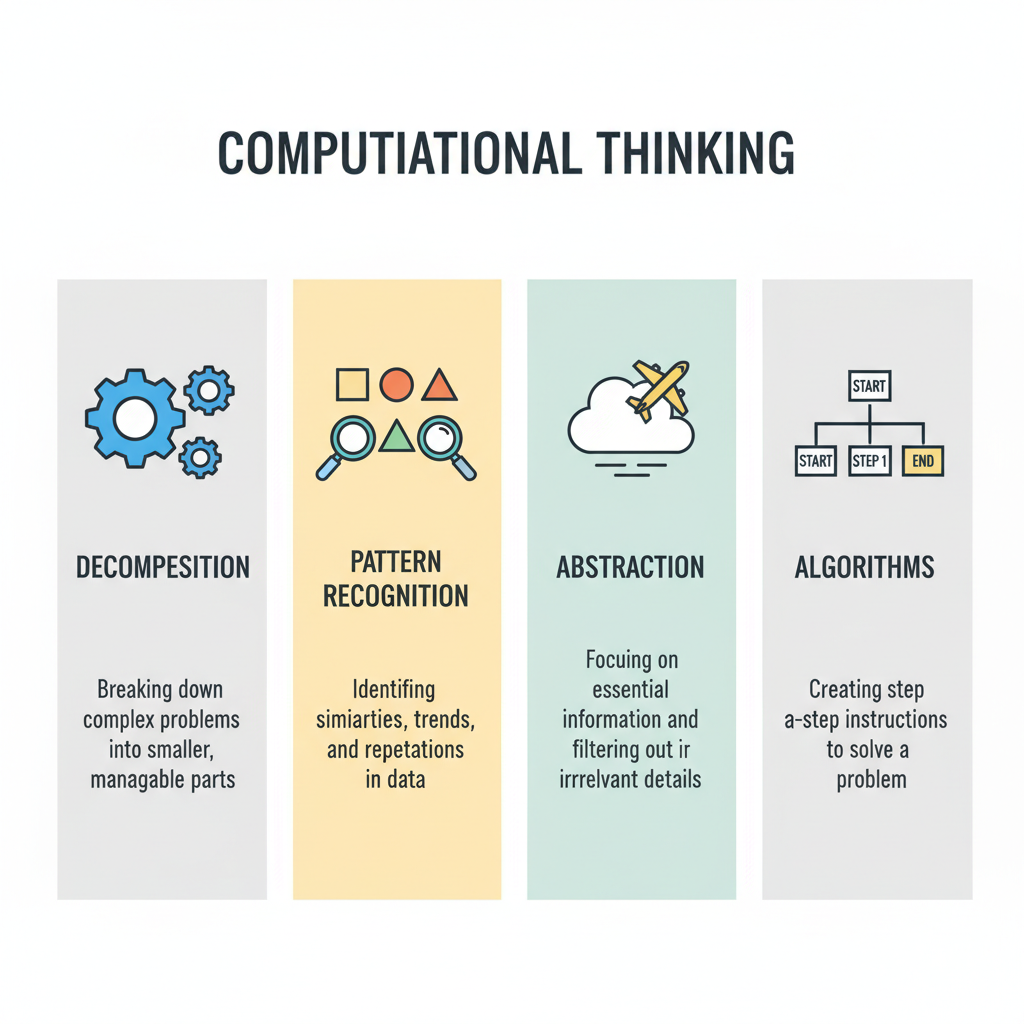
The Four Pillars of Computational Thinking
Computational Thinking isn't one single skill; it's a combination of four powerful techniques that work together. Let's explore them one by one!
1. Decomposition: The Art of Breaking Things Down
Imagine you're trying to build a giant LEGO castle. If you just dump all the pieces on the floor and try to build it all at once, you'd probably get overwhelmed, right? Decomposition is like taking that huge castle-building project and breaking it into smaller, more manageable parts. Instead of 'build a castle,' you'd think: 'build the walls,' 'build the towers,' 'add the flags,' 'create the drawbridge.'
Definition: Decomposition is the process of breaking down a complex problem or system into smaller, more easily manageable parts.
Analogy: Think about cleaning your very messy room. If you just say, 'I need to clean my room,' it feels like a giant task. But if you decompose it, you might say: 'First, put away all the clothes. Second, clear my desk. Third, vacuum the floor. Fourth, organize my books.' Each smaller task is easier to start and finish.
Why it's useful: By breaking a problem into smaller pieces, each piece becomes less intimidating and easier to solve. When you solve all the small pieces, you've solved the big problem!
2. Pattern Recognition: Finding Similarities and Trends
Once you've broken down your big problem, the next step is to look for patterns! Have you ever noticed that many video games have a 'jump' button? Or that most songs have a verse, chorus, verse, chorus structure? That's pattern recognition in action!
Definition: Pattern Recognition is the process of observing trends, regularities, or similarities within data or problems.
Analogy: Imagine you're trying to sort your laundry. You might notice a pattern: all the socks go together, all the T-shirts go together, and all the jeans go together. Once you recognize these patterns, sorting becomes much faster and easier than trying to figure out what to do with each individual item.
Why it's useful: Recognizing patterns helps us make predictions, understand how things work, and develop solutions more efficiently. If you've solved a similar small problem before, you might be able to apply that solution to a new, similar small problem.
3. Abstraction: Focusing on What Matters, Ignoring the Rest
When you look at a map, it doesn't show every single tree, every blade of grass, or every parked car, right? It only shows the important things like roads, landmarks, and city names. That's abstraction!
Definition: Abstraction is the process of focusing on the essential information while ignoring the irrelevant details. It's about simplifying a complex idea or system.
Analogy: Think about a weather report. It tells you the temperature, whether it will rain, and if it will be sunny. It doesn't tell you the exact humidity levels in every part of the city or the precise wind speed at every minute. It gives you the important information you need to decide what to wear or if you need an umbrella, without overwhelming you with tiny details.
Why it's useful: Abstraction helps us manage complexity by reducing the amount of information we need to consider. It allows us to create models and generalizations that apply to many situations, making problem-solving more manageable.
 ⚠️ This picture may have spelling mistakes. Trust the words in the lesson.
4. Algorithms: Step-by-Step Instructions
Have you ever followed a recipe to bake cookies? Or followed directions to get to a friend's house? Both of those are examples of algorithms! An algorithm is simply a set of clear, ordered instructions to solve a problem or complete a task.
Definition: An Algorithm is a step-by-step set of instructions or rules designed to solve a problem or complete a specific task.
Analogy: Imagine teaching a robot how to make a peanut butter and jelly sandwich. You can't just say 'make a sandwich.' You'd need to give it very specific, sequential instructions: '1. Get two slices of bread. 2. Get a knife. 3. Open the peanut butter jar. 4. Scoop peanut butter with the knife. 5. Spread peanut butter on one slice of bread.' And so on. Every single step must be clear and in the correct order.
Why it's useful: Algorithms ensure that tasks are completed accurately and efficiently. Once you have a good algorithm, you can repeat it many times to get the same correct result. It's the blueprint for how to solve the problem you've decomposed, analyzed for patterns, and simplified through abstraction.
Putting It All Together: Solving Real-World Problems
These four pillars don't work in isolation; they often work together to solve complex problems. Let's think about planning a school fundraiser:
- Decomposition: Instead of 'plan a fundraiser,' you break it down: 'choose a theme,' 'set a date,' 'find a venue,' 'organize activities,' 'promote the event,' 'manage finances.'
- Pattern Recognition: You might look at past fundraisers. Did certain activities raise more money? Did promotions on social media work better than flyers? You see patterns in what was successful (or not!).
- Abstraction: You don't need to worry about the exact type of paper for the flyers (unless it's part of the budget). You focus on the message and how many people will see it. You also don't need to know every single person attending, just the total number for catering.
- Algorithms: You create step-by-step plans for each sub-task. For example, for 'promoting the event,' your algorithm might be: '1. Design flyer. 2. Print X copies. 3. Distribute to Y locations. 4. Post on social media every Z days.'
As you can see, Computational Thinking isn't just about computers; it's a way of thinking that empowers you to approach any challenge with confidence and a clear strategy. By mastering these four pillars, you're not just learning about technology; you're learning how to think smarter and solve problems more effectively in every part of your life!
Keep practicing these skills, and you'll be a computational thinking superstar in no time!
Keep learning, free
Create a free Syllabax account to unlock practice questions and games for this topic.
Visual Learning Enhanced! 🚀
To help you master this topic, we use Advanced Syllabax AI to generate detailed diagrams and visual models.
Note on Visuals: The AI sometimes makes spelling errors in image labels. Please refer to the lesson text for the correct terminology.