Learning Journey
Watch this topic in 60 seconds
Free preview · Lesson 1
Understanding Work = force × displacement[PHYSICS]
Unpacking "Work" in Physics: Force, Displacement, and the Energy Behind Movement
Ever feel exhausted after a long day of studying or helping out around the house, and say, "Wow, I did so much work today!"? In everyday language, "work" often means effort, activity, or a job. But in the fascinating world of physics, "work" has a very specific and powerful meaning. It's not just about trying hard; it's about making things move and transferring energy!
What is Work in Physics?
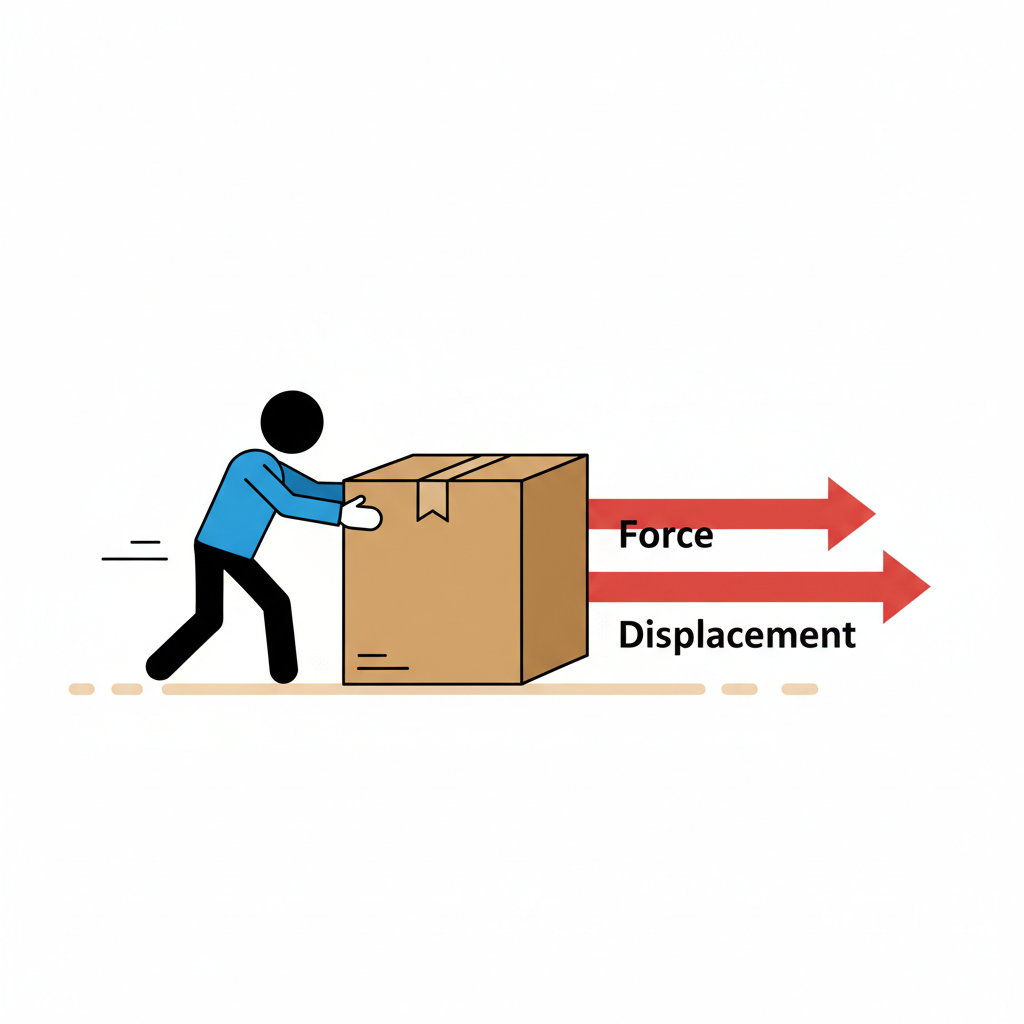
Imagine you're trying to move a heavy box across a room. If you push it, and it slides across the floor, you've done 'work' in physics. But what if you push and push with all your might, and the box doesn't budge an inch? Guess what? In physics, you've done ZERO work on the box! Confusing? Let's break it down.
At its core, **work in physics is the transfer of energy that occurs when a force causes an object to move over a distance in the direction of that force.** Think of it as the 'effort' that actually leads to motion. If there's no motion, or the motion isn't in the direction of your effort, then no work (in the physics sense) has been done.
The Two Essential Ingredients for Work
For work to happen, we need two main things:
1. Force (F): The Push or Pull
- Think of force as the 'oomph!' It's any push or pull on an object. When you kick a soccer ball, you apply a force. When you lift your backpack, you apply a force. The harder you push or pull, the greater the force.
- We measure force in units called **Newtons (N)**, named after the famous scientist Sir Isaac Newton. So, if you push a shopping cart with a force of 10 Newtons, that's how much 'oomph' you're putting into it.
- Analogy: Imagine force is like the strength of your push or the power of your pull.
2. Displacement (d): The Movement with Direction
- Displacement isn't just any old movement; it's the change in an object's position in a specific direction. It's how far an object has moved from its starting point in a straight line.
- If you push a toy car, and it moves 2 meters forward, its displacement is 2 meters. If you push it 2 meters forward and then 2 meters back, its total displacement is zero (it ended up where it started!).
- We measure displacement in **meters (m)**, just like any other length or distance.
- Analogy: Displacement is like how far the object actually *travels* because of your push, and importantly, in what direction.
The Golden Rule: Force and Displacement MUST Be in the Same Direction!
This is the trickiest, but most important, part for beginners. For work to be done, the force you apply and the displacement (movement) of the object *must be in the same direction*.
Analogy: Think of trying to open a door. If you push the door *forward* (horizontally, towards the frame), it opens, and you do work. But if you stand next to the door and push *down* on it, the door doesn't move forward. Even though you're pushing hard, you're doing no work *to open the door* because your force isn't in the direction of the desired movement.
Examples where NO work is done (in the physics sense):
- Pushing a Wall: You push a wall as hard as you can. Does it move? No. Since there's no displacement (d=0), no work is done *on the wall*. You might feel tired, but physics says zero work!
- Holding a Heavy Book: You hold a heavy physics textbook perfectly still in your hands for five minutes. Are you applying a force? Yes, you're pushing up to counteract gravity. Is there displacement? No, the book isn't moving. So, no work is done *on the book* by your hands. (Your muscles are doing internal work, but that's a different concept!)
- Carrying a Backpack Horizontally: You walk across a level football field with a heavy backpack on your back. The force from your back supporting the backpack is upwards (against gravity). However, your displacement is horizontal. Since the force (up) and displacement (horizontal) are at right angles (perpendicular) to each other, no work is done *by your back's upward force on the backpack* to move it horizontally. Similarly, gravity does no work on the backpack as you walk horizontally for the same reason.
The Formula for Work: W = F × d
If work is done, we can calculate exactly how much using a simple formula:
Work = Force × Displacement
Or, in symbols:
W = F × d
Wstands for WorkFstands for Force (in Newtons)dstands for Displacement (in meters)
Units of Work: The Joule (J)
When you multiply Newtons by meters (N × m), you get a new unit for work called the **Joule (J)**. This unit is named after James Prescott Joule, another brilliant scientist. So, 1 Joule of work is done when a force of 1 Newton moves an object by 1 meter in the direction of the force.
Analogy: Think of a Joule as a 'packet' of energy transferred. The more packets, the more work done. It's the currency of energy transfer!
Let's Do Some Physics Work! (Examples)
Example 1: Pushing a Mower
Imagine you push a lawnmower with a force of 50 N across your lawn for a distance of 10 meters. How much work have you done?
- Force (F) = 50 N
- Displacement (d) = 10 m
- Using the formula: W = F × d
- W = 50 N × 10 m
- W = 500 Joules (J)
You did 500 Joules of work on the lawnmower!
Example 2: Lifting a Box
You lift a box that weighs 20 N from the floor to a shelf 1.5 meters high. How much work did you do?
Here, the force you apply to lift the box is equal to its weight (20 N), and the displacement is upwards, matching the direction of your lifting force.
- Force (F) = 20 N
- Displacement (d) = 1.5 m
- Using the formula: W = F × d
- W = 20 N × 1.5 m
- W = 30 Joules (J)
You did 30 Joules of work against gravity!
Conclusion
Understanding work is fundamental to understanding energy transfer in physics. It helps us explain everything from why a car moves to how much energy is needed to launch a rocket! Keep these basic ideas in mind: work is about force causing displacement, and they must be in the same direction. Master this, and you'll be well on your way to mastering more complex physics concepts.
Keep learning, free
Create a free Syllabax account to unlock practice questions and games for this topic.
Visual Learning Enhanced! 🚀
To help you master this topic, we use Advanced Syllabax AI to generate detailed diagrams and visual models.
Note on Visuals: The AI sometimes makes spelling errors in image labels. Please refer to the lesson text for the correct terminology.