Respiration[BIOLOGY]
Watch this topic in 60 seconds
Free preview · Lesson 1
Understanding Respiration[BIOLOGY]
Decoding Respiration: Your Body's Tiny Power Plants! (Grade 10 Biology)
Hello, future biologists! Have you ever wondered how your body gets the energy to run, jump, think, or even just breathe? It's not magic, it's science! The incredible process behind all this energy is called Respiration. In simple terms, respiration is like your body's personal power plant, constantly working to convert the food you eat into the energy you need to live.
Think of Food as Fuel!
Imagine your body is a car. What does a car need to move? Fuel, right? Just like a car needs petrol or diesel, your body needs fuel too! This fuel comes from the food you eat, particularly from a type of sugar called glucose. When you digest food, complex carbohydrates are broken down into simpler sugars, with glucose being the most important one for energy production.
So, glucose is the high-octane fuel for your cells. But how does this fuel get converted into power?
The Tiny Power Plants: Your Cells!
Every single part of your body – from your brain to your toes – is made up of tiny living units called cells. And within each of these cells are even tinier structures, often called organelles, that act like miniature factories. The most famous 'power plant' organelle inside your cells is the mitochondria (that's pronounced my-toe-KON-dree-uh). This is where most of the magic of respiration happens!
Here's a simplified way to visualize the process:
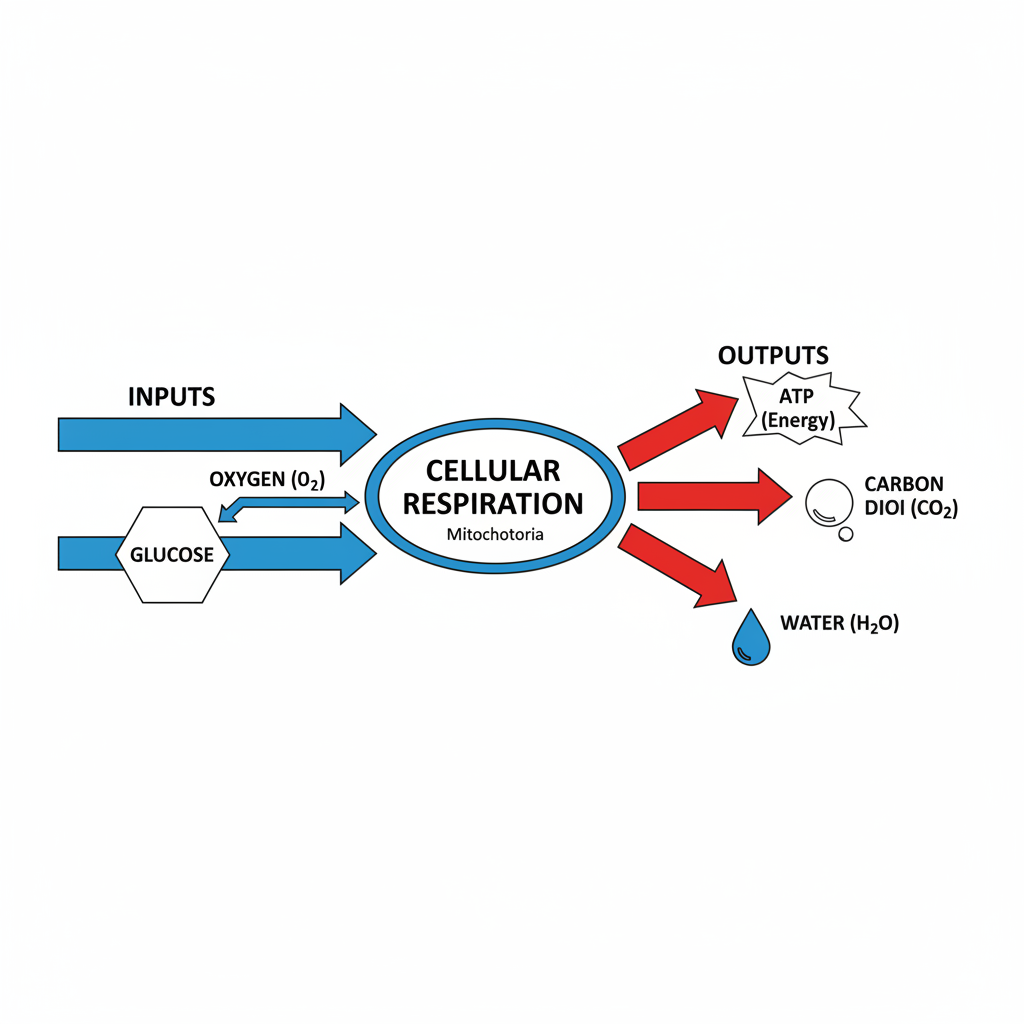 ⚠️ This picture may have spelling mistakes. Trust the words in the lesson.
The Breath of Life: Oxygen's Role
You know how a fire needs oxygen to burn? It's the same principle in your body! For the most efficient way to get energy from glucose, your cells need oxygen. When you breathe in, your lungs take in oxygen, which is then transported by your blood to every cell in your body. This oxygen acts like the 'spark' or 'combustion agent' that helps 'burn' the glucose fuel inside your cells.
The Energy Currency: ATP!
When glucose is 'burned' (or broken down) with the help of oxygen, the energy released isn't used directly. Instead, it's captured and stored in a special molecule called ATP (Adenosine Triphosphate). Think of ATP as the universal energy currency of your body. Just like you can't buy things with raw ingredients but need money, your cells can't use raw energy but need ATP! When your cells need to do something – contract a muscle, send a message through a nerve, or build a new protein – they 'spend' ATP.
What Comes Out? Byproducts!
Just like a car engine produces exhaust fumes and heat, your cellular power plants also produce byproducts. The main byproducts of respiration are carbon dioxide and water. The carbon dioxide is transported back to your lungs by your blood and then breathed out. The water is either used by your body or expelled as waste.
Two Main Types of Respiration: With or Without Oxygen!
Not all power plants work the same way. There are two main types of respiration, depending on whether oxygen is available or not:
1. Aerobic Respiration (With Oxygen)
This is the most common and efficient type of respiration. 'Aerobic' literally means 'with air' (or in biology, 'with oxygen'). When your cells have plenty of oxygen, they use it to fully break down glucose, releasing a large amount of energy (ATP). This happens mainly in the mitochondria.
Think of aerobic respiration as a big, efficient power station that runs 24/7, providing consistent energy for all your daily activities. It's what keeps you going during a long walk, studying, or even sleeping.
- Inputs: Glucose + Oxygen
- Outputs: A LOT of ATP (energy) + Carbon Dioxide + Water
The chemical equation for aerobic respiration is often simplified as:
C6H12O6 (Glucose) + 6O2 (Oxygen) → 6CO2 (Carbon Dioxide) + 6H2O (Water) + Energy (ATP)
2. Anaerobic Respiration (Without Oxygen)
What happens if your cells don't have enough oxygen, or no oxygen at all? Don't worry, your body has a backup plan! This is where 'anaerobic' respiration comes in. 'Anaerobic' means 'without air' or 'without oxygen'. This process doesn't use oxygen and produces much less ATP compared to aerobic respiration. It's like a small, less efficient backup generator that kicks in when the main power station is down or can't keep up.
There are a couple of important types of anaerobic respiration:
a) Lactic Acid Fermentation (in Animals)
This happens in your muscle cells when you exercise very intensely – like sprinting or lifting heavy weights. Your muscles need a lot of energy very quickly, and sometimes your body can't deliver oxygen fast enough to meet the demand. So, your muscle cells switch to anaerobic respiration. They break down glucose without oxygen, but instead of producing just carbon dioxide and water, they produce lactic acid as a byproduct.
It's like burning fuel quickly but leaving behind a sour, leftover substance. This buildup of lactic acid is what can make your muscles feel sore and fatigued after a tough workout. Once oxygen becomes available again (when you rest), the lactic acid is converted back to pyruvate and processed further, or transported to the liver.
- Inputs: Glucose
- Outputs: A little ATP (energy) + Lactic Acid
b) Alcoholic Fermentation (in Yeast and some Plants)
You might not experience this directly in your body, but it's super important in nature and for certain industries! Yeast, which are single-celled fungi, and some plant cells perform alcoholic fermentation when oxygen is absent. They break down glucose to produce a little ATP, along with ethanol (alcohol) and carbon dioxide.
This process is what makes bread rise (the carbon dioxide creates bubbles) and is used to produce alcoholic beverages.
- Inputs: Glucose
- Outputs: A little ATP (energy) + Ethanol + Carbon Dioxide
Respiration vs. Breathing: What's the Difference?
It's very common to mix these two up! Let's clarify:
- Breathing (or Ventilation): This is the physical act of inhaling and exhaling. It's how your body takes in oxygen from the air and expels carbon dioxide. Think of it as the 'delivery and waste disposal service' for your cells.
- Respiration (or Cellular Respiration): This is the chemical process that happens inside your cells, where glucose is broken down to release energy (ATP). It's the 'factory floor' where the actual work of energy conversion takes place.
So, you breathe to allow cellular respiration to happen efficiently!
The Big Picture: Why Respiration Matters
Every single process that keeps you alive – from your heart beating, to your brain thinking, to your muscles moving, to your cells repairing themselves – requires energy. And that energy comes almost exclusively from cellular respiration. Without it, life as we know it wouldn't be possible. It's the fundamental process that powers every living thing on Earth!
By understanding respiration, you're unlocking one of the most basic, yet profound, secrets of life itself. Keep exploring!
Keep learning, free
Create a free Syllabax account to unlock practice questions and games for this topic.
Visual Learning Enhanced! 🚀
To help you master this topic, we use Advanced Syllabax AI to generate detailed diagrams and visual models.
Note on Visuals: The AI sometimes makes spelling errors in image labels. Please refer to the lesson text for the correct terminology.