Points, lines, line segments, rays [Basic Geometrical Concepts]
Watch this topic in 60 seconds
Free preview · Lesson 1
Understanding Points, lines, line segments, rays [Basic Geometrical Concepts]
Understanding Basic Geometric Shapes: Points, Lines, Line Segments, and Rays
Welcome to the fascinating world of geometry! Geometry is like a secret code that describes the shapes and spaces all around us, from the smallest dot to the biggest universe. Today, we're going to start with the most basic building blocks of geometry: points, lines, line segments, and rays. Think of them as the ABCs of shapes!
What is a Point?
Imagine the very tip of a sharp pencil. When it touches a piece of paper, it leaves a tiny mark. That tiny mark is like a geometric point. A point is a location. It has no size – no length, no width, no height. It's just a specific spot in space. We usually represent points with a capital letter, like point A or point P.
Analogy: Think of a point as a tiny speck of glitter on a table. You can see it, but it doesn't take up any space. Or, imagine the exact spot where two roads meet – that intersection is a point. It tells you where something is, but it's not a thing with size itself.
What is a Line?
Now, imagine taking that tiny speck of glitter (our point) and drawing a straight path from it. What if you could keep drawing that path forever in both directions? That's essentially what a line is! A line is a straight path that goes on forever in both directions. It has no beginning and no end. Lines have length, but no width.
Because lines go on forever, we can't draw a whole line. We can only draw a part of it. We show that a line continues forever by drawing arrows at both ends. We can name a line by using two points on the line (like line AB) or by using a lowercase letter (like line m).
Analogy: Think of a perfectly straight, infinitely long road that never ends. No matter how far you drive in either direction, it just keeps going. That's a line! Another way to think about it is the path of a laser beam that shoots out from a laser pointer and never stops. The light travels in a straight line forever.
What is a Line Segment?
Sometimes, we're interested in just a *part* of a line. That's where a line segment comes in! A line segment is a part of a line that has two specific endpoints. It starts at one point and ends at another point. It has a definite length.
Since it has two endpoints, we name a line segment by its two endpoints. For example, if we have a line segment with an endpoint at point C and another at point D, we call it line segment CD (or DC – the order doesn't matter).
Analogy: Think of a jump rope. It has a beginning and an end. It's a definite length. That's a line segment! Or, consider the edge of a ruler. It's a straight piece with a start and an end. That's also a line segment. Unlike the endless road (the line), the jump rope or the ruler's edge has a clear beginning and a clear end.
What is a Ray?
Now, let's mix things up a little! What if we have something that starts at a point and goes on forever in *one* direction? That's a ray! A ray has one endpoint (called the starting point or origin) and continues infinitely in the other direction.
We name a ray by its starting point first, followed by any other point on the ray. For example, if a ray starts at point E and goes through point F forever, we call it ray EF. You must name the starting point first!
Analogy: Think of a flashlight beam. It starts at the flashlight (the endpoint) and shines out in one direction forever (or until it hits something). That's a ray! Another great example is the path of sunlight coming from the sun. The sun is the starting point, and the light travels outwards in all directions, but each individual beam of light is a ray.
Putting It All Together
Let's review the key differences:
- Point: A single location, no size. (Like a tiny dot)
- Line: Goes on forever in both directions, no endpoints. (Like an endless straight road)
- Line Segment: A part of a line with two endpoints. (Like a jump rope)
- Ray: Starts at one endpoint and goes on forever in one direction. (Like a flashlight beam)
Imagine you have a long string. If you stretch it out perfectly straight, it's like a line. If you cut a piece of that string, you have a line segment. If you tie one end of the string to a post and let the rest of the string fly out in the wind, that flying-out part is like a ray. A single knot in the string could be like a point.
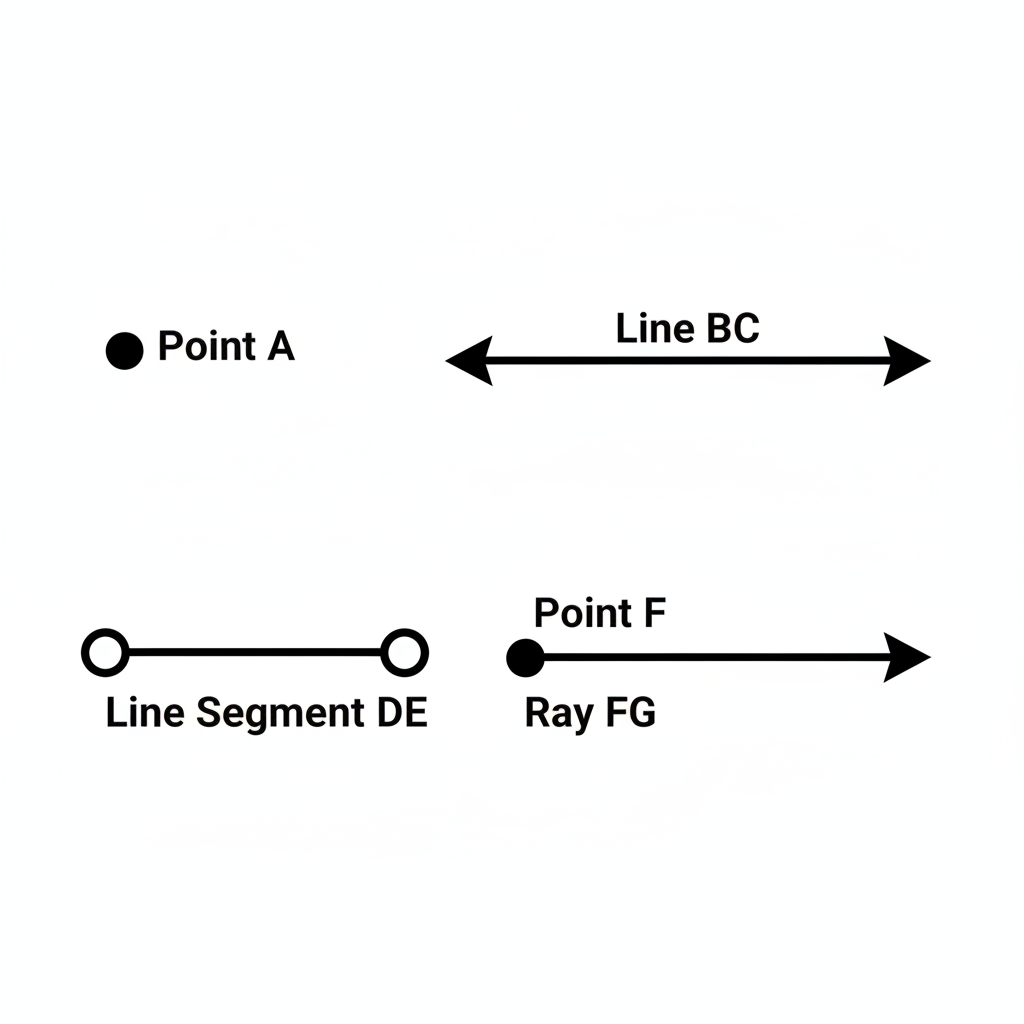 ⚠️ This picture may have spelling mistakes. Trust the words in the lesson.
Understanding these basic terms is the first step to exploring many exciting geometric ideas. Keep practicing, and you'll become a geometry whiz in no time!
Keep learning, free
Create a free Syllabax account to unlock practice questions and games for this topic.
Visual Learning Enhanced! 🚀
To help you master this topic, we use Advanced Syllabax AI to generate detailed diagrams and visual models.
Note on Visuals: The AI sometimes makes spelling errors in image labels. Please refer to the lesson text for the correct terminology.