Learning Journey
Watch this topic in 60 seconds
Free preview · Lesson 1
Understanding Flame structure[CHEMISTRY]
Understanding Flame Structure: A Journey into Fire!
Welcome, aspiring scientists! Today, we're going to explore something familiar yet fascinating: fire! You've seen it in campfires, candles, and maybe even a chef's torch. But have you ever wondered what's really happening inside a flame? It's not just a simple blob of heat and light. Flames have a specific structure, like layers in a cake or rings on a tree. Let's dive in and uncover the secrets of flame structure!
What is a Flame? The Basics
Before we talk about structure, let's define what a flame is. Imagine you're baking a cake. You mix ingredients and put them in the oven. A flame is kind of like the 'oven' for certain chemical reactions. Specifically, a flame is the visible, gaseous part of a fire. It's where combustion, a rapid chemical reaction between a substance and an oxidant (usually oxygen), happens and produces heat and light.
Think of burning wood in a fireplace. The wood itself isn't the flame. The flame is the hot, glowing gas that rises from the wood as it burns. This gas is made up of tiny particles and molecules that are super excited and glowing!
Why Do Flames Have Layers?
You might have noticed that flames aren't uniform. Some parts are brighter, some are hotter, and some are less visible. This is because combustion doesn't happen all at once. It's a step-by-step process, and different steps occur in different places within the flame. These places are what we call the 'zones' or 'layers' of a flame.
Let's use an analogy. Imagine a pizza oven. There's the very hot part where the pizza cooks quickly, a slightly cooler part where the crust gets golden brown, and the outer edges where the dough might be just starting to cook. Similarly, a flame has different regions with different temperatures and chemical activities.
The Three Main Zones of a Simple Flame (Like a Candle Flame)
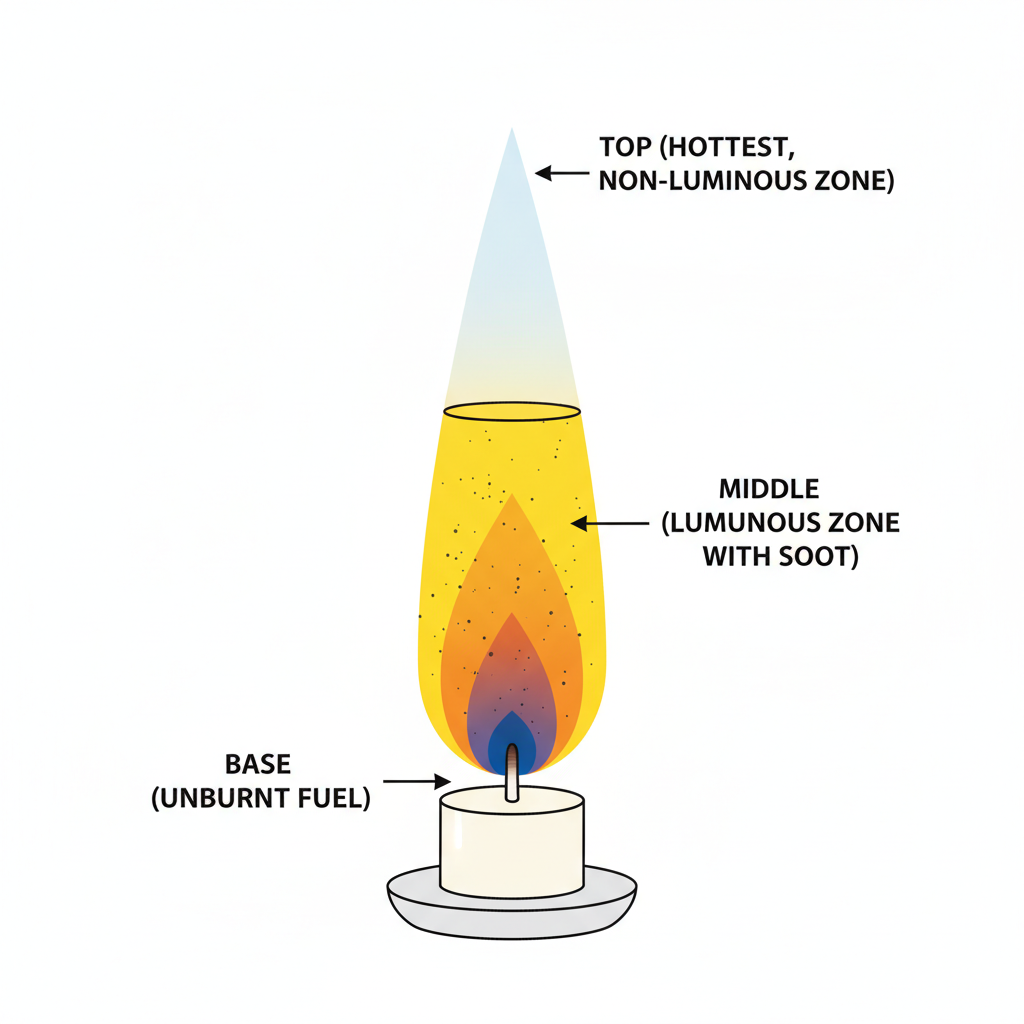
For a common flame, like the one from a candle or a gas stove, we can often identify three main zones:
- The Unburnt Fuel Zone (or Base): This is at the very bottom of the flame, closest to where the fuel is coming from (like the wick of a candle or the gas nozzle).
- The Brightest Zone (or Luminous Zone): This is the middle part, where most of the visible light comes from.
- The Faintest/Hottest Zone (or Non-luminous Zone): This is the top part of the flame, which is often the hottest but less visible.
Let's break down each zone:
Zone 1: The Unburnt Fuel Zone (The 'Preparation Area')
Imagine this zone as the 'prep station' in a busy kitchen. Before the ingredients can be cooked, they need to be prepared. In a flame, the fuel (like the wax vapor from a candle) is still in the process of getting ready to burn. It's rising from the source but hasn't fully mixed with enough oxygen yet to combust intensely. This area is relatively cool and dark because not much burning is happening here.
Think about a campfire. The solid logs are the fuel. As they heat up, they start to release gases. These gases are like the 'unburnt fuel' rising up before they catch fire properly. This part of the flame is often a bluish color or barely visible.
Zone 2: The Brightest Zone (The 'Cooking Zone')
This is where the magic happens! This middle part of the flame is like the 'main cooking area' of our kitchen. Here, the fuel vapor mixes with oxygen and starts to burn vigorously. What makes it bright? Well, the combustion process releases tiny, glowing particles of soot (like microscopic bits of charcoal). When these soot particles get super hot, they glow brightly, giving the flame its characteristic yellow or orange color and making it highly visible.
This zone is a mix of burning and incomplete burning. It's hot, but not the absolute hottest part of the flame. Think of the bubbling, glowing part of a campfire – that's similar to this zone.
Zone 3: The Faintest/Hottest Zone (The 'Finishing Touch')
At the very top of the flame, we have the 'finishing touch' zone. This is where the combustion is most complete. Here, the fuel has mixed well with plenty of oxygen, and the reaction is happening efficiently. This zone is usually the hottest part of the flame, but it's often fainter and bluer than the bright middle zone.
Why is it fainter? Because there's less soot being produced. The fuel is burning more cleanly. This clean burning produces a lot of heat but not as much glowing soot. If you've ever used a gas stove, the blue flame you see is mainly this zone. It's very hot and efficient for cooking!
Imagine a perfectly cooked steak. It's done all the way through and has a great char. The top of the flame is like that – efficient and hot, but maybe not as visually dramatic as the main cooking part.
Visualizing the Flame Structure
Let's imagine a candle flame:
- Bottom: A small, faint blueish area near the wick. (Unburnt Fuel Zone)
- Middle: A large, bright yellow/orange area. (Brightest Zone)
- Top: A less visible, almost clear or pale blue tip. (Faintest/Hottest Zone)
This is a simplified view, and different types of flames (like a Bunsen burner flame) can have more complex structures, but these three zones give us a great basic understanding.
 ⚠️ This picture may have spelling mistakes. Trust the words in the lesson.
Why is Understanding Flame Structure Important?
Knowing about flame structure helps us in many ways:
- Safety: Understanding where the hottest parts of a flame are helps us handle fires safely.
- Efficiency: For things like stoves or engines, designing them to have the most efficient burning (often in the non-luminous zone) means we use less fuel.
- Science Experiments: When conducting experiments involving flames, knowing which part is hottest or has specific chemical reactions can be crucial.
In Summary: The Flame as a Process
So, a flame isn't just a random burst of heat. It's a dynamic process with different stages happening in different places. It's like a tiny, continuous chemical factory producing light and heat. From the preparation of fuel at the base, to the bright glow of burning in the middle, to the super-hot, clean finish at the top, each zone plays a vital role.
Keep observing flames around you and think about these different zones. You're now one step closer to becoming a fire expert!
Keep learning, free
Create a free Syllabax account to unlock practice questions and games for this topic.
Visual Learning Enhanced! 🚀
To help you master this topic, we use Advanced Syllabax AI to generate detailed diagrams and visual models.
Note on Visuals: The AI sometimes makes spelling errors in image labels. Please refer to the lesson text for the correct terminology.