Choosing materials for daily objects[CHEMISTRY]
Watch this topic in 60 seconds
Free preview · Lesson 1
Understanding Choosing materials for daily objects[CHEMISTRY]
Choosing Materials for Daily Objects: A Chemistry Adventure!
Have you ever wondered why your toothbrush handle is made of plastic, but the bristles are softer? Or why your favorite mug is made of ceramic, not paper? The answer lies in chemistry, the study of matter and how it behaves! Today, we're going on a journey to explore why different materials are chosen for the everyday objects around us.
What is Matter?
Everything you can touch, see, or even smell is made of matter. Matter is basically anything that has mass (how much "stuff" is in it) and takes up space (has volume). Think of it like building blocks. You can have big blocks, small blocks, heavy blocks, and light blocks. All of these are different types of matter!
Matter comes in different forms, called states: solid, liquid, and gas. A solid, like a chair, keeps its shape. A liquid, like water, flows and takes the shape of its container. A gas, like the air we breathe, spreads out to fill its container.
What are Materials?
Materials are specific types of matter that we use to make things. Think of them as the ingredients for our objects. Just like a baker chooses flour, sugar, and eggs to make a cake, engineers and designers choose specific materials to make objects that work well.
Properties: The Secret Ingredients of Materials!
How do we choose the right material? We look at its properties. Properties are like the special characteristics or features of a material. They tell us how the material will act or feel. Let's explore some important properties:
1. Strength: Can it Hold Up?
Strength tells us how much a material can resist breaking or bending when a force is applied.
- Analogy: Imagine trying to bend a spaghetti noodle versus a metal rod. The metal rod is much stronger!
Examples:
- Steel is very strong, which is why it's used to build bridges and car frames.
- Paper is not very strong, so it's used for books, not for building houses.
2. Flexibility: Can it Bend?
Flexibility is the opposite of strength in a way. It tells us how easily a material can bend or be shaped without breaking.
- Analogy: A rubber band is very flexible, while a brick is not flexible at all.
Examples:
- Rubber is flexible and used for tires, balloons, and shoe soles.
- Glass is not flexible and will shatter if you try to bend it too much.
3. Hardness: Can it Be Scratched?
Hardness describes a material's resistance to being scratched or dented.
- Analogy: Try scratching your fingernail on wood versus a piece of metal. The metal is much harder to scratch.
Examples:
- Diamond is the hardest natural substance and is used in cutting tools.
- Wax is soft and can be easily scratched, which is why candles can get dented.
4. Elasticity: Will it Snap Back?
Elasticity is the ability of a material to return to its original shape after being stretched or squeezed.
- Analogy: A bouncy ball is very elastic. When you squeeze it, it bounces back to its round shape. A piece of clay is not elastic; once you shape it, it stays that way.
Examples:
- Elastic bands are used in clothing and hair ties because they can stretch and return to their original size.
- Metal springs in pens are also elastic, allowing them to compress and expand.
5. Conductivity: Does it Let Heat or Electricity Pass Through?
Conductivity is about how well a material allows heat or electricity to travel through it.
- Analogy: Imagine holding a metal spoon in hot soup versus a wooden spoon. The metal spoon quickly becomes hot (conducts heat well), while the wooden spoon stays cool (doesn't conduct heat well).
Examples:
- Copper is a great conductor of electricity, which is why it's used in electrical wires.
- Plastic is a poor conductor of heat and electricity (an insulator), which is why it's used to cover electrical wires and for pot handles.
6. Density: How Packed is the "Stuff"?
Density is a measure of how much mass is packed into a certain volume. Think of it as how "heavy" a material feels for its size.
- Analogy: Imagine a box filled with feathers versus the same size box filled with rocks. The box of rocks is much denser because rocks are heavier than feathers for the same amount of space.
Examples:
- Lead is very dense, which is why lead weights sink quickly in water.
- Wood is less dense than water, which is why many types of wood float.
7. Porosity: Can it Soak Things Up?
Porosity refers to whether a material has tiny holes or spaces within it that can absorb liquids or gases.
- Analogy: A sponge is very porous; it can soak up a lot of water. A solid piece of glass is not porous.
Examples:
- Sponges are porous and used for cleaning up spills.
- Concrete can be porous, which is why it needs to be sealed to prevent water damage.
Putting it All Together: Why These Materials?
Now let's see how these properties help us choose materials for everyday objects:
- Toothbrushes: The handle needs to be strong and easy to grip, so plastic is a good choice. The bristles need to be flexible enough to clean your teeth without hurting your gums, so a different type of plastic or nylon is used.
- Mugs: Mugs need to hold hot liquids and be easy to clean. Ceramics are strong, can withstand heat, and are not porous (so they don't leak or absorb flavors). Glass is also good but can break more easily. Paper cups are cheap but not durable and don't hold heat well.
- Pots and Pans: The part that heats up needs to conduct heat well, so metals like aluminum or stainless steel are used. The handles often need to be insulators to protect your hands, so they are made of plastic or wood.
- Clothing: We want clothes to be comfortable, flexible, and sometimes waterproof. Cotton is breathable and soft. Polyester is durable and can be made water-resistant. Spandex is very elastic, allowing clothes to stretch.
- Windows: We need to see through them, so they must be transparent. They also need to be somewhat strong and resistant to weather. Glass is a common choice, though newer materials are also being developed.
Common Materials and Their Properties
Let's look at some common materials:
- Wood: Strong, relatively hard, can be flexible or rigid depending on type and grain, good insulator, not very dense (floats).
- Plastic: Very versatile! Can be strong, flexible, hard, elastic, a good insulator. Comes in many forms.
- Metal (e.g., Steel, Aluminum, Copper): Generally strong, hard, good conductors of heat and electricity, often dense.
- Glass: Hard, brittle (shatters easily), transparent, good insulator, not very flexible.
- Ceramic: Hard, strong, brittle, good insulator, resistant to heat and chemicals, often not porous.
- Fabric/Textiles: Flexible, can be soft or stiff, breathable, can be made water-resistant.
The world around us is built from amazing materials, each chosen for its unique properties. Understanding these properties helps us appreciate the clever design behind everything we use!
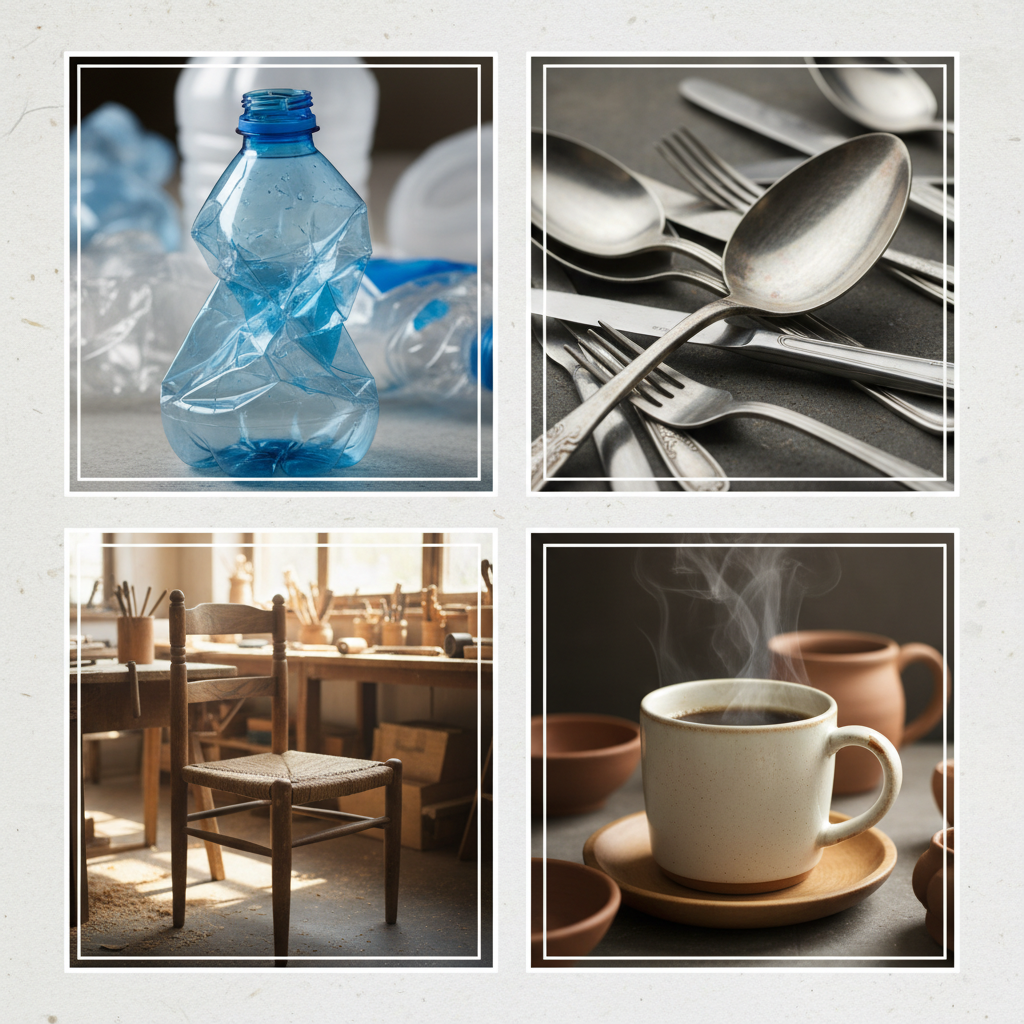 ⚠️ This picture may have spelling mistakes. Trust the words in the lesson.
Keep learning, free
Create a free Syllabax account to unlock practice questions and games for this topic.
Visual Learning Enhanced! 🚀
To help you master this topic, we use Advanced Syllabax AI to generate detailed diagrams and visual models.
Note on Visuals: The AI sometimes makes spelling errors in image labels. Please refer to the lesson text for the correct terminology.