Conversion of units [Measurement Basics]
Watch this topic in 60 seconds
Free preview · Lesson 1
Understanding Conversion of units [Measurement Basics]
Mastering Measurement: Converting Units (Grade 5)
Welcome, young mathematicians, to a journey into the world of measurement! We use measurements every single day, even when we don't realize it. When you ask, 'How tall am I?', you're asking about length. When your mom says, 'We need two liters of milk,' she's talking about volume. When a recipe calls for 'one cup of flour,' that's also volume! Even when you check the time, you're measuring time itself. Measurement helps us understand and describe the world around us.
Why Do We Need to Convert Units?
Imagine you're baking a cake, and the recipe calls for 500 grams of flour. But your measuring cup only shows ounces! What do you do? You need to convert grams to ounces so you can use the right amount of flour. Or, maybe you're building a fort, and you need a piece of wood that is 1 meter long. But all you have is a ruler that measures in centimeters. You need to know how many centimeters are in a meter!
Converting units is like speaking different languages. If someone speaks French and you speak English, you need a translator to understand each other. Converting units is our 'translator' for different measurement tools and scales. It allows us to compare, add, subtract, and work with measurements that are given in different units. It's a super important skill for everything from cooking to science experiments to even just understanding distances when you travel.
Understanding Basic Units
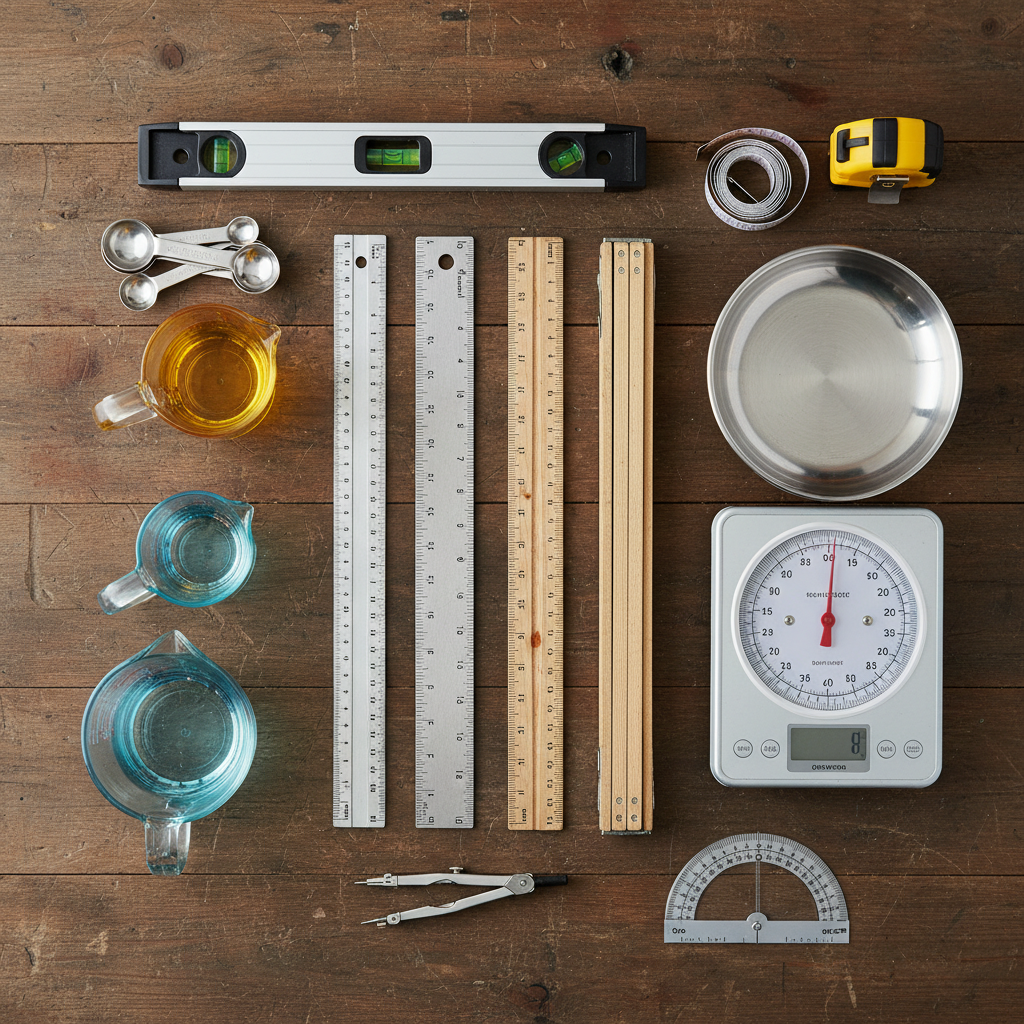
Before we start converting, let's get familiar with some basic units of measurement. We'll focus on three main types:
1. Length: How Long or Tall Something Is
Length tells us how far apart two points are, or how tall, wide, or deep something is. Think of it as stretching a measuring tape!
- Inch (in): A small unit of length. Imagine the width of your thumb – that's about an inch!
- Foot (ft): A longer unit. There are 12 inches in 1 foot. Think of a grown-up's shoe – that's roughly a foot long.
- Yard (yd): Even longer! There are 3 feet in 1 yard. A big step you take might be about a yard.
- Mile (mi): A very long distance. Think of how far you might run in a race or how far it is to the next town.
- Centimeter (cm): A small unit used in places that use the metric system. About the width of your pinky finger.
- Meter (m): A longer metric unit. It's about the height of a doorknob from the floor.
- Kilometer (km): A very long metric distance, used for things like the distance between cities.
2. Weight (or Mass): How Heavy Something Is
Weight tells us how much 'stuff' is in an object. We often use the terms 'weight' and 'mass' interchangeably in everyday life, though scientists use them differently. Think of how hard it is to lift something.
- Ounce (oz): A small unit of weight. A slice of bread might weigh about an ounce.
- Pound (lb): A heavier unit. A bag of sugar is often about 2 pounds.
- Ton (T): A very heavy unit! A car weighs many tons.
- Gram (g): A small metric unit of mass. A paperclip might weigh about 1 gram.
- Kilogram (kg): A heavier metric unit. A bag of apples might weigh about 1 kilogram.
3. Volume (or Capacity): How Much a Container Holds
Volume tells us how much space a liquid or a substance takes up, or how much a container can hold. Think of filling up a cup or a swimming pool.
- Cup (c): Used for cooking and baking.
- Pint (pt): You might get a pint of ice cream.
- Quart (qt): Larger than a pint.
- Gallon (gal): A very large amount. A milk jug at the grocery store is usually a gallon.
- Milliliter (mL): A small metric unit of volume. A few drops of medicine might be measured in milliliters.
- Liter (L): A larger metric unit. A big bottle of soda is often 2 liters.
 ⚠️ This picture may have spelling mistakes. Trust the words in the lesson.
The Key to Conversion: Conversion Factors
The most important thing to remember when converting units is that there's always a relationship between them. This relationship is called a conversion factor. It's like a secret code that tells you how many of one unit fit into another.
Here are some common conversion factors we'll use:
Length Conversion Factors:
- 1 foot = 12 inches
- 1 yard = 3 feet
- 1 mile = 5,280 feet (This is a big one!)
- 1 meter = 100 centimeters
- 1 kilometer = 1,000 meters
Weight/Mass Conversion Factors:
- 1 pound = 16 ounces
- 1 ton = 2,000 pounds
- 1 kilogram = 1,000 grams
Volume Conversion Factors:
- 1 gallon = 4 quarts
- 1 quart = 2 pints
- 1 pint = 2 cups
- 1 liter = 1,000 milliliters
How to Convert: The Multiplication Method
The easiest way to convert units is to use multiplication. We use our conversion factor like a special fraction that helps us cancel out the units we don't want and leave the units we do want.
Step 1: Identify what you know. What is the measurement you have, and what unit is it in?
Step 2: Identify what you want. What unit do you want to change it to?
Step 3: Find the conversion factor. Look up the relationship between the two units.
Step 4: Set up the problem. Write your original measurement as a fraction (put a '1' underneath if it's a whole number). Then, multiply it by the conversion factor, written as a fraction. IMPORTANT: Make sure the unit you want to get rid of is on the *opposite* side of the fraction line (one on top, one on the bottom) so it can cancel out.
Step 5: Multiply and Simplify. Multiply the numbers across the top and across the bottom. Cancel out the units you don't need. Then, do the math!
Example 1: Converting Feet to Inches
Let's say you have a rope that is 3 feet long, and you want to know how many inches it is.
- Know: 3 feet
- Want: inches
- Conversion Factor: 1 foot = 12 inches
- Set up: We want to get rid of 'feet' and end up with 'inches'. So, we write the conversion factor with 'feet' on the bottom:
3 feet * (12 inches / 1 foot)
- Multiply & Simplify:
(3 feet / 1) * (12 inches / 1 foot)
Notice how 'feet' appears on the top and bottom? They cancel out!
(3 * 12) inches / (1 * 1)
36 inches
So, 3 feet is the same as 36 inches!
Example 2: Converting Kilograms to Grams
A scientist has a rock that weighs 2 kilograms. How many grams does it weigh?
- Know: 2 kilograms
- Want: grams
- Conversion Factor: 1 kilogram = 1,000 grams
- Set up: We want to get rid of 'kilograms' and end up with 'grams'. Write the conversion factor with 'kilograms' on the bottom:
2 kilograms * (1,000 grams / 1 kilogram)
- Multiply & Simplify:
(2 kilograms / 1) * (1,000 grams / 1 kilogram)
The 'kilograms' cancel out!
(2 * 1,000) grams / (1 * 1)
2,000 grams
So, 2 kilograms is the same as 2,000 grams!
Example 3: Converting Gallons to Quarts
A large juice container holds 3 gallons. How many quarts does it hold?
- Know: 3 gallons
- Want: quarts
- Conversion Factor: 1 gallon = 4 quarts
- Set up: We want to cancel 'gallons' and get 'quarts'. Put 'gallons' on the bottom of the conversion factor:
3 gallons * (4 quarts / 1 gallon)
- Multiply & Simplify:
(3 gallons / 1) * (4 quarts / 1 gallon)
The 'gallons' cancel out!
(3 * 4) quarts / (1 * 1)
12 quarts
So, 3 gallons is the same as 12 quarts!
Practice Time!
Now it's your turn to practice being a unit conversion wizard! Remember to use your conversion factors and the multiplication method.
Length Conversions
1. How many inches are in 2 feet?
2. How many centimeters are in 5 meters?
Weight Conversions
3. How many ounces are in 4 pounds?
4. How many grams are in 3 kilograms?
Volume Conversions
5. How many pints are in 2 quarts?
Keep practicing, and soon you'll be a master of measurement!
Keep learning, free
Create a free Syllabax account to unlock practice questions and games for this topic.
Visual Learning Enhanced! 🚀
To help you master this topic, we use Advanced Syllabax AI to generate detailed diagrams and visual models.
Note on Visuals: The AI sometimes makes spelling errors in image labels. Please refer to the lesson text for the correct terminology.