Negative exponents (Exponents & Powers)
Watch this topic in 60 seconds
Free preview · Lesson 1
Understanding Negative exponents (Exponents & Powers)
Understanding Negative Exponents: A Foundational Dive for 8th Graders
Welcome, 8th-grade explorers, to the fascinating world of exponents! You've likely met exponents before, those little numbers floating above another number, telling you to multiply the base by itself a certain number of times. For example, 23 means 2 multiplied by itself 3 times (2 x 2 x 2 = 8). Simple, right?
But what if that little number, the exponent, decides to go on an adventure and turns negative? What does 2-3 mean? Does it mean the number becomes negative? Does it mean something entirely different? Prepare to unravel this mystery with simple terms, clear definitions, and a sprinkle of fun analogies!
What Are Exponents, Really? A Quick Review
Before we jump into the 'negative' side of things, let's quickly remind ourselves what positive exponents do:
- Base: The main number that is being multiplied (e.g., in 52, 5 is the base).
- Exponent (or Power): The small number that tells you how many times to multiply the base by itself (e.g., in 52, 2 is the exponent).
So, 42 = 4 x 4 = 16. And 34 = 3 x 3 x 3 x 3 = 81. Easy peasy!
The Mystery of the Negative Exponent
Now, imagine you see something like 5-2. Your first instinct might be to think, "Oh, a negative exponent means the answer must be negative!" But hold that thought! That's actually one of the biggest misconceptions we'll clarify today. A negative exponent does NOT make the number negative.
Analogy 1: The Elevator Ride to the Reciprocal Floor!
Think of exponents like floors in a building, and the 'ground floor' (or 1st floor, depending on how you count) is where the value 1 lives. When you have a positive exponent, like 23, it's like taking the number 2 and multiplying it by itself, going UP floors from 1. 1 x 2 x 2 x 2 = 8.
But what if you have a negative exponent, like 2-3? This is like pressing the 'down' button on the elevator! Instead of multiplying, you're doing the opposite. You're dividing! Specifically, you're telling the number to go to the basement, or rather, to become a fraction – its reciprocal!
The ground floor is 1. If you go 'up' 3 floors with a base of 2, you get 23 = 8. If you go 'down' 3 floors with a base of 2 (2-3), you go to the reciprocal of 23. So, 2-3 means take 1 and divide by 2 three times: 1 ÷ 2 ÷ 2 ÷ 2 = 1/8.
Analogy 2: The "Flip It!" Rule – Turning Things Upside Down
Perhaps an even simpler way to think about it is with a magical "flip it!" spell. When you see a negative exponent, it's a signal to take the base and "flip it" to its reciprocal, and then the exponent magically becomes positive!
- If you have a whole number base, like 5-2, imagine it as 5/1. To "flip it," you turn it into 1/5. Then the exponent becomes positive: (1/5)2.
- If you have a fraction base, like (2/3)-2, to "flip it," you turn it into 3/2. Then the exponent becomes positive: (3/2)2.
This "flip it!" action is called taking the reciprocal. The reciprocal of a number is 1 divided by that number. For example, the reciprocal of 5 is 1/5. The reciprocal of 1/2 is 2 (because 1 ÷ 1/2 = 2).
The Official Definition: What Does a Negative Exponent Actually Mean?
Mathematically, the rule for negative exponents is very straightforward:
For any non-zero number 'a' and any positive integer 'n':
a-n = 1 / an
This means: "A base raised to a negative exponent is equal to 1 divided by the base raised to the positive version of that exponent."
Let's See Some Examples in Action:
Example 1: Evaluate 2-3
- Step 1: Identify the base (2) and the negative exponent (-3).
- Step 2: Apply the rule: 2-3 = 1 / 23
- Step 3: Calculate the positive exponent: 23 = 2 x 2 x 2 = 8
- Step 4: Combine: 2-3 = 1/8
Example 2: Evaluate 5-2
- Step 1: Base (5), negative exponent (-2).
- Step 2: Apply the rule: 5-2 = 1 / 52
- Step 3: Calculate: 52 = 5 x 5 = 25
- Step 4: Combine: 5-2 = 1/25
Example 3: Evaluate (1/3)-2
- Step 1: Base (1/3), negative exponent (-2).
- Step 2: Apply the rule (or the "flip it" rule directly!): (1/3)-2 = 1 / (1/3)2
- Step 3: Calculate (1/3)2 = (1/3) x (1/3) = 1/9
- Step 4: Combine: 1 / (1/9). Remember that dividing by a fraction is the same as multiplying by its reciprocal. So, 1 x 9/1 = 9.
- Alternatively, using "flip it!": (1/3)-2 becomes (3/1)2 = 32 = 9. Much faster!
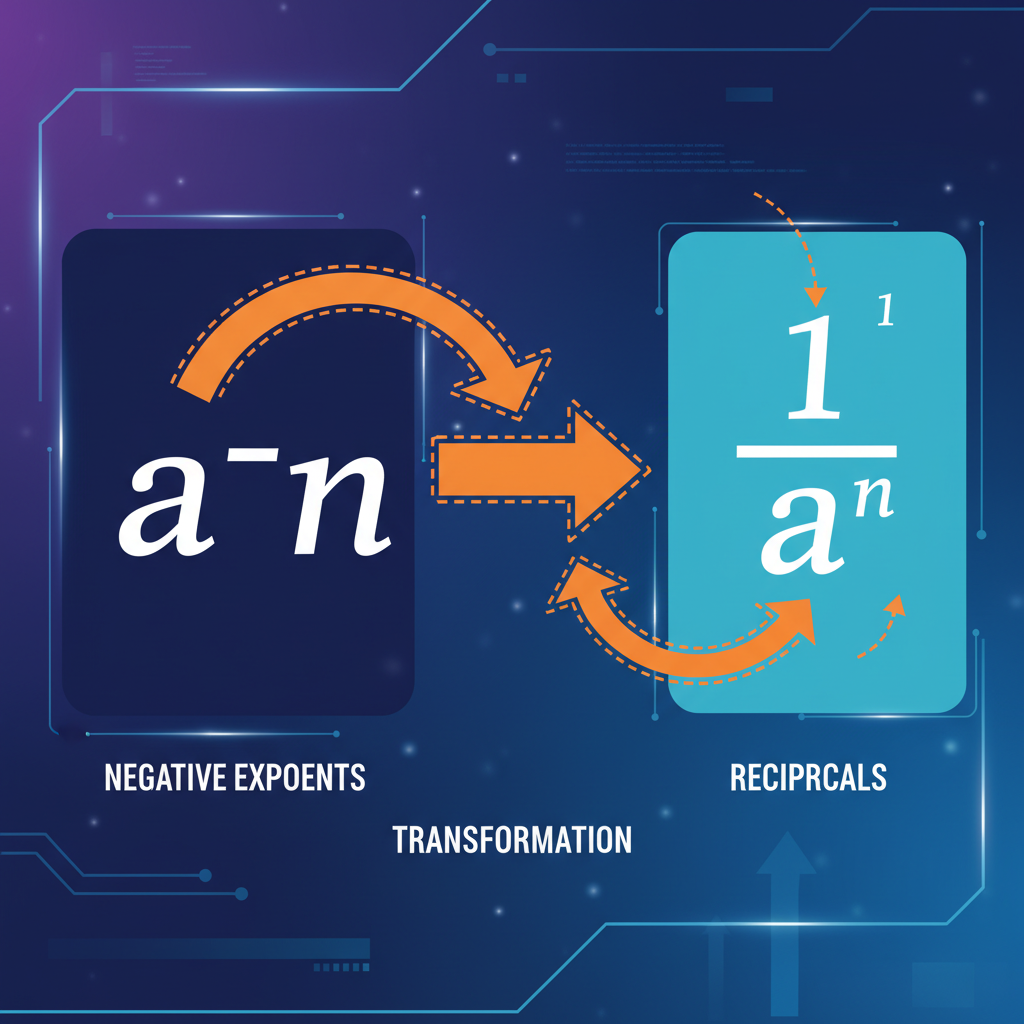 ⚠️ This picture may have spelling mistakes. Trust the words in the lesson.
Why Does This Rule Make Sense? Pattern Power!
Let's look at a sequence of powers of 2 and see if we can find a pattern that leads us to negative exponents naturally:
- 24 = 16
- 23 = 8 (Notice: 16 ÷ 2 = 8)
- 22 = 4 (Notice: 8 ÷ 2 = 4)
- 21 = 2 (Notice: 4 ÷ 2 = 2)
What happens if we keep following this pattern? Each time we decrease the exponent by 1, we divide the result by the base (which is 2 in this case).
- 20 = 1 (Notice: 2 ÷ 2 = 1). This is why any non-zero number to the power of 0 is always 1!
- 2-1 = 1/2 (Notice: 1 ÷ 2 = 1/2)
- 2-2 = 1/4 (Notice: 1/2 ÷ 2 = 1/4)
- 2-3 = 1/8 (Notice: 1/4 ÷ 2 = 1/8)
See? The pattern beautifully shows us that 2-3 is indeed 1/8, which is the same as 1/23. This logical progression proves why the rule a-n = 1/an works perfectly!
Common Mistakes to Avoid!
It's super important to remember these two things:
- A negative exponent does NOT make the number negative. It makes it a fraction (or a smaller positive number if the original base was greater than 1). For example, 2-3 = 1/8, not -8.
- Do not confuse a-n with -an. These are very different! 2-3 = 1/8. But -23 = -(2 x 2 x 2) = -8. The negative sign in front of the base is different from a negative exponent.
Where Do We Use Negative Exponents?
While this is a foundational topic, negative exponents are everywhere in advanced math and science! They are particularly useful when dealing with very small numbers, like in scientific notation. For instance, the size of a hydrogen atom might be written as 5.3 x 10⁻¹¹ meters. That tiny exponent means 5.3 divided by 10 eleven times – a super, super small number!
Recap: The Core Idea
Whenever you see a negative exponent, just remember its job is to send the base to the 'denominator zone' (or make it a reciprocal), changing the exponent to a positive one. It's like a mathematical magic trick that flips numbers into fractions!
You've unlocked the secret of negative exponents! Keep practicing, and you'll master this concept in no time!
Keep learning, free
Create a free Syllabax account to unlock practice questions and games for this topic.
Visual Learning Enhanced! 🚀
To help you master this topic, we use Advanced Syllabax AI to generate detailed diagrams and visual models.
Note on Visuals: The AI sometimes makes spelling errors in image labels. Please refer to the lesson text for the correct terminology.