Learning Journey
Watch this topic in 60 seconds
Free preview · Lesson 1
Understanding Things that move / don’t (Force & Work)
Let's Explore Moving & Not Moving: The Magic of Pushes, Pulls, and Work!
Hello, young explorers! Have you ever wondered why some things move and others stay perfectly still? Or what makes a toy car zoom across the floor, or a heavy door open? Today, we're going on an exciting adventure to discover the secrets behind movement, stillness, and the invisible helpers called 'forces'!
Part 1: Moving or Staying Still?
Imagine your favorite toy car. When it's sitting on the floor, it's still or stationary. This means it's not moving at all. It's like a sleepy cat curled up on a comfy chair – perfectly still! It's staying in the same place.
But what happens when you give that toy car a little push? Zoom! It starts to move! Movement is when something changes its position from one place to another. A bird flying in the sky, a person running, or a ball rolling down a hill are all examples of things moving. They are changing their spot!
Analogy: Think of it like a game of 'Musical Statues'. When the music plays, everyone moves! When the music stops, everyone becomes still like a statue.
Everything around us is either moving or staying still. Your desk is still, but the hands on a clock are moving. Your house is still, but a car driving by is moving.
Part 2: What Makes Things Move? Meet "Force"!
So, what's the magic trick that makes something start moving, stop moving, speed up, slow down, or change direction? It's called a FORCE!
A force is simply a push or a pull. It's like an invisible hand that makes things happen!
Pushes:
When you open a door by pushing it away from you, you are using a push force. When you kick a soccer ball, you push it with your foot. When you press a button on a remote control, you push it. A push moves something away from you.
Analogy: Imagine you're pushing a shopping cart in a store. You're using a push force to make it roll forward!
Pulls:
When you close a door, you often pull it towards you. When you open a drawer, you pull it out. When you play 'Tug-of-War,' both teams are pulling on the rope. A pull moves something towards you.
Analogy: Think of a dog on a leash. When it wants to go forward, it pulls the leash! Or when you pull a wagon full of toys behind you.
Forces are everywhere! Even without touching something, forces are at work. For example, gravity is a special kind of pull force that pulls everything down towards the Earth. That's why when you drop a toy, it falls down to the floor, not up into the sky!
Forces can do many things:
- They can make something start moving (like pushing a swing).
- They can make something stop moving (like pressing the brakes on your bike).
- They can make something speed up (like pushing a skateboard faster).
- They can make something slow down (like the wind slowing down a kite).
- They can make something change direction (like hitting a tennis ball with a racket).
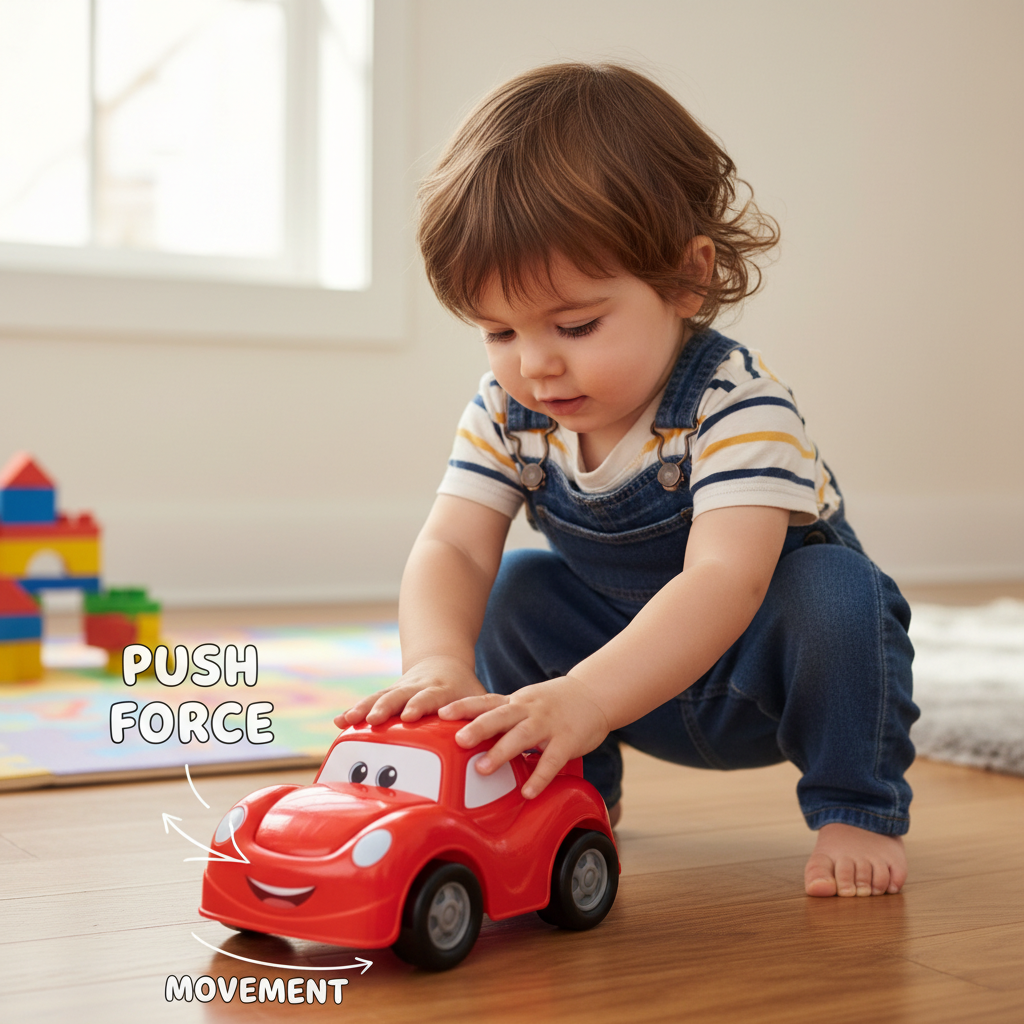 ⚠️ This picture may have spelling mistakes. Trust the words in the lesson.
Here, the child is using a push force to make the toy car move. You can see how a simple force creates motion!
Part 3: When Force Does "Work" (The Science Way!)
Now, let's talk about a special word: WORK. In everyday life, 'work' might mean doing chores or homework. But in science, 'work' has a very specific meaning.
Work is done when a force makes something move a distance.
Think about it this way:
- If you push your toy car and it rolls across the room, you did work. Why? Because you used a force (a push), and the car moved a distance.
- If you push a big, heavy wall as hard as you can, and the wall doesn't move even an inch, did you do work in science? No! You used a lot of force, and you might feel tired, but because the wall didn't move a distance, no scientific work was done. It's like trying to pull a giant mountain – you can pull and pull, but if it doesn't budge, no work is done.
So, for work to be done in science, two important things must happen:
- There must be a force acting on an object.
- The object must move a distance in the direction of the force.
Analogy: Imagine you are carrying a backpack to school. Your arms are using force to hold it up, but you are not doing work on the backpack just by holding it still. But when you walk from your house to school, your legs are doing work because they are using force to move your body (and the backpack with it) a distance! Also, when you lift the backpack from the floor to your back, you are doing work because you applied a force upwards and the backpack moved upwards.
This person is using a pull force on the wagon. Because the wagon is moving a distance, the person is doing work!
Part 4: Putting It All Together - Forces Make Our World Move!
Forces are constantly making things start, stop, speed up, slow down, or change direction. Without forces, everything would either stay perfectly still or keep moving forever in a straight line!
- When you kick a ball, your foot applies a force that makes the ball move.
- When the ball rolls into the grass, friction (another type of force that slows things down when surfaces rub together) makes it stop.
- When you ride your bike down a hill, gravity helps pull you faster.
- When you use your brakes, they apply a force to slow you down.
From tiny movements like blinking your eyes (muscles are applying force!) to huge movements like a rocket launching into space, forces are the silent workers making everything happen. And when those forces cause something to move a distance, we say 'work' has been done!
Isn't it amazing how a simple push or a pull can change the world around us? Keep observing the world, and you'll see forces and work everywhere you look!
Keep learning, free
Create a free Syllabax account to unlock practice questions and games for this topic.
Visual Learning Enhanced! 🚀
To help you master this topic, we use Advanced Syllabax AI to generate detailed diagrams and visual models.
Note on Visuals: The AI sometimes makes spelling errors in image labels. Please refer to the lesson text for the correct terminology.