Profit, loss & CP/SP relationships (Financial Mathematics)
Watch this topic in 60 seconds
Free preview · Lesson 1
Understanding Profit, loss & CP/SP relationships (Financial Mathematics)
Understanding Profit, Loss, and the Dance of Prices!
Welcome, future financial wizards! Have you ever wondered how businesses decide prices, or how a shop knows if it's making money? This is where Financial Mathematics comes in, and today, we're going to unlock the secrets of Profit, Loss, and the relationship between Cost Price and Selling Price. Don't worry, we'll break it down into simple terms with lots of everyday examples!
The Basics: Cost Price (CP) and Selling Price (SP)
Imagine you want to sell delicious homemade cookies. Before you can sell them, you first have to make them!
1. Cost Price (CP) - What You Spend
The Cost Price (CP) is simply the amount of money you spend to acquire or produce an item. Think of it as your initial investment or the money that leaves your pocket first.
- Analogy: If you're making those cookies, your CP would include the cost of flour, sugar, eggs, butter, electricity for the oven, and even the packaging. If you're a shop selling toys, the CP is the price you paid to your supplier for each toy.
- In simple terms: CP is the 'buy price' for you, the seller.
2. Selling Price (SP) - What You Earn
The Selling Price (SP) is the amount of money you receive when you sell an item to a customer. This is the money that comes back into your pocket.
- Analogy: For your cookies, the SP is the price tag you put on each cookie for your customers. For the toy shop, it's the price the customer pays for the toy at the counter.
- In simple terms: SP is the 'sell price' to your customer.
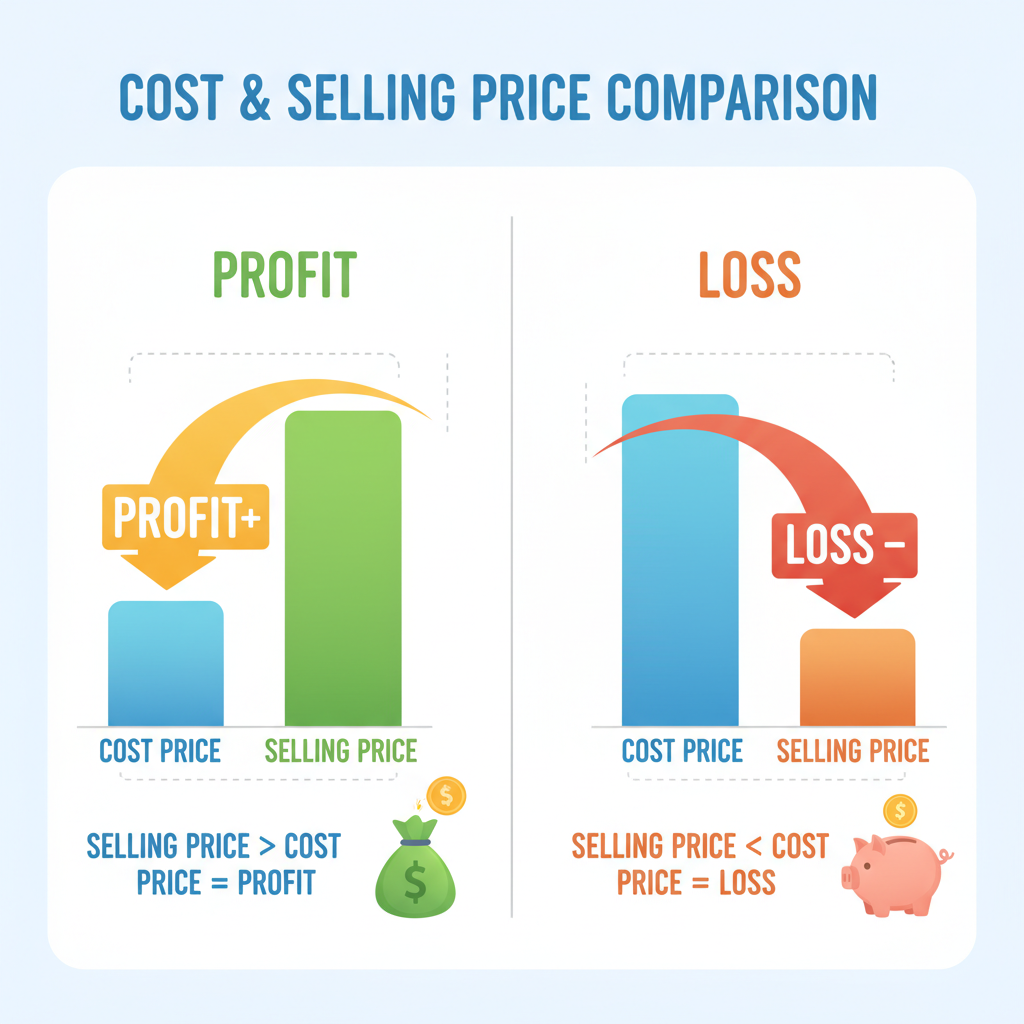
The entire world of profit and loss revolves around comparing these two values: CP and SP.
The Main Events: Profit, Loss, or Break-Even
Now that we know CP and SP, let's see what happens when we compare them.
1. Profit - The Happy Scenario!
You make a Profit when your Selling Price (SP) is greater than your Cost Price (CP). This means you sold something for more money than it cost you to get it. Hooray!
- Formula:
Profit = Selling Price (SP) - Cost Price (CP) - Analogy: You bought a cool comic book for
- Key indicator: SP > CP
2. Loss - The Sad Scenario!
You incur a Loss when your Cost Price (CP) is greater than your Selling Price (SP). This means you sold something for less money than it cost you to get it. Oh dear!
- Formula:
Loss = Cost Price (CP) - Selling Price (SP) - Analogy: You bought a new video game for
- Key indicator: CP > SP
3. No Profit, No Loss (Break-Even) - The Neutral Scenario!
Sometimes, you might sell an item for exactly the same price you bought or made it for. This is called No Profit, No Loss, or breaking even. Your Selling Price (SP) is equal to your Cost Price (CP).
- Formula:
SP = CP - Analogy: You bought a pack of fancy pens for
- Key indicator: SP = CP
Understanding Profit and Loss as Percentages
Just knowing the dollar amount of profit or loss is good, but sometimes we need to understand how big that profit or loss is relative to what we invested. That's where percentages come in!
Important Rule: Profit Percentage and Loss Percentage are ALWAYS calculated based on the Cost Price (CP). Why? Because CP represents your initial investment, and it helps you understand the return (or loss) on that investment.
1. Profit Percentage (%)
This tells you what percentage of your Cost Price you gained as profit.
- Formula:
Profit % = (Profit / Cost Price) × 100% - Analogy: You made a
2. Loss Percentage (%)
This tells you what percentage of your Cost Price you lost.
- Formula:
Loss % = (Loss / Cost Price) × 100% - Analogy: You lost
Let's Put It All Together with Examples!
Example 1: The Lemonade Stand
- You spend
- You sell all your lemonade for
- Is it a profit or a loss? Since SP (
- Profit = SP - CP =
- Profit % = (Profit / CP) * 100% = (
Example 2: The Old Bicycle
- You bought an old bicycle for
- It needed a lot of repairs, so you sold it quickly for
- Is it a profit or a loss? Since CP (
- Loss = CP - SP =
- Loss % = (Loss / CP) * 100% = (
Example 3: The Trading Card
- You bought a rare trading card for
- A few weeks later, you decided to sell it for
- Is it a profit or a loss? Since SP (
Understanding these basic concepts of CP, SP, Profit, Loss, and their percentages is the first step to becoming smart about money, whether you're managing your allowance, starting a small business, or just making wise purchasing decisions!
Keep learning, free
Create a free Syllabax account to unlock practice questions and games for this topic.
Visual Learning Enhanced! 🚀
To help you master this topic, we use Advanced Syllabax AI to generate detailed diagrams and visual models.
Note on Visuals: The AI sometimes makes spelling errors in image labels. Please refer to the lesson text for the correct terminology.