Identities used for simplification [Algebraic Identities (Intro)]
Watch this topic in 60 seconds
Free preview · Lesson 1
Understanding Identities used for simplification [Algebraic Identities (Intro)]
Algebraic Identities: Your Shortcut to Simplification!
Unlocking the Power of Pre-Made Math Formulas (Grade 7 Introduction)
Welcome, young mathematicians! Have you ever wished there was a faster, easier way to solve certain types of math problems? Well, today is your lucky day! We're about to dive into the exciting world of Algebraic Identities. Think of them as special cheat codes or super-efficient recipes that always work, no matter what numbers you put into them.
What Exactly is an Identity?
Before we jump into the identities themselves, let's clarify a few basic terms:
- Expression: A combination of numbers, variables, and operation signs (like
x + 5or3y - 2). It doesn't have an equals sign. - Equation: A statement that two expressions are equal (like
x + 5 = 10). An equation is only true for specific values of the variable(s). For example,x + 5 = 10is only true whenx = 5. - Identity: This is where it gets special! An identity is an equation that is true for ALL possible values of the variables involved. It's like a universal truth in algebra.
Analogy: Imagine you have a recipe for a cake. If the recipe says 'mix flour and eggs', that's like an expression. If it says 'mix flour and eggs until batter forms a thick consistency', that's like an equation, which is true only if you follow the steps correctly. An identity is like a fundamental chemical reaction – for example, 'Water is always H₂O'. No matter where you find water, its composition is always H₂O. Similarly, an algebraic identity holds true no matter what numbers you substitute for the variables!
Why Are Identities So Useful?
Identities are incredibly powerful tools for simplification. They allow us to transform complex-looking expressions into simpler ones, or to quickly expand expressions without doing lengthy multiplication. This saves time, reduces errors, and makes solving problems much more efficient.
Analogy: Think of identities as pre-built tools in a carpenter's toolbox. Instead of cutting and shaping wood every time they need a specific joint, they might have a jig or a pre-cut piece that fits perfectly. Identities are those pre-cut pieces – ready to be used to quickly fit parts of your math problems together!
Our First Three Foundational Identities (The Core Shortcuts!)
1. The Square of a Sum: (a + b)² = a² + 2ab + b²
Let's break this down. When we say (a + b)², it means (a + b) multiplied by itself, or (a + b) × (a + b).
How Does it Work? (The Proof)
If we expand (a + b)(a + b) using the distributive property (often called FOIL for First, Outer, Inner, Last):
- First:
a × a = a² - Outer:
a × b = ab - Inner:
b × a = ba(which is the same asab) - Last:
b × b = b²
Adding them all together: a² + ab + ab + b². Combining the like terms (ab + ab = 2ab), we get: a² + 2ab + b².
Analogy: The Big Square
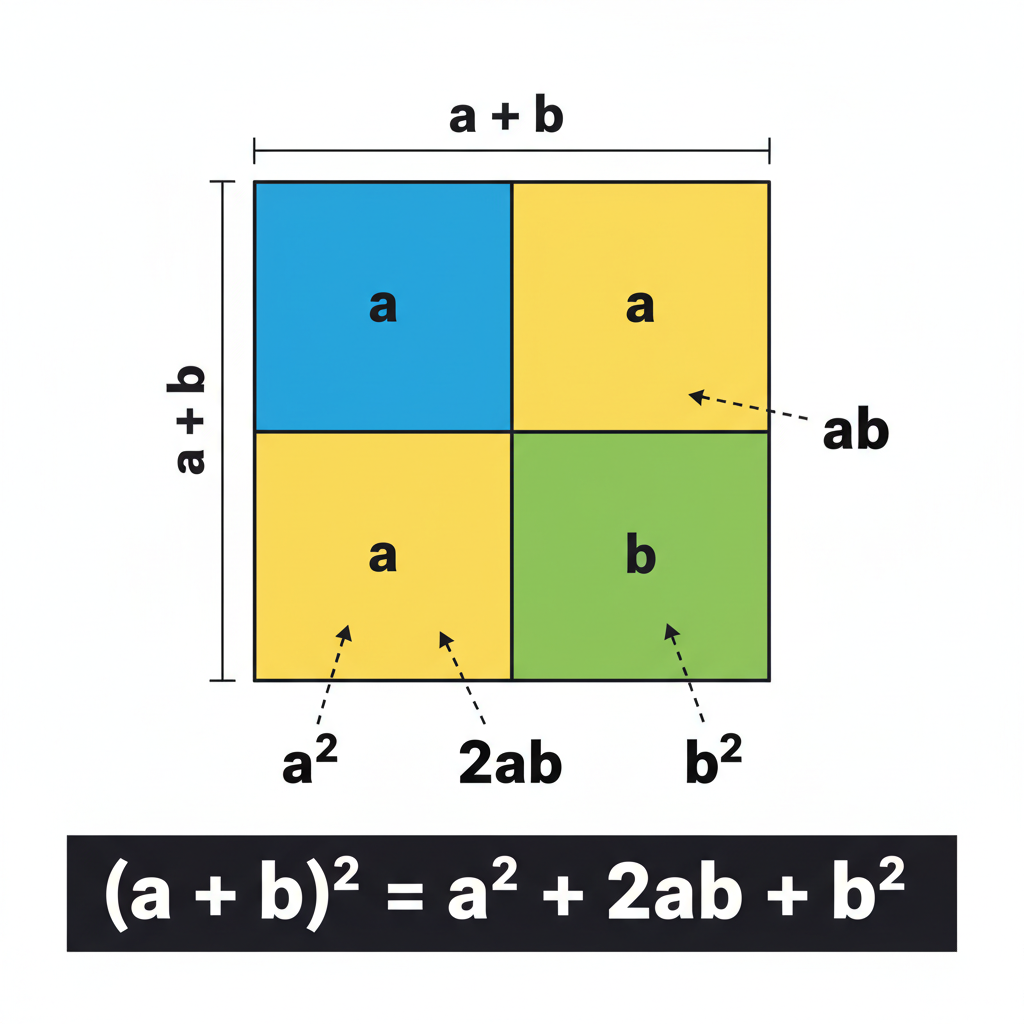
Imagine a large square whose side length is (a + b). The area of this square would be (a + b)². You can divide this big square into four smaller parts:
- A square with side
a(areaa²) - A square with side
b(areab²) - Two rectangles, each with sides
aandb(areaabfor each).
If you add up the areas of these four pieces, you get a² + ab + ab + b² = a² + 2ab + b². This visual proof shows why the identity always works!
Example Time!
Let's use the identity to calculate (x + 3)² quickly:
Here, a = x and b = 3. Using a² + 2ab + b²:
a² = x²2ab = 2 × x × 3 = 6xb² = 3² = 9
So, (x + 3)² = x² + 6x + 9. Much faster than multiplying everything out!
2. The Square of a Difference: (a - b)² = a² - 2ab + b²
This identity is very similar to the first one, but with a subtraction in the middle. It means (a - b) × (a - b).
How Does it Work? (The Proof)
Expanding (a - b)(a - b):
- First:
a × a = a² - Outer:
a × (-b) = -ab - Inner:
(-b) × a = -ba(which is-ab) - Last:
(-b) × (-b) = b²(remember, a negative times a negative is a positive!)
Adding them all together: a² - ab - ab + b². Combining like terms: a² - 2ab + b².
Analogy: Removing a Part
Imagine starting with a square of side a (area a²). Now, you want to cut out a strip of width b from two sides to create a smaller square of side (a-b). The identity shows you the remaining area. It's the original square a², minus two strips of area ab (one for each side), but then you added back the small square of area b² that was 'double-counted' as removed from the corner.
Example Time!
Let's expand (y - 5)² using the identity:
Here, a = y and b = 5. Using a² - 2ab + b²:
a² = y²-2ab = -2 × y × 5 = -10yb² = 5² = 25
So, (y - 5)² = y² - 10y + 25.
3. The Difference of Squares: (a + b)(a - b) = a² - b²
This is perhaps the coolest shortcut because it often helps simplify expressions very quickly!
How Does it Work? (The Proof)
Expanding (a + b)(a - b):
- First:
a × a = a² - Outer:
a × (-b) = -ab - Inner:
b × a = ab - Last:
b × (-b) = -b²
Adding them all together: a² - ab + ab - b². Notice anything special? The -ab and +ab terms cancel each other out!
This leaves us with a beautifully simple: a² - b².
Analogy: The Rearranged Rectangle
Imagine a large square with side a (area a²). Now, imagine you cut out a smaller square of side b from one corner (area b²). You're left with an L-shaped region whose area is a² - b².
Now, here's the magic: If you cut that L-shaped region in a clever way (cutting off one of the rectangles of dimension a by b), you can rearrange the pieces to form a large rectangle with sides (a + b) and (a - b)! The area of this new rectangle is (a + b)(a - b). Since you just rearranged the pieces, the area must be the same: a² - b² = (a + b)(a - b).
Example Time!
Let's simplify (x + 7)(x - 7) using the identity:
Here, a = x and b = 7. Using a² - b²:
a² = x²b² = 7² = 49
So, (x + 7)(x - 7) = x² - 49. That was super quick!
Another example: Calculate 105 × 95 without a calculator.
Notice that 105 is (100 + 5) and 95 is (100 - 5). This fits the (a + b)(a - b) pattern!
Here, a = 100 and b = 5.
So, 105 × 95 = (100 + 5)(100 - 5) = 100² - 5²
100² = 10,0005² = 25
Therefore, 10,000 - 25 = 9,975. Easy peasy!
Putting it All Together
Algebraic identities are not just fancy equations; they are fundamental tools that simplify your journey through algebra. By understanding and memorizing these three basic identities, you're equipping yourself with powerful shortcuts that will make expanding, simplifying, and even solving more complex problems much easier in the future.
Remember, practice makes perfect! The more you use these identities, the more natural they will become. Keep an eye out for patterns in algebraic expressions – sometimes, what looks like a complicated problem is just waiting for you to apply one of these identity 'cheat codes'!
Keep learning, free
Create a free Syllabax account to unlock practice questions and games for this topic.
Visual Learning Enhanced! 🚀
To help you master this topic, we use Advanced Syllabax AI to generate detailed diagrams and visual models.
Note on Visuals: The AI sometimes makes spelling errors in image labels. Please refer to the lesson text for the correct terminology.