Division as repeated subtraction (Division)
Watch this topic in 60 seconds
Free preview · Lesson 1
Understanding Division as repeated subtraction (Division)
Understanding Division as Repeated Subtraction (Grade 3)
Hello young mathematicians! Today, we're going on an exciting adventure to explore a super helpful math concept called division. But we're not just going to learn any kind of division; we're going to learn about division as repeated subtraction. Sounds fancy, right? But don't worry, it's like a fun game we already know how to play!
What is Division Anyway?
Imagine you have a big bag of yummy candies, and you want to share them equally with your friends. Division is a way to figure out how many groups you can make, or how many candies each friend gets. It's all about sharing fairly!
Repeated Subtraction: The Building Blocks of Division
Before we dive into division, let's talk about subtraction. Remember subtraction? It's when you take away some items from a group. For example, if you have 5 cookies and you eat 2, you have 5 - 2 = 3 cookies left. You took away 2 cookies.
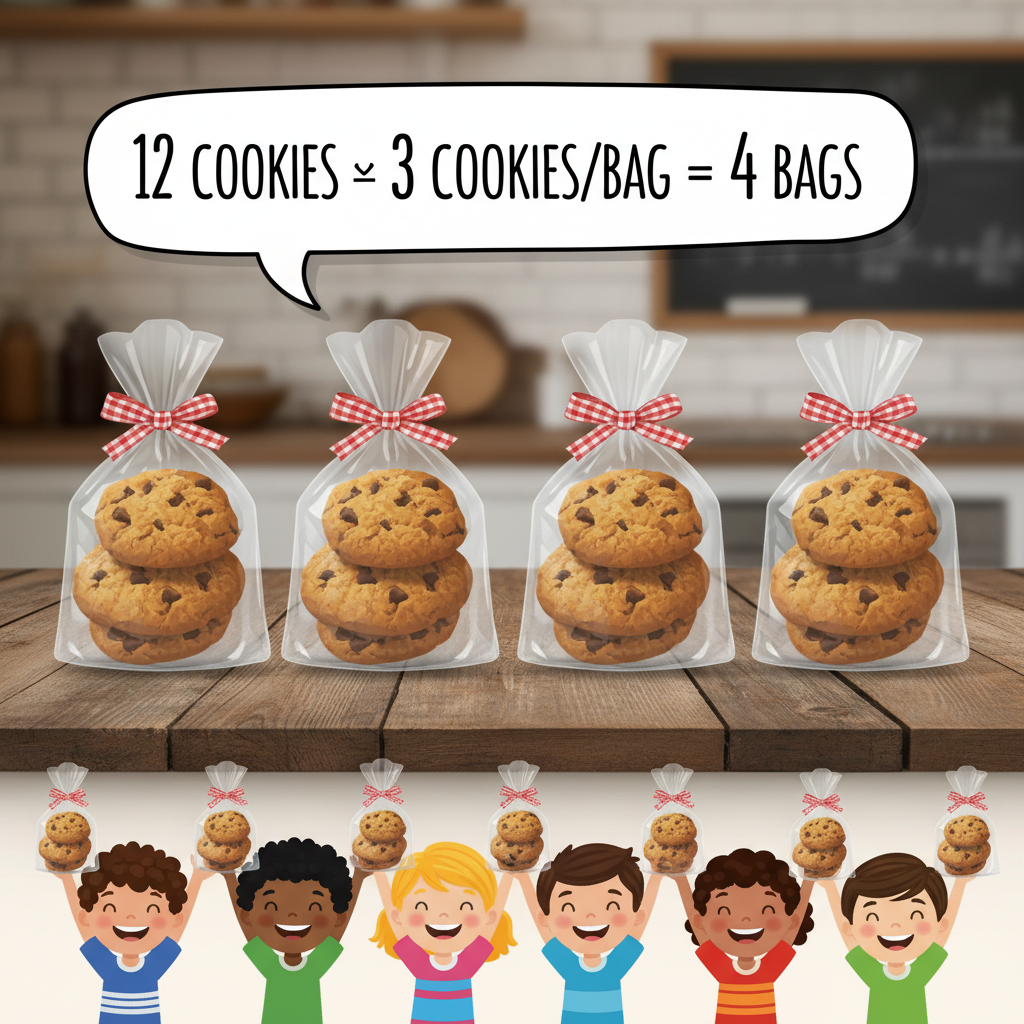
Now, imagine you have a large number of cookies, say 12, and you want to put them into bags, with each bag holding exactly 3 cookies. How many bags will you need?
You can figure this out by repeatedly subtracting 3 from 12 until you reach 0. Each time you subtract 3, it's like filling one bag!
- Start with 12 cookies.
- Take away 3 cookies for the first bag: 12 - 3 = 9 cookies left.
- Take away 3 more cookies for the second bag: 9 - 3 = 6 cookies left.
- Take away 3 more cookies for the third bag: 6 - 3 = 3 cookies left.
- Take away 3 more cookies for the fourth bag: 3 - 3 = 0 cookies left.
We subtracted 3 a total of 4 times! So, you need 4 bags. This process of taking away the same number over and over again is called repeated subtraction.
Connecting Repeated Subtraction to Division
Division is like a shortcut for repeated subtraction! When we see a division problem like 12 ÷ 3, it's asking us the same question: 'How many times can we subtract 3 from 12 until we get to 0?'
So, 12 ÷ 3 = 4 because we subtracted 3 from 12 exactly 4 times.
Let's Try Another Analogy!
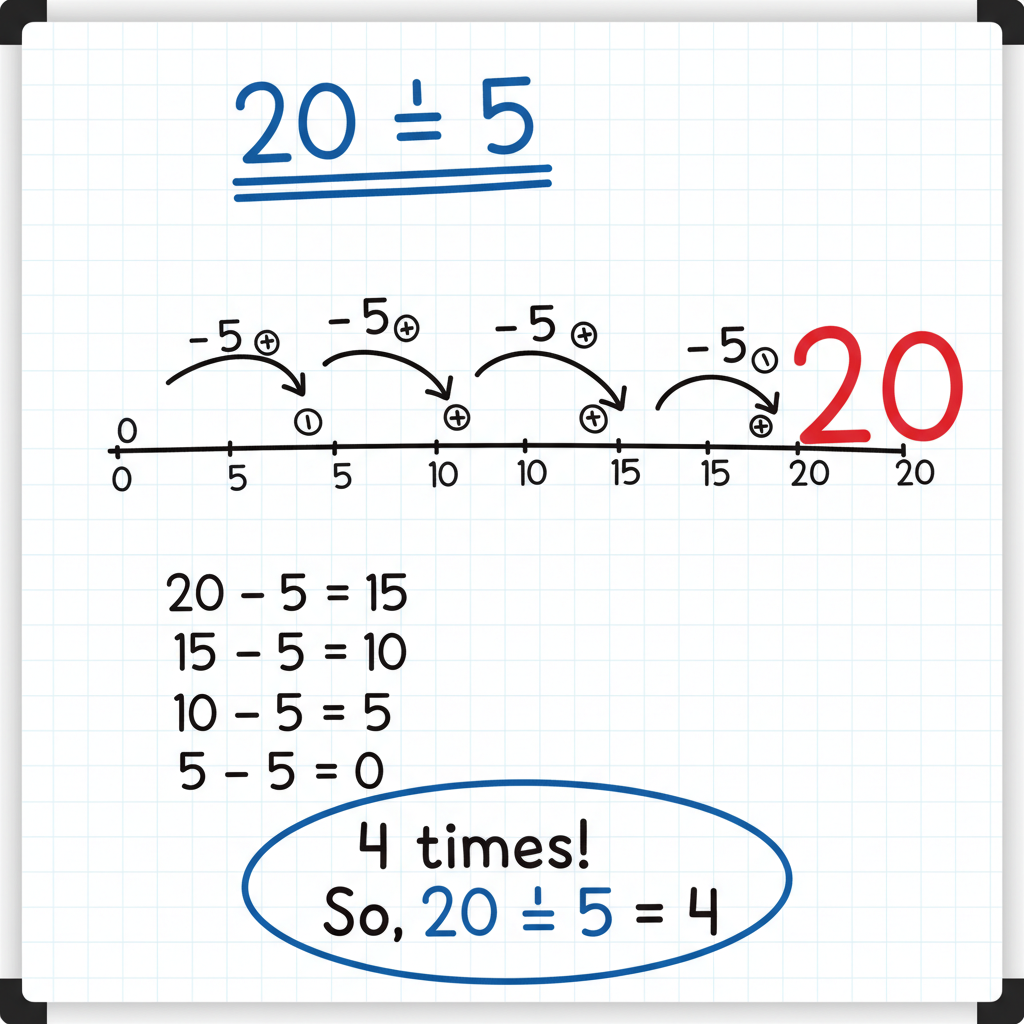
Imagine you have 20 toy cars, and you want to arrange them in rows on a shelf, with 5 cars in each row. How many rows can you make?
Using repeated subtraction:
- Start with 20 cars.
- Row 1: 20 - 5 = 15 cars left.
- Row 2: 15 - 5 = 10 cars left.
- Row 3: 10 - 5 = 5 cars left.
- Row 4: 5 - 5 = 0 cars left.
We subtracted 5 a total of 4 times. So, you can make 4 rows.
In division terms, this means 20 ÷ 5 = 4.
Key Terms in Division
Division has some special words:
- Dividend: The total number you start with (the number being divided). In our cookie example, the dividend was 12. In the car example, it was 20.
- Divisor: The number you are dividing by, or the size of each group. In the cookie example, the divisor was 3. In the car example, it was 5.
- Quotient: The answer to a division problem; it tells you how many groups you made or how many are in each group. In the cookie example, the quotient was 4. In the car example, it was also 4.
So, when we do Dividend ÷ Divisor = Quotient, we are essentially asking: 'How many times can we subtract the Divisor from the Dividend to reach 0?' The number of times we subtract is the Quotient.
 ⚠️ This picture may have spelling mistakes. Trust the words in the lesson.
Let's Practice!
Think of division problems as a game of 'take away'! The number you're dividing by is the number you keep taking away. The answer tells you how many times you could take it away.
Example: 9 ÷ 3
- Start with 9.
- Take away 3: 9 - 3 = 6 (1st time)
- Take away 3: 6 - 3 = 3 (2nd time)
- Take away 3: 3 - 3 = 0 (3rd time)
We subtracted 3 three times. So, 9 ÷ 3 = 3.
Remember, repeated subtraction is a foundational way to understand what division means. It's all about grouping and fair sharing!
Keep learning, free
Create a free Syllabax account to unlock practice questions and games for this topic.
Visual Learning Enhanced! 🚀
To help you master this topic, we use Advanced Syllabax AI to generate detailed diagrams and visual models.
Note on Visuals: The AI sometimes makes spelling errors in image labels. Please refer to the lesson text for the correct terminology.