Main Idea & Supporting Details
Watch this topic in 60 seconds
Free preview · Lesson 1
Main Idea & Supporting Details (Foundational)
Main Idea & Supporting Details
Hi there, young scientists! Today, we're going to become super detectives of reading. We'll learn how to find the main idea and the supporting details in a story or paragraph. Think of it like this: every story has a big idea, and then smaller ideas that tell us more about it.
What is the Main Idea?
The main idea is what the story is mostly about. It's the big point the author wants you to understand. It's like the title of a book – it gives you a hint about what you're going to read.
- Main Idea: What the story or paragraph is all about.
- Hint: Look for it at the beginning or end of the paragraph.
 What are Supporting Details?
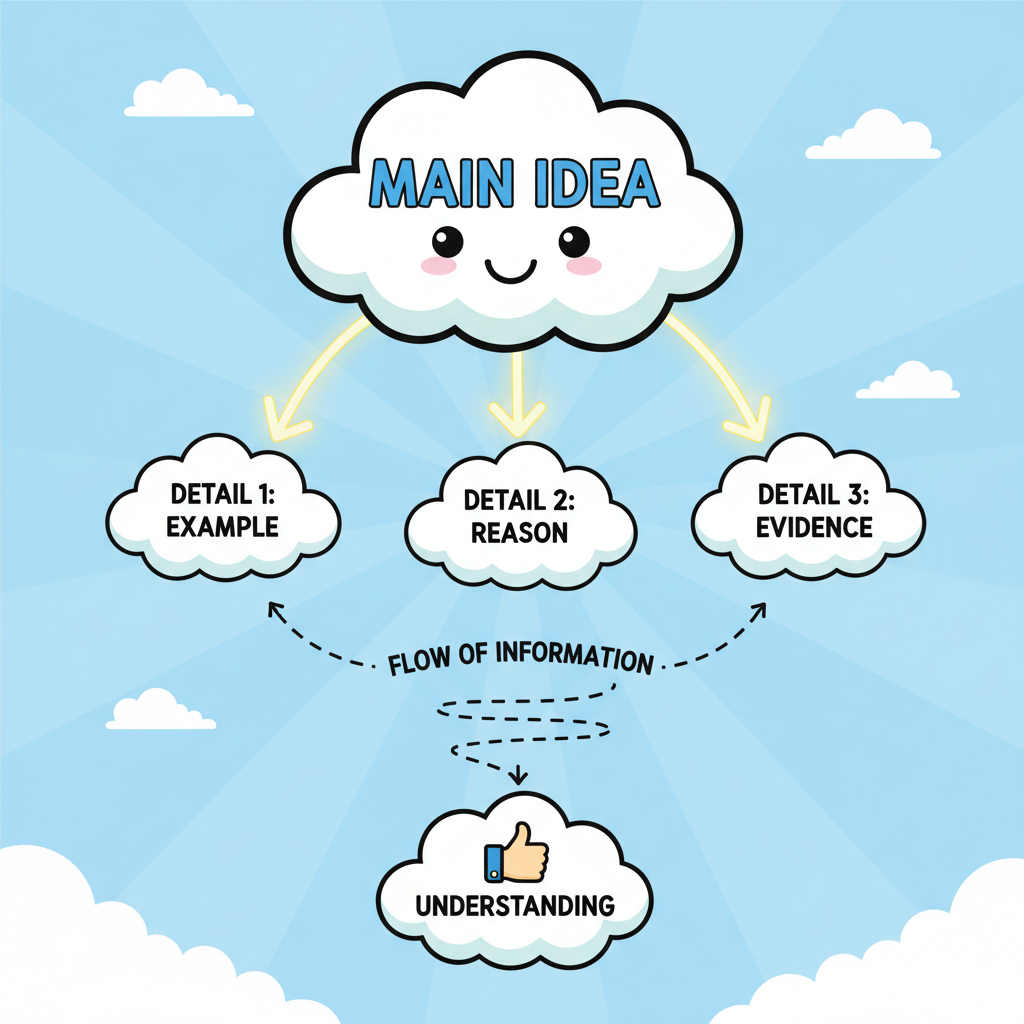
Supporting details are like the clues that help you understand the main idea better. They give you more information, facts, and examples. They tell you *why* the main idea is true or important.
- Supporting Details: Information that tells more about the main idea.
- Examples: Facts, descriptions, reasons, and examples.
 Let's Practice!
Here's a short paragraph. Let's see if we can find the main idea and supporting details:
Dogs make great pets. They are loyal and friendly. They love to play fetch and go for walks. Dogs also protect your house and keep you company.
- Main Idea: Dogs make great pets.
- Supporting Details: They are loyal, friendly, love to play, protect your house, and keep you company.
See? It's like putting together a puzzle. The main idea is the big picture, and the supporting details are the pieces that help you see the whole thing!
Keep learning, free
Create a free Syllabax account to unlock practice questions and games for this topic.
Visual Learning Enhanced! 🚀
To help you master this topic, we use Advanced Syllabax AI to generate detailed diagrams and visual models.
Note on Visuals: The AI sometimes makes spelling errors in image labels. Please refer to the lesson text for the correct terminology.