Conductors and insulators (PHYSICS)
Watch this topic in 60 seconds
Free preview · Lesson 1
Understanding Conductors and insulators (PHYSICS)
Conductors and Insulators: The Flow of Electricity!
Welcome, young scientists, to an exciting journey into the world of electricity! Have you ever wondered how a light bulb turns on, or how your toys light up and make sounds? It all has to do with something called electricity, and how it travels. Today, we're going to learn about two important types of materials that control this flow: conductors and insulators.
What is Electricity?
Imagine tiny, tiny particles called electrons. These electrons are like little runners that can move around. When these electrons start moving together in a path, that's electricity! Think of it like a river of tiny runners flowing.
To make electricity flow, we need a complete path, like a road for our runners. This path is usually made of wires. But not all wires are the same, and not all materials let electricity flow easily.
Conductors: The Easy Passages
Some materials are like superhighways for our electron runners. They let electricity zip through them very easily and quickly. These materials are called conductors.
Analogy: The Water Pipe
Think of a conductor like a wide, smooth water pipe. Water (electricity) can flow through it without much resistance. The electrons (water) can move freely.
What kind of materials are good conductors?
- Metals: Most metals are excellent conductors! Think of copper (like in the wires inside your walls), aluminum (like in some cooking pans), and gold and silver (which are super conductors but a bit too expensive for everyday wires!).
- Water (especially with impurities): Believe it or not, water can conduct electricity, but only if it has things like salt dissolved in it. Pure water is actually a pretty good insulator!
Why are metals good conductors? Inside metals, some of the electrons are not tightly held by their atoms. They are like free-range chickens, ready to move and carry the electrical signal when needed. When you connect a metal wire to a battery or a power source, these free electrons start moving in the same direction, creating an electric current.
Insulators: The Roadblocks
On the other hand, some materials are like roadblocks for our electron runners. They make it very difficult for electricity to pass through them. These materials are called insulators.
Analogy: The Sponge
Think of an insulator like a sponge. If you try to push water through a sponge, it soaks it up and doesn't let it flow easily. The electrons (water) get stuck.
What kind of materials are good insulators?
- Rubber: This is why electrical wires usually have a rubber or plastic coating. The rubber stops the electricity from escaping the wire and shocking you!
- Plastic: Similar to rubber, plastic is a great insulator. Think of the plastic around your phone charger cord.
- Glass: Glass does not let electricity flow through it easily.
- Wood (dry): Dry wood is a good insulator, but wet wood can conduct electricity because of the water in it.
- Air: The air around us is a very good insulator! That's why we can have power lines high up in the sky without everything around them getting shocked.
Why are insulators good at stopping electricity? In insulating materials, the electrons are held very tightly by their atoms. They are like chickens in a coop, unable to move freely. Even when you try to push electricity, these electrons stay put.
Why Do We Need Both?
Conductors and insulators work together like a team to make electricity safe and useful!
Think about an electrical cord for a lamp. The metal wires inside are the conductors. They allow the electricity to travel from the wall socket to the light bulb. But, the rubber or plastic coating around those wires is the insulator. This coating is super important because it prevents the electricity from leaking out and causing a fire or shocking someone who touches the cord.
It’s like having a race track (the conductor) with strong fences all around it (the insulators). The cars (electrons) can race on the track, but the fences keep them safely contained.
A Visual Example: A Simple Circuit
Let's imagine a simple circuit: a battery, a light bulb, and some wires connecting them.
The wires are made of a conductor (like copper) so that electricity can flow from the battery to the bulb. The battery provides the 'push' for the electrons. The light bulb has a thin wire inside made of a special conductor that heats up and glows when electricity passes through it.
If we wanted to be extra safe, we might put the whole thing inside a plastic box. The plastic box would be an insulator, protecting us from touching any of the electrical parts.
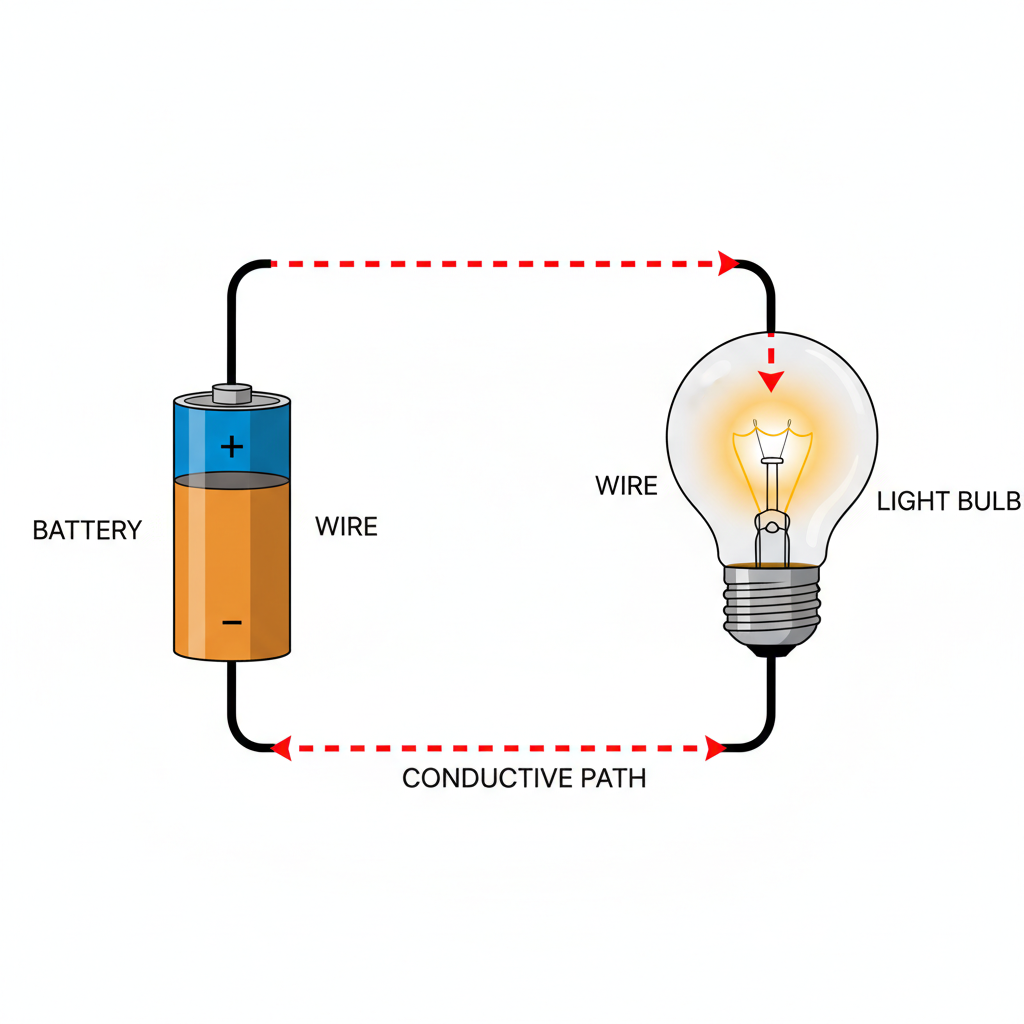
In the diagram above, the metal wires are the pathways for electricity (the conductors). The plastic or rubber coating that we don't always see in simple diagrams acts as the insulator, keeping the electricity on the path.
How Do We Test for Conductors and Insulators?
Scientists and engineers use a special tool called a multimeter, or sometimes build simple circuits with a battery, a light bulb, and the material they want to test.
If you connect the material into the circuit and the light bulb lights up, it means electricity flowed through it – so it's a conductor! If the light bulb stays off, it means the material blocked the electricity – so it's an insulator.
Analogy: The Gatekeeper
Think of a gatekeeper at a castle. A conductor is like a gatekeeper who happily lets everyone pass through the gate. An insulator is like a gatekeeper who firmly blocks everyone from entering or leaving.
Safety First!
It's really important to remember that electricity can be dangerous. Always be careful around electrical outlets and appliances. Never touch exposed wires. It's the insulators, like the rubber on cords, that keep us safe from the conductors!

Look around your home and identify things that are made of metal (conductors) and things made of plastic or rubber (insulators). Can you guess why they are made of those materials?
Summary: Conductors vs. Insulators
- Conductors: Materials that allow electricity (electrons) to flow through them easily. Examples: Metals like copper, silver, aluminum.
- Insulators: Materials that resist the flow of electricity. Examples: Rubber, plastic, glass, dry wood, air.
- Both are essential for using electricity safely and effectively.
Keep learning, free
Create a free Syllabax account to unlock practice questions and games for this topic.
Visual Learning Enhanced! 🚀
To help you master this topic, we use Advanced Syllabax AI to generate detailed diagrams and visual models.
Note on Visuals: The AI sometimes makes spelling errors in image labels. Please refer to the lesson text for the correct terminology.