Addition/subtraction of money [Money]
Watch this topic in 60 seconds
Free preview · Lesson 1
Understanding Addition/subtraction of money [Money]
Counting Your Coins and Bills: Addition and Subtraction of Money (Grade 5 - Foundational)
Welcome to the exciting world of money! Just like you can add and subtract toys or cookies, you can also add and subtract money. It's like a superpower that helps you understand how much you have and how much you spend. Let's dive in and become money masters!
What is Money?
Imagine you want to trade your amazing drawing for a yummy ice cream. The person selling the ice cream might not want your drawing. They want something valuable that everyone agrees on. That's where money comes in! Money is like a special tool that we use to buy and sell things. It's much easier than trading your toys for groceries!
In many countries, money comes in two main forms: coins and bills (or banknotes). Coins are usually made of metal and are smaller, like pennies, nickels, dimes, and quarters. Bills are made of paper or a special plastic and have bigger values, like one-dollar bills, five-dollar bills, and so on.
Think of coins and bills as building blocks. Each coin and bill has a specific value, meaning how much it's worth. For example, a quarter is worth more than a dime, and a ten-dollar bill is worth much more than a one-dollar bill.
Addition with Money: When Your Money Grows!
Addition is all about putting things together to find a total. When we add money, it means we are getting more money! This happens when you receive your allowance, get money for your birthday, or sell something you made.
Analogy: Building a Tower of Blocks!
Imagine you have a tower of 5 blocks. Your friend gives you 3 more blocks. How many blocks do you have now? You put them all together, right? That's addition! You have 5 + 3 = 8 blocks.
Money works the same way. If you have
How to Add Money:
When adding money, we usually write it with a dollar sign (
Example 1: Allowance Time!
Sarah receives an allowance of
We need to add the allowance and the gift money:
Sarah has $8.00.
Example 2: Saving for a Toy!
Tom has
We need to add his savings and his earnings:
To add money, we line up the decimal points, just like stacking your blocks perfectly straight:
  $12.75
+  $4.50
-------
Now, add column by column, starting from the right:
- 5 + 0 = 5
- 7 + 5 = 12. Write down the 2 and carry over the 1.
- 1 (carried over) + 2 + 4 = 7
- 1 + 0 = 1
Don't forget to put the decimal point in the answer, directly below the other decimal points!
  $12.75
+  $4.50
-------
  $17.25
Tom now has $17.25.
 ⚠️ This picture may have spelling mistakes. Trust the words in the lesson.
Subtraction with Money: When Your Money Shrinks!
Subtraction is the opposite of addition. It's about taking away or finding the difference. When we subtract money, it means we are spending money or giving it away. This happens when you buy something, pay for a service, or lend money to a friend.
Analogy: Eating Cookies from a Jar!
Imagine you have a jar with 10 cookies. You eat 4 of them. How many cookies are left? You took some away, right? That's subtraction! You have 10 - 4 = 6 cookies left.
Money works the same way. If you have
How to Subtract Money:
Subtracting money is very similar to adding money. We line up the decimal points and subtract column by column, starting from the right. Sometimes, we need to 'borrow' from the next column, just like when you need an extra cookie from the jar!
Example 3: Buying a Treat!
Maria has
We need to subtract the cost of the ice cream from the money Maria has:
Line up the decimal points:
  $20.00
-  $3.50
-------
Let's subtract:
- 0 - 0 = 0
- 0 - 5: We can't take 5 from 0, so we need to borrow. Go to the next column (the dollars column). The 0 can't lend, so we go to the next 2. The 2 becomes a 1, and the next 0 becomes 10. Now, this 10 can lend to the right, becoming a 9, and the original 0 becomes 10.
- So, we have 10 - 5 = 5.
- Now, in the dollars column, we have 9 - 3 = 6.
- And in the tens of dollars column, we have 1 - 0 = 1.
Remember the decimal point!
  $20.00
-  $3.50
-------
  $16.50
Maria will have $16.50 left.
Example 4: Finding the Difference!
David has
To find the difference, we subtract the smaller amount from the larger amount:
  $50.00
- $38.25
-------
Again, we need to borrow to subtract:
- 0 - 5: Borrow. Go to the 0, then the 0, then the 5. The 5 becomes a 4, the first 0 becomes 10, then 9, and the last 0 becomes 10.
- 10 - 5 = 5
- 9 - 2 = 7
- 9 - 8 = 1
- 4 - 3 = 1
  $50.00
- $38.25
-------
  $11.75
David has $11.75 more than Emily.
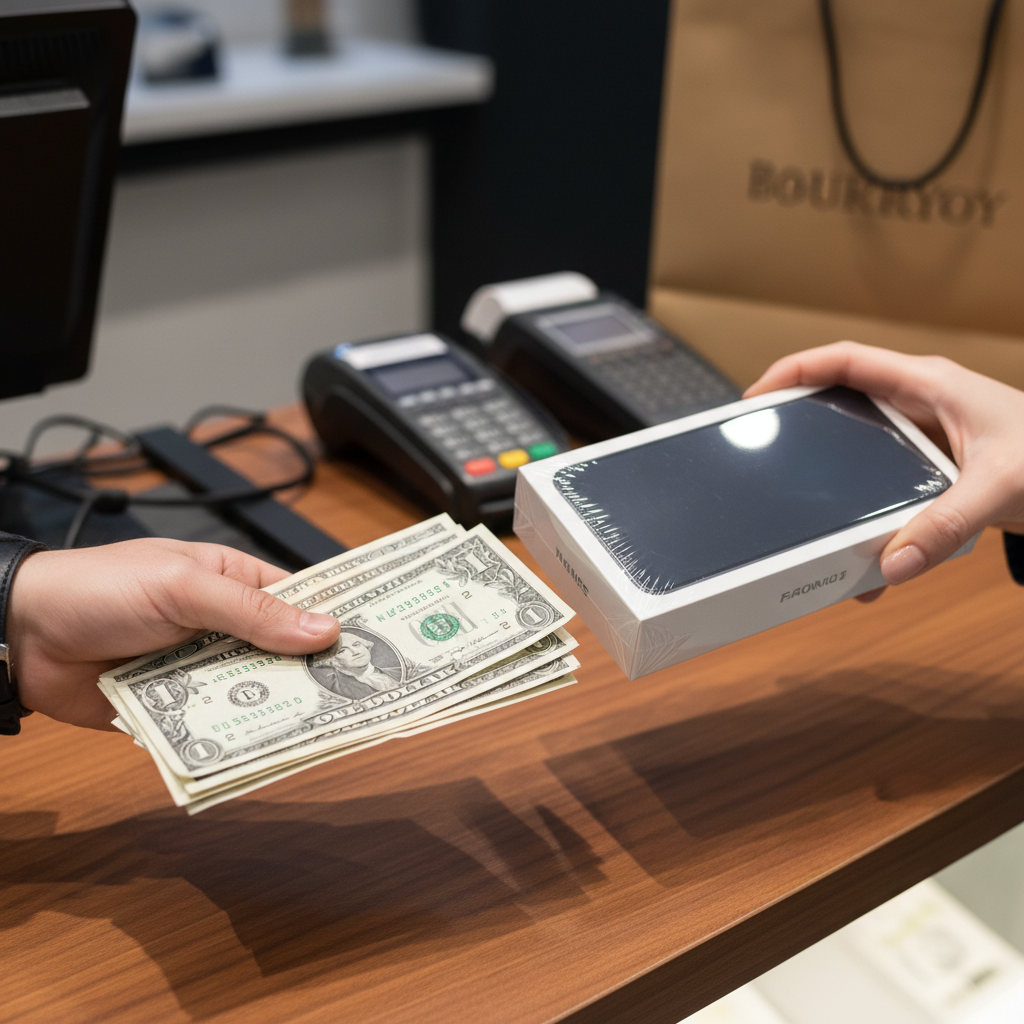 ⚠️ This picture may have spelling mistakes. Trust the words in the lesson.
Putting it all Together: Word Problems
Word problems are like little stories that ask you to use your math skills. For money word problems, you need to figure out if you need to add or subtract.
Analogy: A Treasure Hunt!
Imagine you're on a treasure hunt. One clue tells you to 'add 5 gold coins' and another clue tells you to 'take away 3 gold coins'. You have to decide which action to do first to find the treasure!
How to Solve Money Word Problems:
- Read carefully: Understand the story. What is happening?
- Find the numbers: Identify the amounts of money involved.
- Look for keywords: Words like 'total', 'altogether', 'how much more', 'left', 'spent', 'saved', 'difference' can tell you whether to add or subtract.
- Set up the problem: Write down the addition or subtraction problem.
- Solve: Calculate the answer, remembering to use the dollar sign and decimal point.
Example 5: A Shopping Trip!
Leo went to the store with
First, find out how much Leo spent in total. This means we need to add the cost of the comic book and the stickers:
  $4.99
+ $2.50
-------
  $7.49
Leo spent $7.49 in total.
Now, we need to find out how much money he has left. This means we need to subtract the amount he spent from the amount he started with:
  $25.00
-  $7.49
-------
  $17.51
Leo has $17.51 left.
You've done a fantastic job learning about adding and subtracting money! Keep practicing, and you'll be a money expert in no time!
Keep learning, free
Create a free Syllabax account to unlock practice questions and games for this topic.
Visual Learning Enhanced! 🚀
To help you master this topic, we use Advanced Syllabax AI to generate detailed diagrams and visual models.
Note on Visuals: The AI sometimes makes spelling errors in image labels. Please refer to the lesson text for the correct terminology.