Perpendicular bisectors (Construction Basics)
Watch this topic in 60 seconds
Free preview · Lesson 1
Understanding Perpendicular bisectors (Construction Basics)
Understanding Perpendicular Bisectors: Cutting Lines Just Right!
Hey there, future geometry wizards! Today, we're going to unlock a cool secret about lines and shapes called "perpendicular bisectors." It might sound like a mouthful, but don't worry, we'll break it down into simple, easy-to-understand pieces. Think of it like learning how to perfectly slice a sandwich or cut a piece of string exactly in half!
What is a Line Segment?
Before we dive into the main event, let's quickly remember what a line segment is. Imagine you have a long, straight line that goes on forever in both directions. A line segment is just a small, specific part of that line, with a clear starting point and a clear ending point. Think of it like drawing a line with your pencil from point A to point B on a piece of paper. It has a definite length.
Part 1: What Does 'Bisect' Mean? (The 'Half' Part)
The word "bisect" might sound a bit fancy, but it just means to cut something into two equal parts. That's it! If you bisect something, you're making two pieces that are exactly the same size.
- Analogy 1: Imagine you have a delicious candy bar. If you "bisect" it, you're cutting it right down the middle so you and a friend each get an equal, fair share. No arguments about who got more!
- Analogy 2: Think about folding a piece of paper exactly in half. The crease you make "bisects" the paper, dividing it into two identical sections.
So, when we talk about "bisecting a line segment," we mean finding its exact middle point and cutting it there, so you end up with two smaller line segments that are the exact same length.
Part 2: What Does 'Perpendicular' Mean? (The 'Right Angle' Part)
Now let's add another important idea: "perpendicular." When two lines are perpendicular, it means they cross or meet each other at a very specific angle – a perfect 90-degree angle. We call this a "right angle."
- Analogy 1: Look at the corner of your room where two walls meet, or where a wall meets the floor. That's a perfect 90-degree angle, and those surfaces are perpendicular to each other.
- Analogy 2: Think about the shape of a capital "L" or a plus sign (+). The lines forming these shapes are perpendicular! If you draw a straight line horizontally and another straight line vertically that crosses it, they are perpendicular.
A 90-degree angle looks like a perfect square corner. It's not pointy and sharp (that's acute), and it's not wide open (that's obtuse). It's just right!
Putting It All Together: The Perpendicular Bisector!
Okay, now for the grand finale! A perpendicular bisector is a very special line that does *two* important jobs at once for a line segment:
- It bisects the segment (cuts it into two equal halves).
- It is perpendicular to the segment (crosses it at a perfect 90-degree angle).
So, imagine that candy bar again. A perpendicular bisector wouldn't just cut it in half, but it would also make sure that the cut was perfectly straight across, forming a perfect 'L' shape with the candy bar's edges if you could somehow see it in 3D!
Analogy: The Perfectly Balanced Seesaw
Imagine you have a long seesaw (that's your line segment). You want to put a strong support beam (that's our perpendicular bisector) under it so that two people of the same weight can sit on each end and it will be perfectly balanced. To do this, you need to:
- Find the exact middle of the seesaw (that's the "bisect" part).
- Place the support beam perfectly straight up and down, making a 90-degree angle with the seesaw so it doesn't tip over (that's the "perpendicular" part).
That support beam, perfectly in the middle and perfectly straight, is like a perpendicular bisector!
Why Are Perpendicular Bisectors Important?
You might be thinking, "Why do I need to know this?" Well, perpendicular bisectors are super useful in geometry and in the real world! They help us:
- Find the exact center of things.
- Create symmetrical designs (designs that are the same on both sides).
- Solve problems about distances and shapes.
Basic Idea of Construction (How We Make One)
While actually drawing a perpendicular bisector with tools like a compass and straightedge involves specific steps, the basic idea is quite simple. If you wanted to *create* a perpendicular bisector for a line segment, you would:
- Find the Middle: Locate the exact center point of your line segment. This is where the "bisecting" happens.
- Draw the Right Angle: From that exact middle point, draw a new line that crosses the first segment, making sure it forms a perfect 90-degree angle.
It’s like setting up a flagpole exactly in the middle of a soccer field, standing perfectly straight up!
A Special Property: Equidistant Points
Here’s a really cool secret about perpendicular bisectors: Any point that lies on the perpendicular bisector is the exact same distance from both endpoints of the original line segment.
- Analogy: Imagine two treasure chests buried at points A and B. If you walk along the perpendicular bisector of the line connecting A and B, no matter where you stop on that line, you will always be the same distance from treasure chest A as you are from treasure chest B! It's like a magical path where you're always fair to both sides.
Take a look at this diagram to visualize a perpendicular bisector:
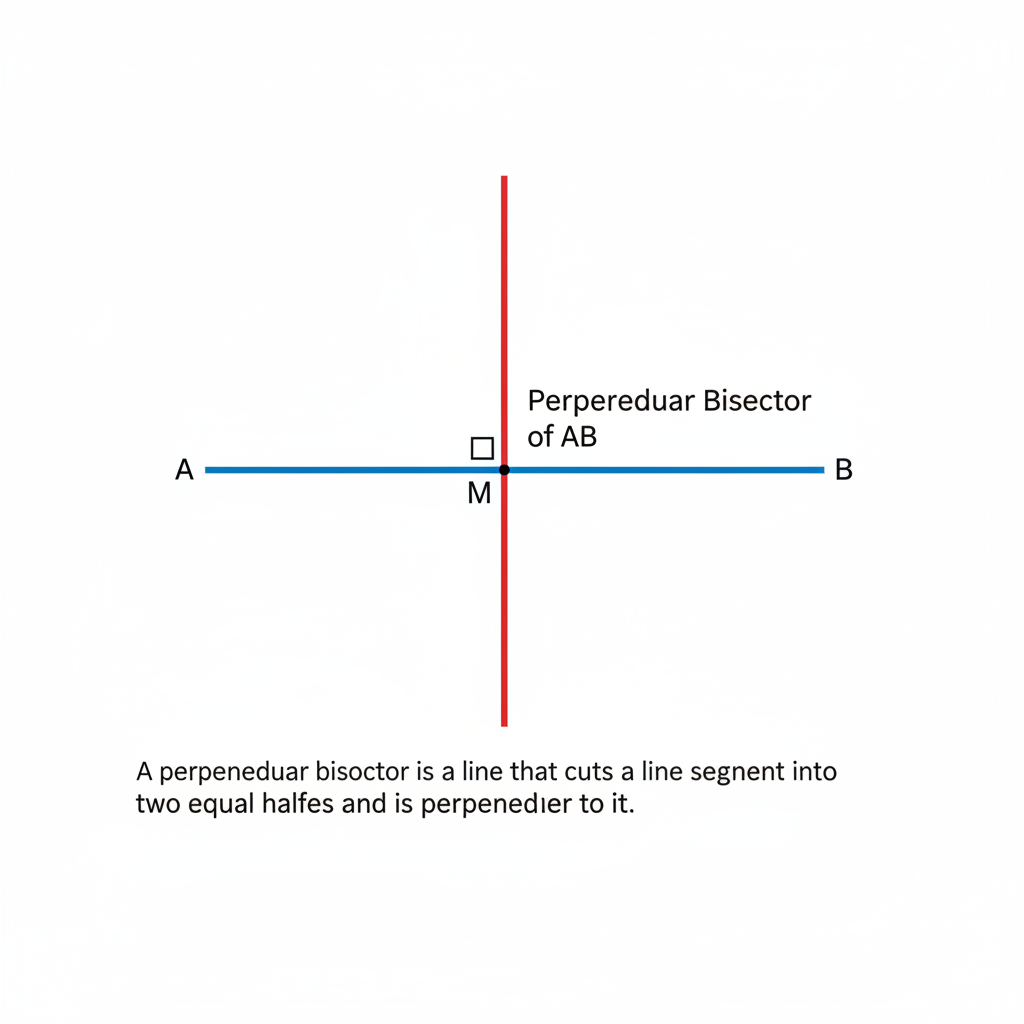 ⚠️ This picture may have spelling mistakes. Trust the words in the lesson.
Wrapping Up
So, a perpendicular bisector is a powerful geometric tool that helps us cut line segments perfectly in half and at a perfect right angle. Remember its two main jobs: cutting equally and meeting at 90 degrees! Understanding this basic concept is a fantastic step in becoming a geometry pro!
Keep learning, free
Create a free Syllabax account to unlock practice questions and games for this topic.
Visual Learning Enhanced! 🚀
To help you master this topic, we use Advanced Syllabax AI to generate detailed diagrams and visual models.
Note on Visuals: The AI sometimes makes spelling errors in image labels. Please refer to the lesson text for the correct terminology.