Learning Journey
Watch this topic in 60 seconds
Free preview · Lesson 1
Understanding Types of movement: rolling, sliding (Movement)
Let's Get Moving! Rolling and Sliding Adventures!
Hello, young explorers! Have you ever watched a toy car zip across the floor or seen a ball bounce and roll away? Everything around us is always moving in some way! Today, we're going to become movement detectives and discover two super fun ways things can move: rolling and sliding.
What is Movement?
Before we dive into rolling and sliding, let's think about movement. Movement is just a fancy word for when something changes its place. If a toy is here, and then it's over there, it has moved! Like when you walk from your bedroom to the kitchen, you are moving!
1. Rolling: The Spinning Journey!
Imagine you have a big, round ball. What happens if you push it? It spins and spins, tumbling over itself as it goes forward! That's rolling! Rolling is when an object moves by turning over and over again on a surface.
Think of it like this:
- Your car's wheels are fantastic rollers! They spin around and around to make the car go.
- A rolling pin in the kitchen rolls over dough to make it flat, spinning all the way.
- When you knock over an apple, it might roll across the floor before it stops.
- Have you ever seen a log roll down a hill? It tumbles and spins all the way to the bottom.
What makes things roll? Usually, things that roll best are round or have round parts. Their shape helps them spin easily. Because they spin, they don't drag much against the ground, which means they can often move very smoothly and quickly!
Let's look at an example!
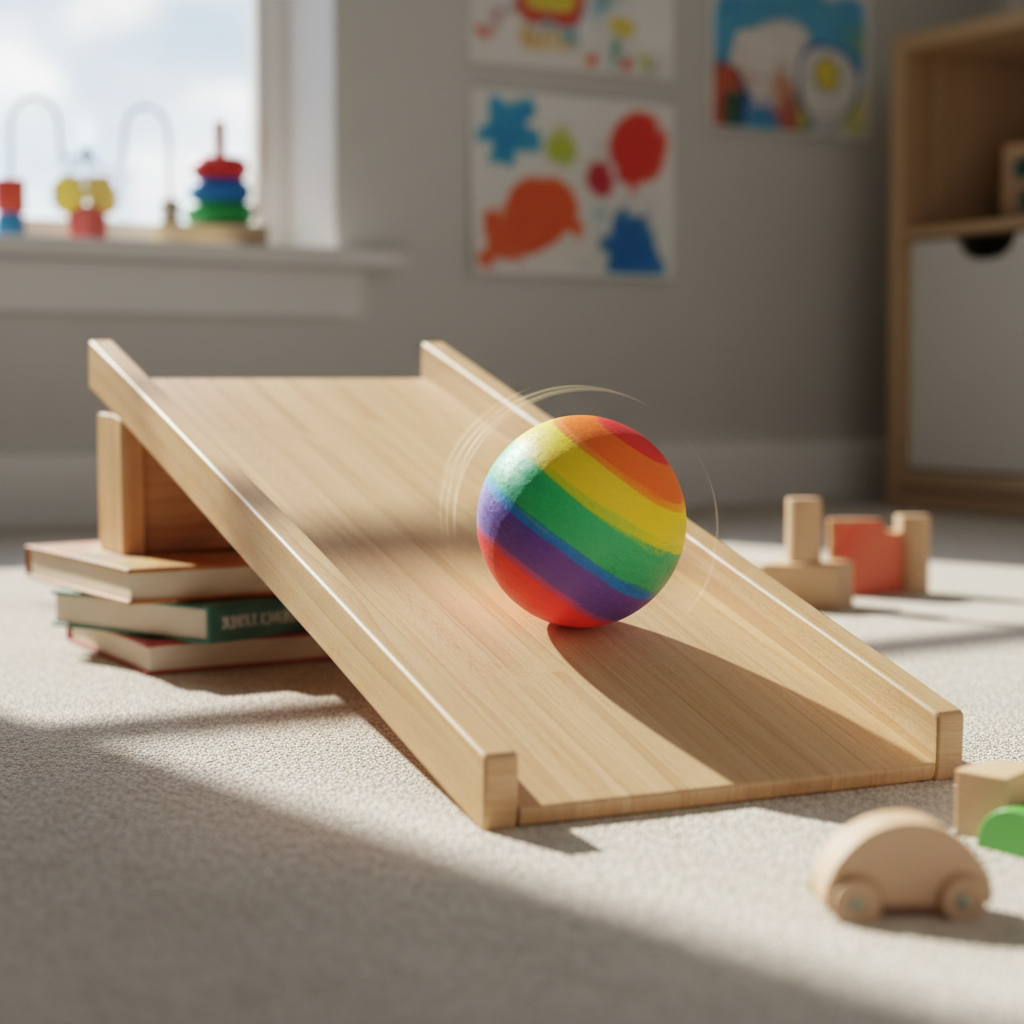
In this picture, the ball is round, and as it goes down the ramp, it turns and turns. That's rolling in action!
2. Sliding: The Gliding Glide!
Now, let's think about something different. Imagine you have a flat book. If you push it across a table, it doesn't spin, does it? It glides or scrapes along the surface. That's sliding! Sliding is when an object moves smoothly or roughly over a surface without spinning.
Think of it like this:
- When you go down a playground slide, you are sliding! Your bottom doesn't spin, it just glides down the surface.
- If you push a heavy box across the floor, it slides along. It doesn't roll because it's not round.
- A hockey puck slides across the ice during a game, not spinning, but just gliding.
- When you draw with a crayon, it slides across the paper, leaving a colorful mark.
What makes things slide? Objects that slide are often flat or have a flat side that stays on the surface. When an object slides, it often has more contact with the surface than a rolling object, which can sometimes make it a bit harder to move, or it might make a scratching sound.
Here’s another example!

See how the child moves from top to bottom on the slide without spinning? They are sliding!
Rolling vs. Sliding: What's the Big Difference?
The biggest difference is how they move:
- Rolling: The object spins and turns over itself. (Think of a wheel!)
- Sliding: The object glides or drags along without spinning. (Think of a sled!)
Usually, round things roll, and flat things slide. Rolling is often easier and faster because there's less rubbing against the ground. Sliding can sometimes be slower because more of the object is rubbing against the surface, which we call friction. But both are super important ways things move in our world!
Can Something Do Both?
That's a great question! Sometimes an object might start to roll and then slide, or vice versa. Imagine a book falling off a shelf. It might tumble (a bit like rolling) and then hit the floor and slide to a stop. Or a dice when you throw it! It tumbles and rolls for a bit, and then often slides to its final spot.
Look Around You!
Now that you know about rolling and sliding, you'll start seeing them everywhere! Look at your pencils – if you push it lengthwise, it slides. If you push it on its side, it rolls! Your shoes slide on the floor when you drag your feet, but when you walk, your feet are mostly lifting and placing, which is a different kind of movement!
Next time you play with your toys, think about how they move. Are they rolling? Are they sliding? Or are they doing something else entirely? The world is full of movement, and you're now an expert at spotting two of the most common types!
Keep learning, free
Create a free Syllabax account to unlock practice questions and games for this topic.
Visual Learning Enhanced! 🚀
To help you master this topic, we use Advanced Syllabax AI to generate detailed diagrams and visual models.
Note on Visuals: The AI sometimes makes spelling errors in image labels. Please refer to the lesson text for the correct terminology.