Symmetry (intro) (Lines & Angles)
Watch this topic in 60 seconds
Free preview · Lesson 1
Understanding Symmetry (intro) (Lines & Angles)
Welcome, Young Explorers, to the Wonderful World of Symmetry!
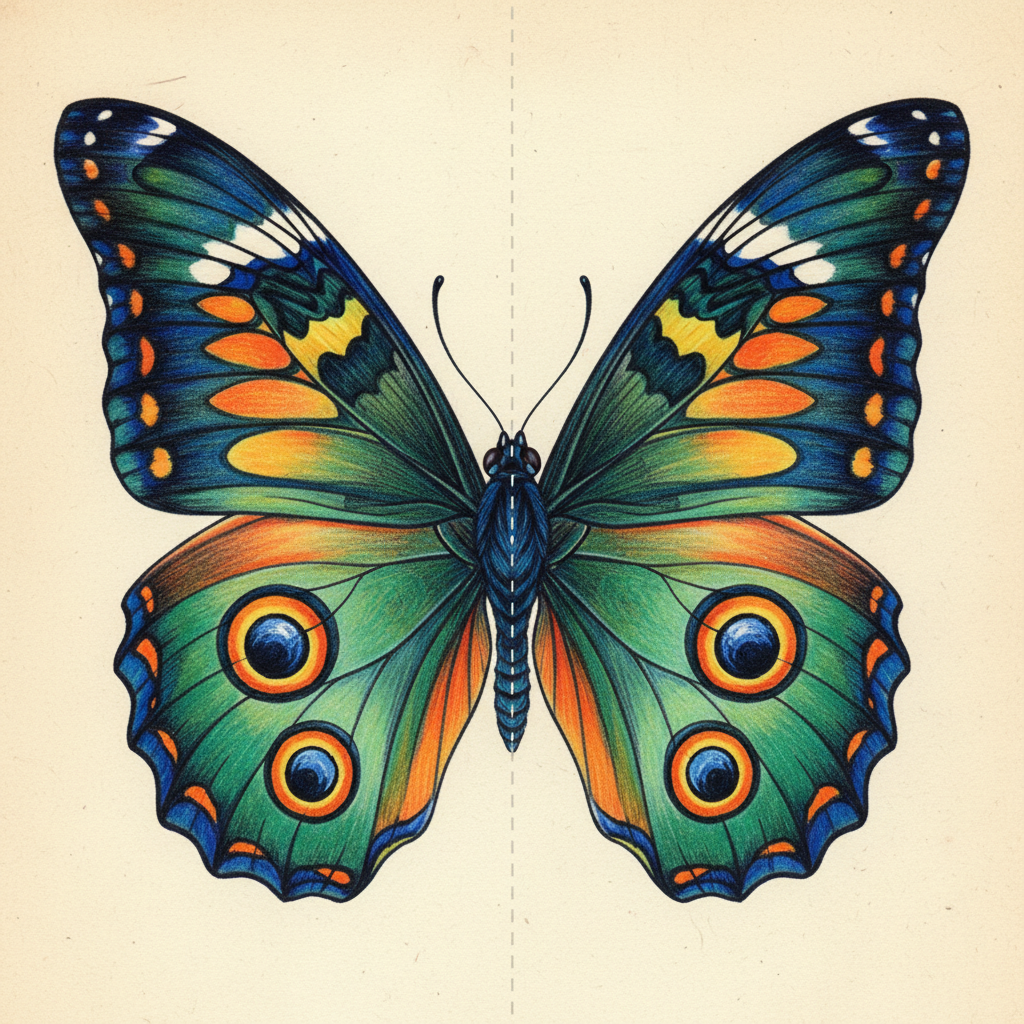
Have you ever looked at a butterfly's wings and noticed how they look exactly the same on both sides? Or perhaps you've seen a perfectly round ball, or a star shape with pointy arms? These amazing things often have something special in common: **Symmetry**!
What is Symmetry?
Imagine you have a special pair of magic scissors. If you could fold a shape perfectly in half, and both sides matched up exactly, like two puzzle pieces fitting together, then that shape has symmetry! The line you folded along is called the line of symmetry. It's like a mirror line, where one side is a perfect reflection of the other.
Let's Explore with Analogies!
Think about your own body! If you draw a line straight down the middle of your face, your left eye looks a lot like your right eye, your left ear like your right ear, and so on. Your body has a line of symmetry!
Or consider a beautiful, perfectly cut pizza slice. If you imagine a line going from the crust to the tip, the left half of the slice looks just like the right half. That's symmetry!
Even simple objects around us have symmetry. A plain, rectangular book has a line of symmetry down the middle, both vertically and horizontally. If you fold it along these lines, the two halves match perfectly. A square is even more symmetrical – it has four lines of symmetry!
Lines of Symmetry: The Magic Fold Lines
The line of symmetry is the invisible crease or mirror line that divides a shape into two identical halves. These halves are mirror images of each other. If you were to hold a mirror along this line, the reflection would look exactly like the other half of the shape.
Examples of Lines of Symmetry:
- A heart shape: Has one vertical line of symmetry down the middle. The left side is a mirror image of the right side.
- An equilateral triangle (all sides equal): Has three lines of symmetry, each going from a corner to the middle of the opposite side.
- A circle: This is super special! A circle has an infinite number of lines of symmetry. You can draw a line through the center in any direction, and it will always divide the circle into two equal halves.
- The letter 'A': Has one vertical line of symmetry.
- The letter 'H': Has both a vertical and a horizontal line of symmetry.
- The letter 'Z': Does NOT have a line of symmetry. If you fold it in half, the two sides don't match.
Look around your classroom or your home. Can you spot objects with lines of symmetry? Maybe a window pane, a table, a clock face, or even a leaf from a tree?
Angles: The Pointy Bits and Turns!
Now, let's talk about angles. Angles are formed when two lines or rays meet at a point, called a vertex. Think of them like corners!
Analogies for Angles:
Imagine the hands on a clock. When the hour and minute hands point in different directions, they form an angle. The space between them is the angle.
Think about opening a door. The hinge is the vertex, and the door and the wall form the two sides of the angle. As you open the door wider, the angle gets bigger. When the door is closed, the angle is very small, almost zero!
A pair of scissors also shows angles. The point where the two blades join is the vertex. When you open the scissors, you create an angle.
Types of Angles (Simple Introduction):
We can describe angles by how big or small they are:
- Right Angle: This is a perfectly square corner, like the corner of a book or a wall meeting the floor. It's like making an 'L' shape. We often draw a little square in the corner to show it's a right angle. Think of the corner of a square or a rectangle.
- Acute Angle: This is a small, pointy angle, like the tip of a sharp pencil or the angle made by the hands of a clock at 1:00. It's smaller than a right angle. Think 'A-cute' and 'tiny'!
- Obtuse Angle: This is a wide, open angle, bigger than a right angle but not a full straight line. Think of an open book lying on a table, or the angle of a very wide staircase.
Symmetry and Angles Together!
Many symmetrical shapes have angles! For example, a square has four right angles. An equilateral triangle has three equal acute angles. A star often has many acute angles at its points.
The lines of symmetry in a shape can also relate to the angles. Sometimes, a line of symmetry cuts through an angle, dividing it into two equal smaller angles.
Keep exploring and looking for symmetry and angles all around you. They are everywhere!
Keep learning, free
Create a free Syllabax account to unlock practice questions and games for this topic.
Visual Learning Enhanced! 🚀
To help you master this topic, we use Advanced Syllabax AI to generate detailed diagrams and visual models.
Note on Visuals: The AI sometimes makes spelling errors in image labels. Please refer to the lesson text for the correct terminology.