Learning Journey
Watch this topic in 60 seconds
Free preview · Lesson 1
Understanding Division as repeated subtraction (Division)
Understanding Division as Repeated Subtraction
Welcome, young mathematicians! Today, we're going to unlock the exciting world of division by exploring it through a familiar concept: repeated subtraction. Think of division as a way to figure out how many times you can take away a certain number from a larger number until you reach zero. It’s like sharing equally or grouping things neatly!
What is Division?
Division is one of the four basic arithmetic operations, just like addition, subtraction, and multiplication. It's often represented by symbols like
Imagine you have a big bag of 12 yummy cookies, and you want to share them equally among 3 friends. How many cookies does each friend get? This is a division problem! We can write it as 12
Division as Repeated Subtraction: The Core Idea
The easiest way to understand division, especially when you're starting, is to think of it as repeated subtraction. This means we keep subtracting the same number from a starting number until we get to zero. The number of times we subtract is our answer!
Let's Use an Analogy: Sharing Candies!
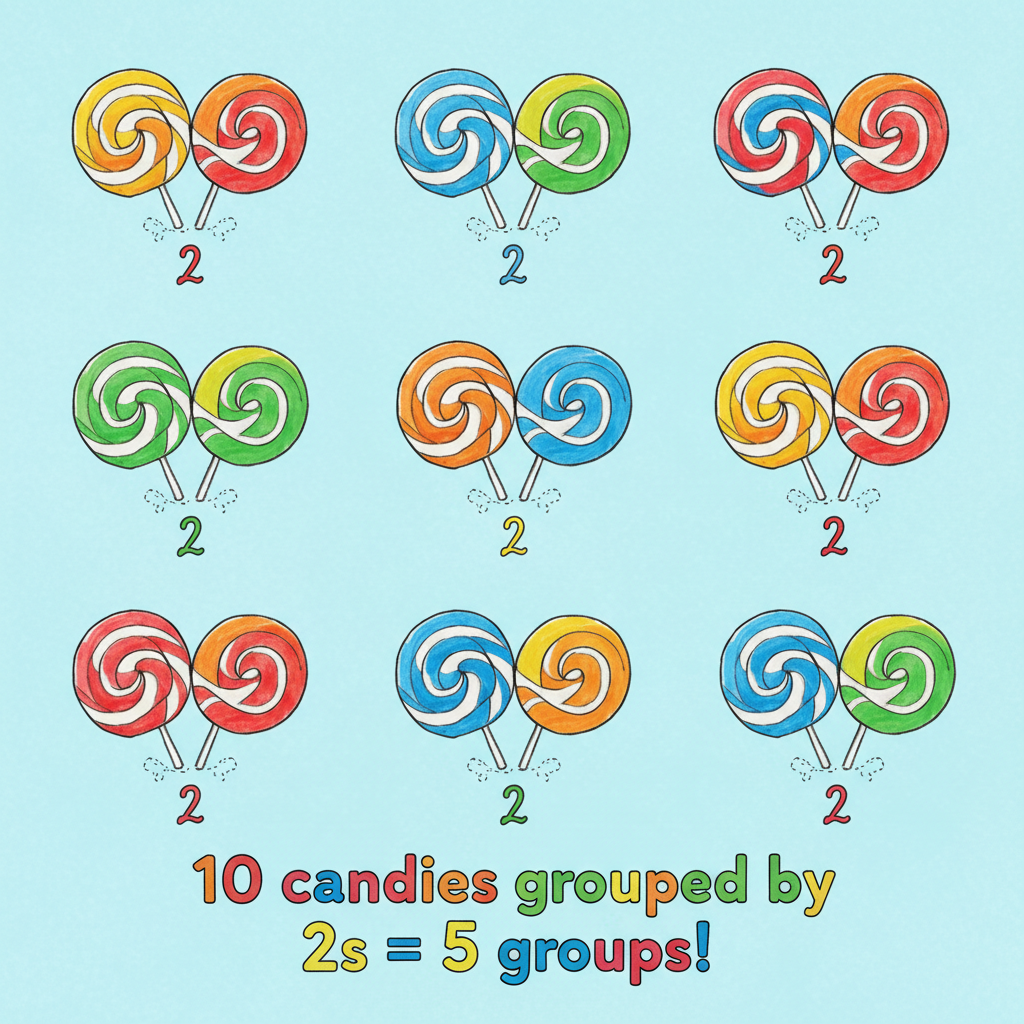
Imagine you have 10 colorful candies, and you want to give 2 candies to each of your friends. How many friends can you share with?
We can solve this using repeated subtraction:
- Start with 10 candies.
- Give 2 candies to the first friend:
- Give 2 candies to the second friend:
- Give 2 candies to the third friend:
- Give 2 candies to the fourth friend:
- Give 2 candies to the fifth friend:
We subtracted 2 candies a total of 5 times until we had 0 candies left. So, you can share 2 candies with 5 friends!
This means 10
Key Terms in Division
Just like in any new topic, division has its own special words:
- Dividend: This is the number you start with (the total amount). In our candy example, the dividend was 10.
- Divisor: This is the number you are dividing by, or the size of each group/how many you're giving away each time. In our candy example, the divisor was 2.
- Quotient: This is the answer to the division problem. It tells you how many groups you can make or how many times you can subtract. In our candy example, the quotient was 5.
So, in
- 10 is the dividend.
- 2 is the divisor.
- 5 is the quotient.
More Examples to Build Your Understanding
Example 1: Packing Books
You have 15 picture books to pack into boxes. Each box can hold 5 books. How many boxes will you need?
We can use repeated subtraction:
- Start with 15 books.
- Subtract 5 books for the first box:
- Subtract 5 books for the second box:
- Subtract 5 books for the third box:
We subtracted 5 a total of 3 times. So, you will need 3 boxes.
The division problem is
Example 2: Building with Blocks
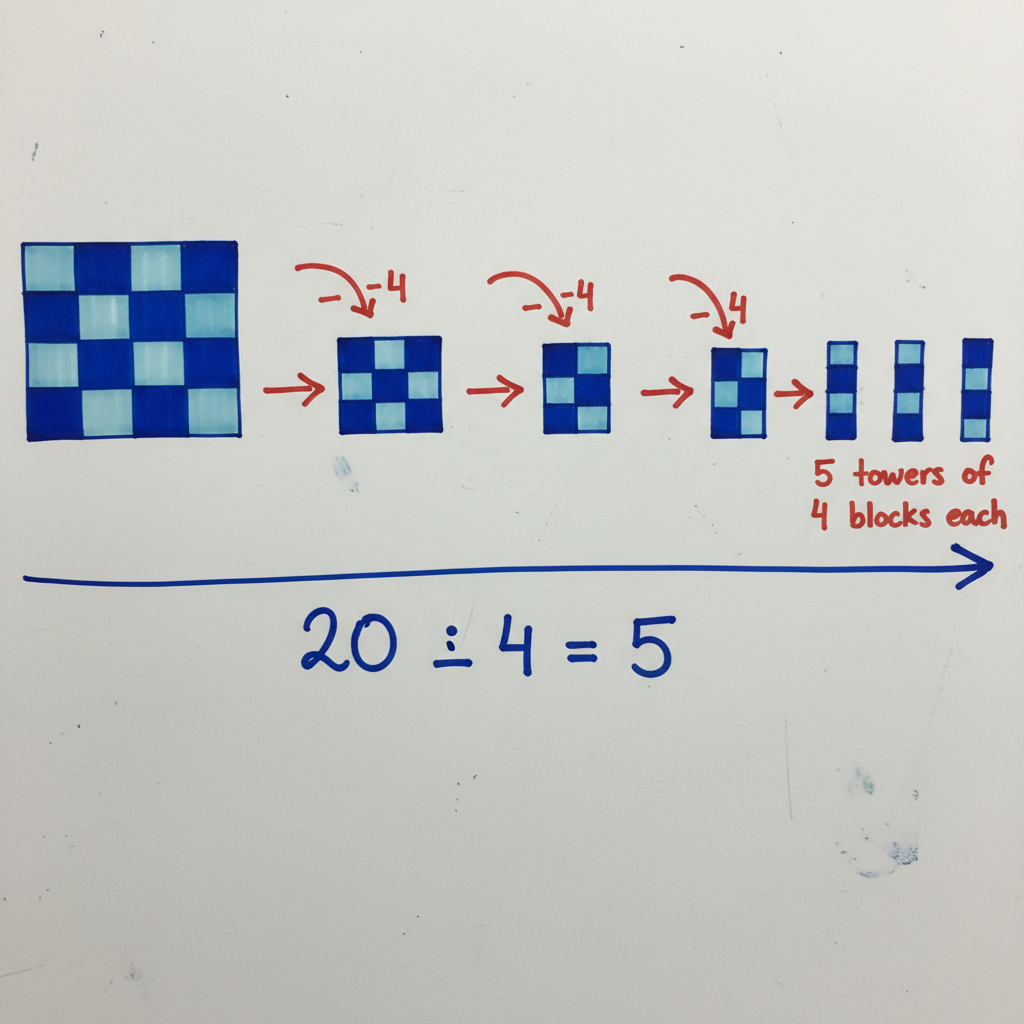
You have 20 building blocks, and you want to build towers that use 4 blocks each. How many towers can you build?
Let's subtract repeatedly:
- Start with 20 blocks.
- Subtract 4 blocks for the first tower:
- Subtract 4 blocks for the second tower:
- Subtract 4 blocks for the third tower:
- Subtract 4 blocks for the fourth tower:
- Subtract 4 blocks for the fifth tower:
We subtracted 4 a total of 5 times. So, you can build 5 towers.
The division problem is
Why is this helpful?
Understanding division as repeated subtraction helps you visualize what's happening. It connects division to a simpler operation (subtraction) that you already know. It's like seeing how many steps you take when walking a certain distance, where each step is the same size.
Think about it: if you have a long rope (the dividend) and you want to cut it into smaller, equal pieces (the divisor), repeated subtraction tells you how many pieces you'll get (the quotient).
Let's Recap!
Division is about splitting a total amount into equal parts or finding out how many times a smaller number fits into a larger number. When we use repeated subtraction, we start with the total amount and keep taking away the size of one part until we have nothing left. The number of times we take away is our answer!
Keep practicing, and you'll become a division expert in no time!
Keep learning, free
Create a free Syllabax account to unlock practice questions and games for this topic.
Visual Learning Enhanced! 🚀
To help you master this topic, we use Advanced Syllabax AI to generate detailed diagrams and visual models.
Note on Visuals: The AI sometimes makes spelling errors in image labels. Please refer to the lesson text for the correct terminology.