Learning Journey
Watch this topic in 60 seconds
Free preview · Lesson 1
Understanding Compound interest (annual/half-yearly) (Commercial Math)
Understanding Compound Interest: Your Money's Growth Superpower!
Hey there, future financial whizzes! Have you ever wondered how money can grow all by itself? It’s not magic, it’s math! Today, we're going to unlock the secrets of something called Compound Interest. Think of it as a superpower for your savings or, sometimes, a hefty cost for your loans. Let’s dive in!
What is Interest, Anyway? (The Basics)
Imagine you lend your friend ₹100. If they keep it for a week, they might offer you an extra ₹10 for the favor. That extra ₹10 is called interest. It's like a 'thank you' payment for using your money.
- When you save money in a bank, the bank uses your money to lend to others. They thank you by giving you interest.
- When you borrow money (like for a loan), you pay interest to the lender as a fee for using their money.
There are a few key terms we use when talking about interest:
- Principal (P): This is the original amount of money you save or borrow. It's the starting point.
- Rate (R): This is the percentage at which interest is calculated, usually given per year (per annum). It tells you how fast your money grows or how much you pay.
- Time (T): This is the duration for which the money is saved or borrowed, usually in years.
- Amount (A): This is the total money at the end, including the principal and all the interest earned or paid.
- Interest (I): The extra money earned or paid over the principal.
Simple Interest: The Straightforward Path
Before we jump into compound interest, let's quickly understand its simpler cousin: Simple Interest.
Simple interest is like renting a bicycle. If you rent a bicycle for ₹50 a day, and you rent it for 3 days, you pay ₹50 on the first day, ₹50 on the second day, and ₹50 on the third day. The rent (interest) is always calculated only on the original price of the bicycle (the principal).
The formula for Simple Interest (SI) is:
SI = (P × R × T) / 100
Where:
- P = Principal
- R = Rate (as a percentage)
- T = Time (in years)
Example: If you invest ₹1000 at 10% simple interest for 2 years:
- Year 1: Interest = (1000 × 10 × 1) / 100 = ₹100
- Year 2: Interest = (1000 × 10 × 1) / 100 = ₹100
- Total Simple Interest = ₹100 + ₹100 = ₹200
- Total Amount = ₹1000 (Principal) + ₹200 (Interest) = ₹1200
Notice how the interest earned each year is the same, ₹100, because it's always calculated on the original ₹1000.
Compound Interest: The Snowball Effect!
Now, let's talk about the real game-changer: Compound Interest. Imagine you have a small snowball, and you start rolling it down a snowy hill. As it rolls, it picks up more snow, getting bigger. The bigger it gets, the more snow it can pick up even faster! That's exactly how compound interest works.
With compound interest, you earn interest not only on your original principal but also on the interest that has already been added to your principal from previous periods. It's like earning 'interest on interest'. This makes your money grow much faster than with simple interest.
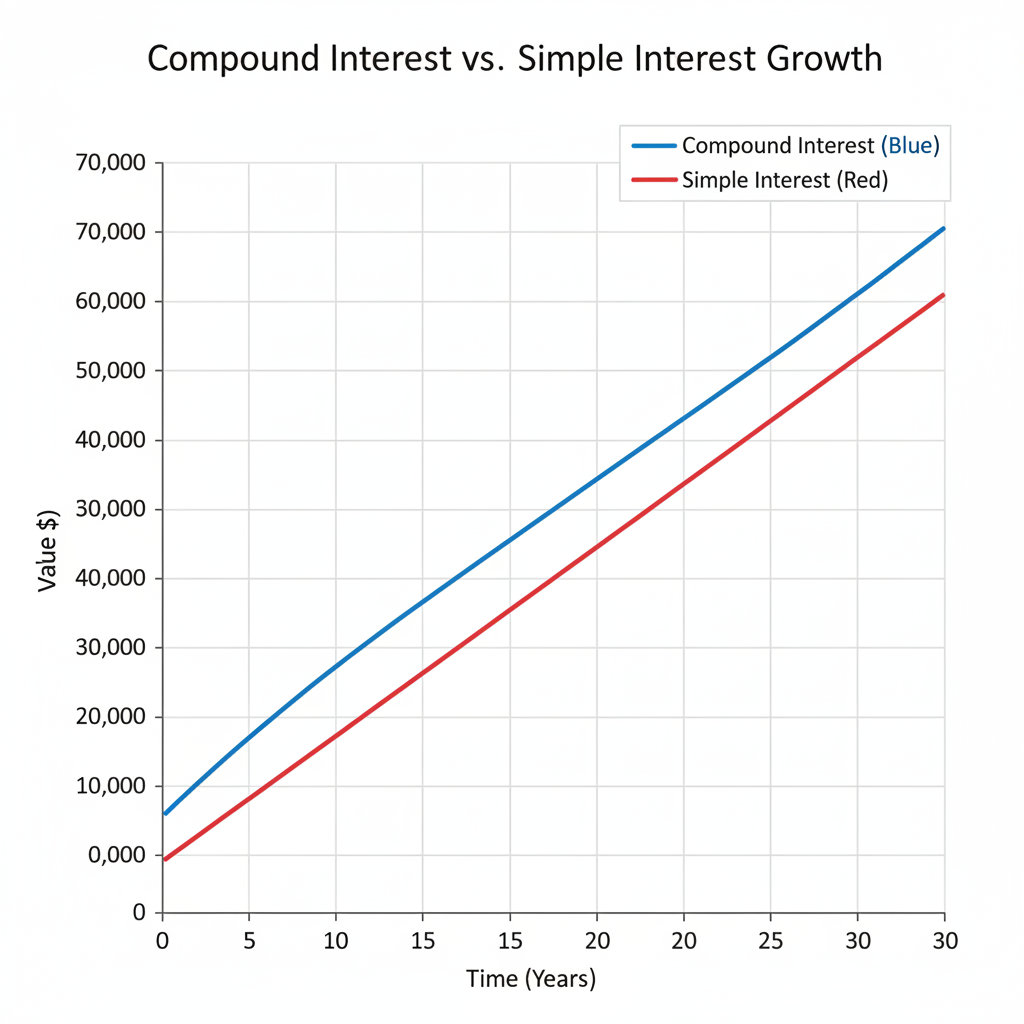 ⚠️ This picture may have spelling mistakes. Trust the words in the lesson.
The Magical Formula for Compound Interest
The general formula to calculate the total Amount (A) with compound interest is:
A = P (1 + R/n)^(nT)
Where:
- P = Principal (original amount)
- R = Annual Rate of interest (as a decimal, so 10% becomes 0.10)
- T = Time (in years)
- n = Number of times the interest is compounded per year
Don't worry too much about the 'n' for now; we'll break it down for annual and half-yearly compounding.
1. Annual Compounding (n=1)
When interest is compounded annually, it means the interest is calculated and added to the principal once every year. So, in our formula, 'n' becomes 1.
The formula simplifies to:
A = P (1 + R/100)^T
Remember, R here is a percentage, so dividing by 100 converts it to a decimal.
Let's revisit our example: Invest ₹1000 at 10% compound interest annually for 2 years.
- End of Year 1:
- Interest for Year 1 = (1000 × 10 × 1) / 100 = ₹100
- Amount at end of Year 1 = ₹1000 + ₹100 = ₹1100
- End of Year 2: (This is where the magic happens! The new principal is ₹1100)
- Interest for Year 2 = (1100 × 10 × 1) / 100 = ₹110
- Amount at end of Year 2 = ₹1100 + ₹110 = ₹1210
Using the formula:
A = 1000 (1 + 10/100)^2
A = 1000 (1 + 0.10)^2
A = 1000 (1.10)^2
A = 1000 × 1.21
A = ₹1210
Notice that with compound interest, you earned ₹10 in extra interest (₹210 total interest) compared to simple interest (₹200 total interest). This difference grows much larger over longer periods!
Compound Interest (CI) is simply the Total Amount minus the Principal: CI = A - P. So, CI = ₹1210 - ₹1000 = ₹210.
2. Half-Yearly Compounding (n=2)
What if the interest is calculated more often? If interest is compounded half-yearly (or semi-annually), it means it's calculated and added to the principal twice a year – every six months.
When this happens, two things change in our formula:
- The Rate (R) is divided by 2: Since the interest is calculated for half a year, you get half of the annual rate each time. So,
R/2. - The Time (T) is multiplied by 2: If you have 1 year, and interest is compounded twice a year, you have 2 compounding periods. For 2 years, you'd have 4 periods. So,
2T.
The formula for half-yearly compounding becomes:
A = P (1 + (R/2)/100)^(2T)
Let's use the same example: Invest ₹1000 at 10% compound interest half-yearly for 2 years.
- P = ₹1000
- Annual Rate (R) = 10%
- Time (T) = 2 years
For half-yearly calculation:
- Rate per period (R/2) = 10% / 2 = 5%
- Number of periods (2T) = 2 years × 2 periods/year = 4 periods
Now, let's apply the formula:
A = 1000 (1 + 5/100)^4
A = 1000 (1 + 0.05)^4
A = 1000 (1.05)^4
A = 1000 × 1.21550625
A = ₹1215.51 (approximately)
Compound Interest (CI) = ₹1215.51 - ₹1000 = ₹215.51.
Comparing Annual vs. Half-Yearly Compounding
In our example:
- Simple Interest: Total Amount = ₹1200, CI = ₹200
- Annual Compounding: Total Amount = ₹1210, CI = ₹210
- Half-Yearly Compounding: Total Amount = ₹1215.51, CI = ₹215.51
As you can see, the more frequently the interest is compounded, the higher the total amount and the higher the compound interest earned (or paid!). This is because your money gets more chances to earn 'interest on interest'.
Compound interest is a very powerful concept in finance. It's why it's great to start saving early, as your money has more time to compound and grow substantially!
Keep learning, free
Create a free Syllabax account to unlock practice questions and games for this topic.
Visual Learning Enhanced! 🚀
To help you master this topic, we use Advanced Syllabax AI to generate detailed diagrams and visual models.
Note on Visuals: The AI sometimes makes spelling errors in image labels. Please refer to the lesson text for the correct terminology.