Types of teeth[BIOLOGY]
Watch this topic in 60 seconds
Free preview · Lesson 1
Understanding Types of teeth[BIOLOGY]
Our Amazing Mouths: A Journey Through the Different Types of Teeth!
Imagine your mouth as a busy kitchen, and your teeth are the specialized tools in that kitchen, each with a very important job. Just like a chef uses a knife to chop, a grater to shred, and a masher to mash, your teeth work together to help you eat, speak, and smile!
Humans have different kinds of teeth, and they all have special names and jobs. Let's explore these dental superstars!
1. The Incisors: Your Front-Line Cutters
At the very front of your mouth, you have eight teeth that look like tiny chisels or spatulas. These are your incisors. They are the sharpest teeth and their main job is to bite and cut your food into smaller pieces. Think of them like the sharp edge of a pair of scissors or the blade of a knife used for slicing.
You have four incisors on the top jaw and four on the bottom jaw. The ones right in the middle are called central incisors, and the ones next to them are lateral incisors. When you take a bite out of an apple or a piece of bread, your incisors are the first ones to get to work!
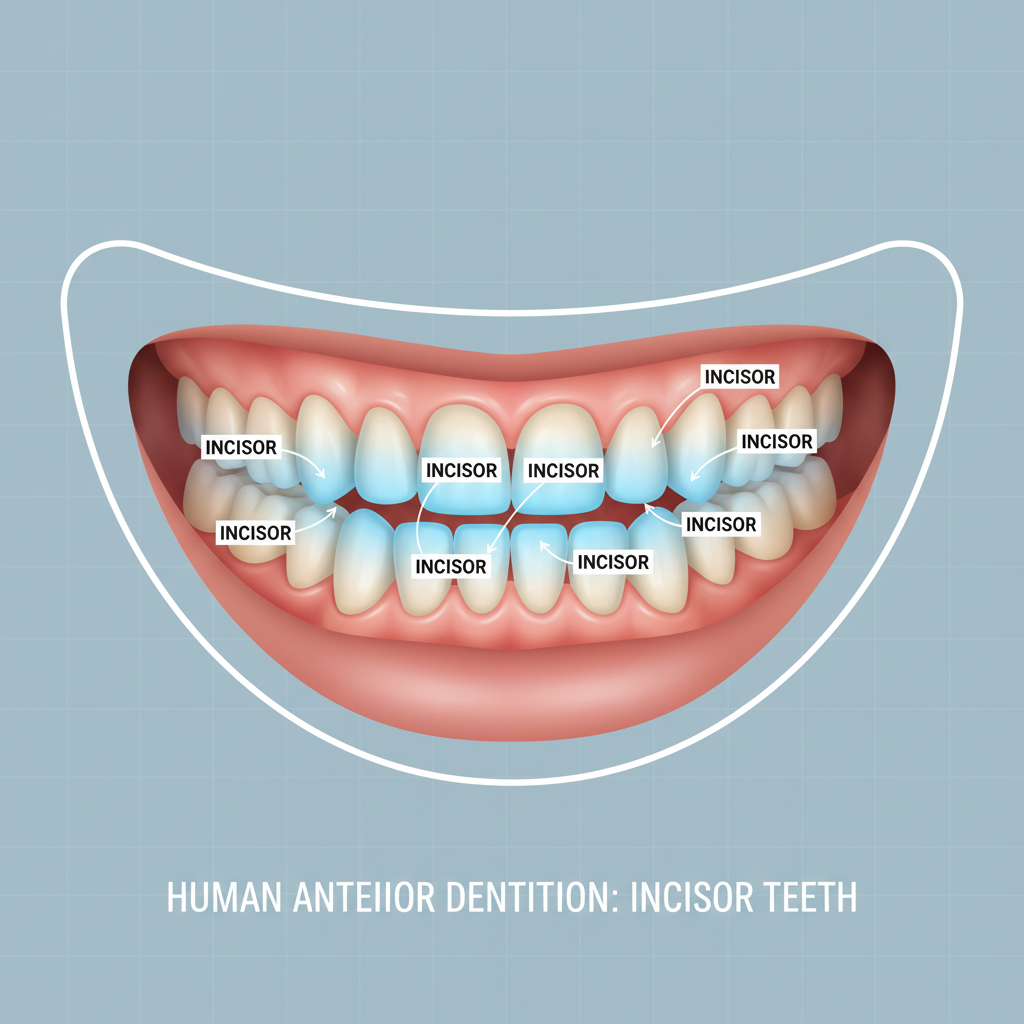 ⚠️ This picture may have spelling mistakes. Trust the words in the lesson.
2. The Canines: Your Tearing Experts
Next to your incisors, on each side of your mouth (both top and bottom), you'll find the canines. These are the pointy teeth, often called 'eye teeth' or 'fangs' because they are a bit sharper and more pointed than incisors. Their job is to tear and rip food. Think of them like the pointy tip of a fork or the sharp point of a spear, perfect for holding onto and tearing apart tougher bits of food.
You have four canines in total – two on the top and two on the bottom. They are longer than incisors and have a single pointy cusp (or tip). These are especially useful when you're eating something like a piece of cooked meat.
3. The Premolars: The Grinding and Chewing Crew
Moving further back in your mouth, behind the canines, you'll find the premolars. These teeth are wider and flatter than incisors and canines, and they have two distinct points or cusps on their chewing surface. Their job is to help grind and mash food, preparing it for swallowing. Imagine them as little mallets or pestles, ready to crush and break down food.
You have eight premolars in total – four on the top jaw and four on the bottom jaw. They act as a bridge between the tearing canines and the heavy-duty grinding molars. They are sometimes called 'bicuspids' because they have two cusps (bi means two).
4. The Molars: The Powerhouse Grinders
The final set of teeth, found right at the back of your mouth, are the molars. These are your largest and strongest teeth. They are broad and flat with several cusps (bumps) on their chewing surface, making them excellent for grinding and crushing food into a fine paste. Think of them as the heavy-duty mills or the workhorses of your chewing team. They have the toughest job, turning your food into something easy to swallow.
Adults typically have twelve molars: six on the top jaw and six on the bottom jaw. The very last set of molars to erupt are often called wisdom teeth. However, sometimes there isn't enough room for them, and they can cause problems, so many people have them removed.
A Summary of Your Dental Tools:
- Incisors: Like scissors, for cutting and biting.
- Canines: Like a fork's point, for tearing.
- Premolars: Like mallets, for mashing and grinding.
- Molars: Like mills, for heavy-duty grinding.
All these teeth work together harmoniously to help you enjoy your meals, pronounce words clearly, and maintain a healthy, confident smile. Taking care of all your different types of teeth with brushing and flossing is super important for keeping them strong and healthy!
Keep learning, free
Create a free Syllabax account to unlock practice questions and games for this topic.
Visual Learning Enhanced! 🚀
To help you master this topic, we use Advanced Syllabax AI to generate detailed diagrams and visual models.
Note on Visuals: The AI sometimes makes spelling errors in image labels. Please refer to the lesson text for the correct terminology.