Learning Journey
Watch this topic in 60 seconds
Free preview · Lesson 1
Understanding Comparing numbers (Number Sense)
Comparing Numbers: Who Has More? (Grade 4)
Welcome, super number detectives! Today, we're going on an exciting adventure to learn how to compare numbers. Comparing numbers is like figuring out who has more cookies, who has more toys, or who can run faster. It's all about telling if one number is bigger, smaller, or the same as another number.
What Does 'Comparing' Mean?
Imagine you have a bag of colorful marbles, and your friend has a bag of marbles. To compare, you want to know: Do you have more marbles than your friend? Does your friend have more than you? Or do you both have the exact same amount?
In math, when we compare numbers, we use special symbols to show our findings. These symbols are like secret codes for numbers!
The Amazing Comparison Symbols!
We have three main symbols to help us compare numbers:
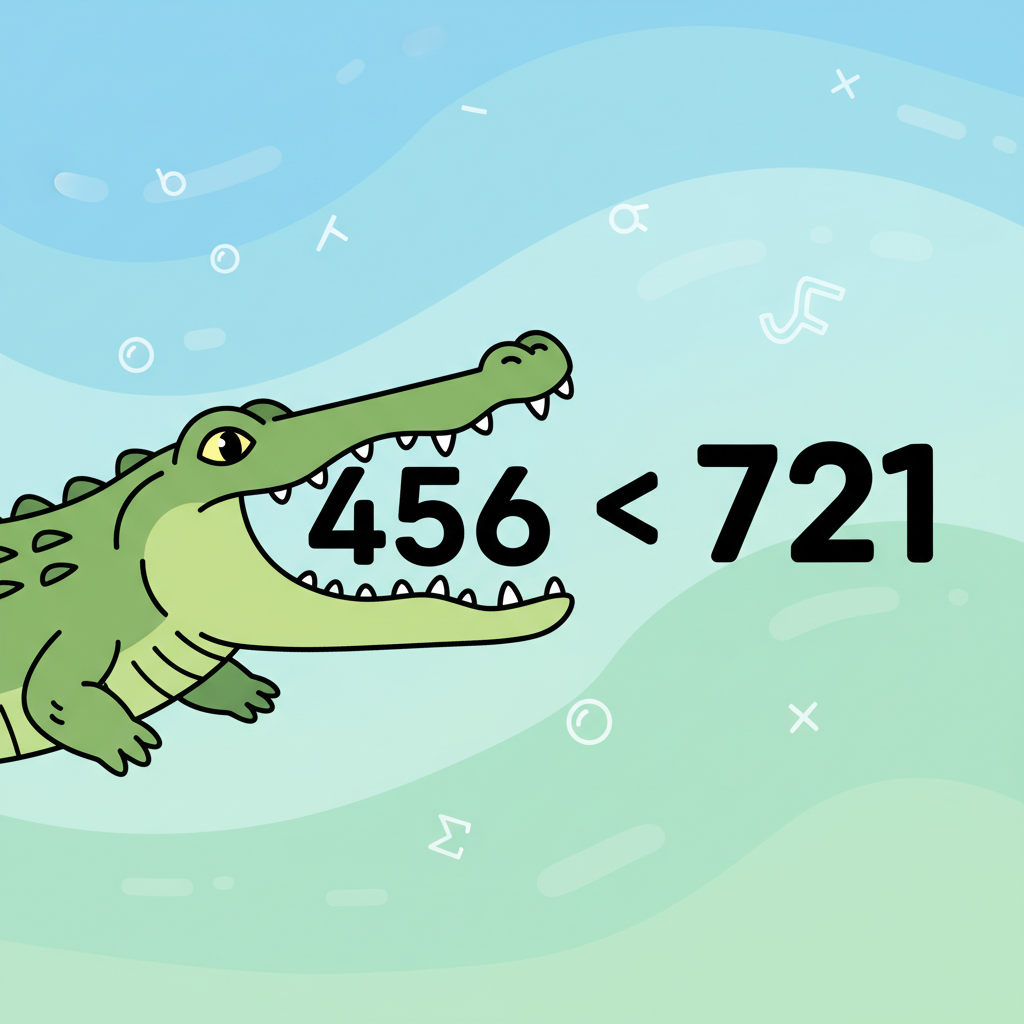
- Greater Than (>): This symbol looks like a little mouth ready to gobble up the bigger number. It means "is bigger than". So, 5 > 3 means 5 is bigger than 3. Think of the hungry alligator's mouth always opening towards the larger meal!
- Less Than (<): This symbol is the opposite of the 'greater than' symbol. It means "is smaller than". So, 3 < 5 means 3 is smaller than 5. The pointy end of the symbol always points to the smaller number. It's like the alligator is facing away from its smaller snack!
- Equal To (=): This symbol means that both numbers are exactly the same. If you have 4 apples and your friend also has 4 apples, you can say 4 = 4. They are twins!
How to Compare Numbers: The Power of Place Value!
To compare numbers, especially big ones, we use something super important called place value. Remember place value? It's the idea that the position of a digit in a number tells us its value. We have the ones place, the tens place, the hundreds place, the thousands place, and so on.
When comparing two numbers, we always start comparing from the leftmost digit, which is the digit with the highest place value. This is like comparing two towers of blocks – you first look at the tallest tower!
Comparing Numbers with Different Digits
Let's compare 456 and 721.
- Look at the leftmost digit (the hundreds place): In 456, the leftmost digit is 4. In 721, the leftmost digit is 7.
- Which digit is bigger? 7 is bigger than 4.
- Conclusion: Since the digit in the hundreds place of 721 (which is 7) is bigger than the digit in the hundreds place of 456 (which is 4), the number 721 is bigger than 456.
So, we can write this as: 456 < 721. The hungry alligator's mouth opens towards 721!
Comparing Numbers with the Same Leftmost Digit
What if the leftmost digits are the same? Let's compare 345 and 312.
- Look at the leftmost digit (the hundreds place): In 345, the leftmost digit is 3. In 312, the leftmost digit is 3. They are the same!
- Move to the next digit to the right (the tens place): In 345, the digit in the tens place is 4. In 312, the digit in the tens place is 1.
- Which digit is bigger? 4 is bigger than 1.
- Conclusion: Since the digit in the tens place of 345 (which is 4) is bigger than the digit in the tens place of 312 (which is 1), the number 345 is bigger than 312.
So, we can write this as: 345 > 312. The alligator is ready to eat 345!
Comparing Numbers with All Digits the Same
If all the digits in the same place values are the same, the numbers are equal. For example, compare 987 and 987.
- Hundreds place: 9 and 9 (Same)
- Tens place: 8 and 8 (Same)
- Ones place: 7 and 7 (Same)
Since all the digits match up, the numbers are equal: 987 = 987.
Comparing Numbers with Different Number of Digits
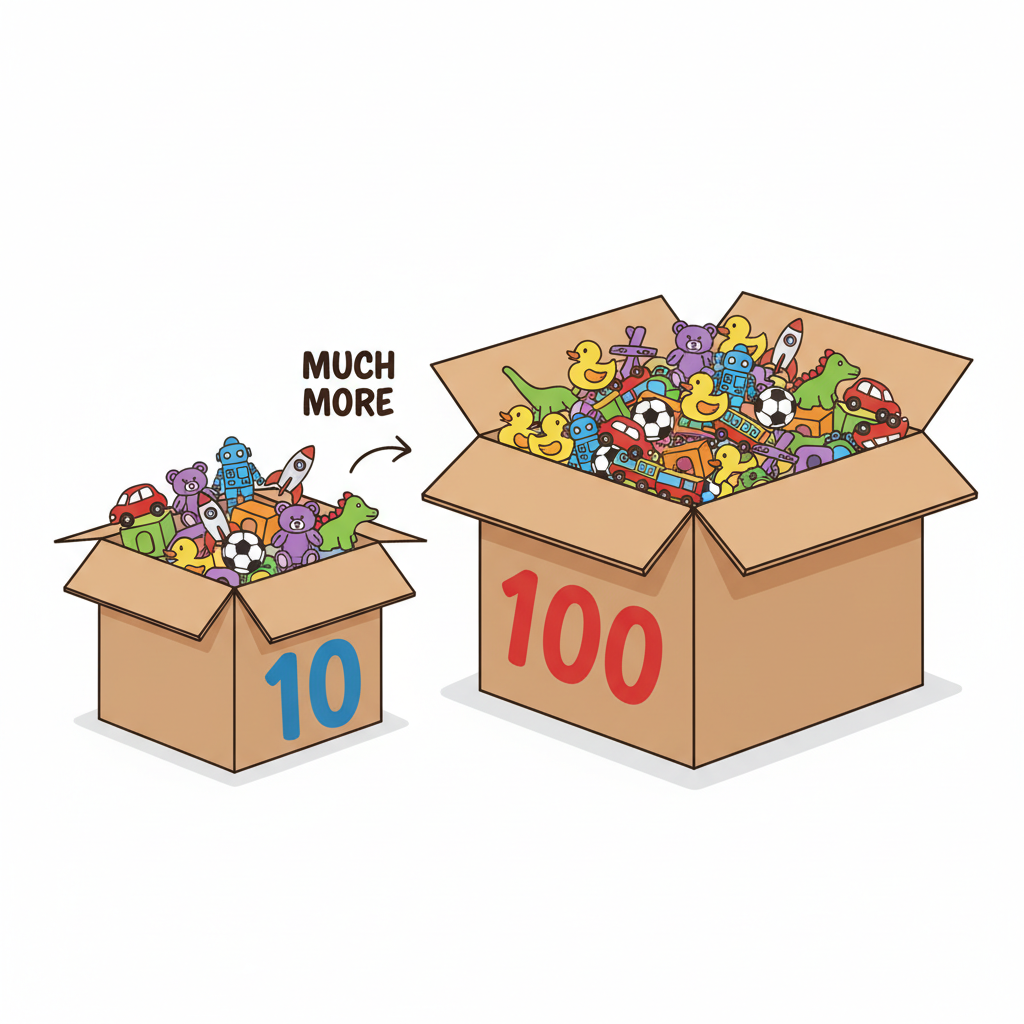
This is the easiest comparison of all! If one number has more digits than another number, the number with more digits is always the bigger number.
Think about it: Are there more toys in a box with 10 toys, or a box with 100 toys? The box with 100 toys has more!
Let's compare 54 and 123.
- 54 has two digits.
- 123 has three digits.
Since 123 has more digits, it is the bigger number.
So, we write: 54 < 123.
Let's Summarize!
Comparing numbers is a fundamental skill in math. Remember these steps:
- Count the digits: The number with more digits is bigger.
- Start from the left: If the number of digits is the same, compare the digits starting from the leftmost (highest place value).
- Move right if needed: If the leftmost digits are the same, move to the next digit to the right and compare again.
- Equal numbers: If all digits match, the numbers are equal.
Keep practicing, and you'll become a number comparison champion!
Keep learning, free
Create a free Syllabax account to unlock practice questions and games for this topic.
Visual Learning Enhanced! 🚀
To help you master this topic, we use Advanced Syllabax AI to generate detailed diagrams and visual models.
Note on Visuals: The AI sometimes makes spelling errors in image labels. Please refer to the lesson text for the correct terminology.