Roots, stems, leaves, flowers[BIOLOGY]
Watch this topic in 60 seconds
Free preview · Lesson 1
Understanding Roots, stems, leaves, flowers[BIOLOGY]
Plant Parts: Roots, Stems, Leaves, and Flowers
Welcome, young scientists! Today, we're going on an amazing adventure into the world of plants. Plants are all around us, from the towering trees in the park to the tiny flowers in a garden. Just like your body has different parts that do different jobs (like your legs for walking and your hands for holding), plants also have special parts that help them live and grow. We're going to explore four main parts: the roots, the stems, the leaves, and the flowers!
1. The Amazing Roots: The Plant's Anchors and Drinkers
Imagine you're building a sandcastle. You need to push the buckets of sand down firmly to make sure it doesn't blow away, right? Roots are like the anchors for plants. They grow down into the soil, holding the plant steady so it doesn't fall over, especially when the wind blows.
But roots do more than just hold on! Think about when you're thirsty. You drink water, right? Roots are the plant's way of drinking. They soak up water from the soil, just like a sponge soaking up spilled juice. This water is super important for the plant to stay alive and healthy. They also soak up something called nutrients from the soil. Nutrients are like the vitamins and minerals that plants need to grow big and strong, just like you need healthy food!
Analogy Alert: Roots are like the plant's built-in straw and anchor! They drink water and nutrients, and they keep the plant from tipping over.
Some plants have one big, thick root called a taproot, like a carrot or a radish. Others have many thin, thread-like roots called fibrous roots, like grass. Both types do the same important jobs!
2. The Strong Stems: The Plant's Highway and Support System
Have you ever seen a tall building? It needs a strong structure to hold it up, right? The stem is like the skeleton or the main support for a plant. It stands tall and holds up the leaves, flowers, and fruits. Without a stem, the plant would just be a floppy pile on the ground!
But the stem isn't just a pole. It's also like a highway or a plumbing system for the plant. Remember how the roots soaked up water and nutrients? The stem's job is to carry that water and those nutrients up to the leaves and flowers. It's like a super-fast delivery service! It also carries food made by the leaves back down to other parts of the plant.
Analogy Alert: The stem is like the plant's elevator and a busy highway! It lifts water and nutrients up and carries food down, while also holding everything up.
Stems can be soft and green, like on a flower, or they can be hard and woody, like on a tree. Woody stems are called trunks and are very strong to support large trees.
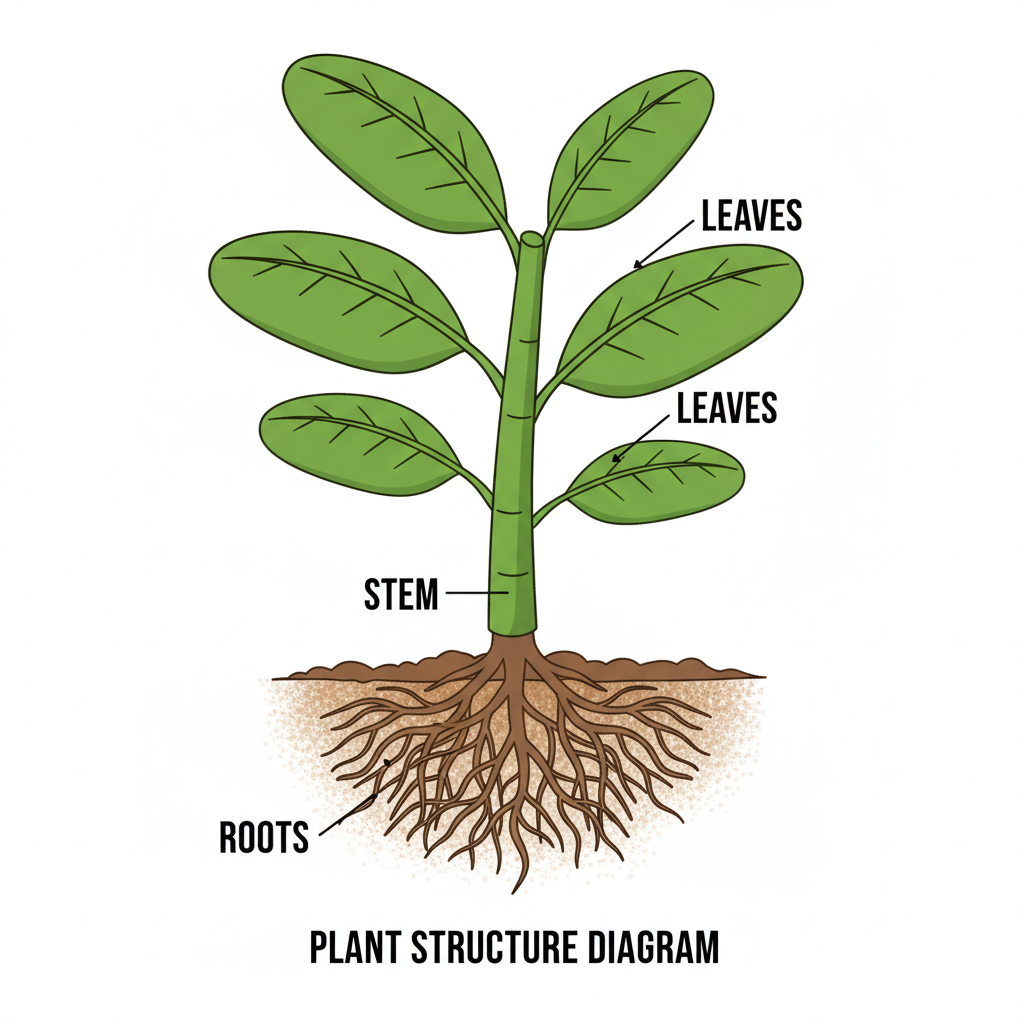
3. The Busy Leaves: The Plant's Food Factories
Think about how you eat food to get energy. Plants can't go to the grocery store! So, how do they get their food? They make it themselves in their leaves! Leaves are like the plant's tiny food factories.
Leaves use sunlight, water (which comes from the roots), and a gas from the air called carbon dioxide (which is what we breathe out) to make sugary food for the plant. This amazing process is called photosynthesis. It's like a chef in a kitchen using ingredients to cook a meal, but the plant uses sunlight as its stove!
Most leaves are flat and wide. This shape helps them catch as much sunlight as possible, just like a solar panel on a roof collects sunlight. They also have tiny little holes, too small to see without a microscope, that let the air in and out.
Analogy Alert: Leaves are like tiny solar-powered kitchens, making food for the whole plant!
Leaves come in all sorts of shapes and sizes! Some are long and thin like pine needles, while others are broad and round like a lily pad.
4. The Pretty Flowers: The Plant's Way to Make New Plants
Have you ever seen a bright, colorful flower? They are often the most beautiful part of a plant. But flowers are more than just pretty – they have a very important job! Flowers are the plant's way of making new plants. They are like the plant's baby-making parts.
Inside the flower, there are special parts that help make seeds. These seeds can then grow into brand new plants! Think of a flower like a special factory that produces seeds. Bees and butterflies often visit flowers to drink nectar, and while they're there, they help move pollen from one flower to another, which is important for making seeds.
Analogy Alert: Flowers are like the plant's seed-making nurseries or special seed factories!
Not all plants have flowers. Some plants, like ferns and mosses, make new plants in other ways. But for plants that do have flowers, they are a crucial part of the plant's life cycle!
Putting It All Together
So, we've met the four main parts of a plant:
- Roots: The anchors and drinkers, holding the plant down and soaking up water and nutrients.
- Stems: The support beams and highways, holding everything up and moving water, nutrients, and food.
- Leaves: The food factories, using sunlight, water, and air to make food for the plant.
- Flowers: The seed makers, helping the plant create new baby plants.
Each part works together like a team to help the plant survive, grow, and make more plants. Isn't nature amazing?
Keep learning, free
Create a free Syllabax account to unlock practice questions and games for this topic.
Visual Learning Enhanced! 🚀
To help you master this topic, we use Advanced Syllabax AI to generate detailed diagrams and visual models.
Note on Visuals: The AI sometimes makes spelling errors in image labels. Please refer to the lesson text for the correct terminology.