Future Trends in Technology
Watch this topic in 60 seconds
Free preview · Lesson 1
Understanding Future Trends in Technology
Future Trends in Technology: A Sneak Peek at Tomorrow!
Hey future explorers! Have you ever wondered what the world will be like when you're older? Will cars fly? Will robots clean your room? While we don't have a crystal ball, we can look at some amazing new technologies that are changing our world right now and give us clues about what's coming next. Think of this lesson as getting a special backstage pass to the future!
Technology is always growing and changing, just like a tiny seed grows into a huge tree. What seems like science fiction today might be part of our everyday lives tomorrow. Let's dive into some of the most exciting trends shaping our future!
1. Artificial Intelligence (AI): The Super-Smart Computer Brains
Imagine if your computer could not only do what you tell it but also *think* and *learn* like a human. That's pretty close to what Artificial Intelligence, or AI, is all about! AI refers to computer systems that can perform tasks that usually require human intelligence. This includes things like understanding speech, recognizing patterns, making decisions, and even solving problems.
Analogy: Think of AI like a very fast, very organized student who can learn incredibly quickly from lots and lots of information. If you show it a million pictures of cats, it learns what a cat looks like and can then identify new cats it's never seen before. It's not magic; it's just super-smart programming!
Where do we see AI today?
- Voice Assistants: When you ask Siri or Alexa a question, you're talking to AI!
- Recommendation Systems: When Netflix suggests a movie you might like, or YouTube recommends a video, that's AI figuring out your preferences.
- Self-Driving Cars: These cars use AI to 'see' the road, understand traffic, and make decisions about driving safely.
In the future, AI will likely help doctors diagnose illnesses, help scientists discover new medicines, and even make our homes smarter and more responsive to our needs.
2. Virtual Reality (VR) & Augmented Reality (AR): Stepping into New Worlds
Get ready to put on some special glasses and see the world in a whole new way! VR and AR are two technologies that blend digital content with our real world, but in different ways.
Virtual Reality (VR)
VR completely immerses you in a digital world. When you put on a VR headset, everything you see and hear is generated by a computer. It's like stepping inside a video game or visiting a place without actually leaving your room.
Analogy: VR is like reading a really good book and being so engrossed that you feel like you're *inside* the story. Or like putting on goggles that transport you to a completely different planet!
Augmented Reality (AR)
AR, on the other hand, adds digital information or objects to your *real* world view. You can still see everything around you, but there are computer-generated elements layered on top. Think of it like a digital overlay.
Analogy: AR is like wearing special glasses that can show you the names of stars when you look up at the night sky, or a game like Pokémon Go, where digital characters appear in your real park through your phone screen.
In the future, VR could revolutionize education (imagine visiting ancient Rome in your history class!) and entertainment, while AR could provide helpful information directly in our line of sight, making tasks easier and more interactive.
3. Robotics: Our Future Helpers
Robots are not just characters in sci-fi movies anymore; they are increasingly becoming a part of our real world! A robot is a machine that can carry out a complex series of actions automatically, often programmed by a computer.
Analogy: Think of a robot as a highly skilled, programmable assistant. You tell it what to do, and it does it efficiently and precisely, often repeating the same task perfectly every time.
What kinds of robots are there?
- Industrial Robots: These work in factories, building cars, assembling electronics, and performing dangerous tasks.
- Service Robots: These can clean floors, deliver food in restaurants, or even assist doctors in surgery.
- Exploration Robots: Like the rovers exploring Mars, these robots go to places too dangerous or difficult for humans.
As robots become more advanced, they will likely help us in more ways, from caring for the elderly to exploring new frontiers in space. They are designed to assist humans, making our lives safer and more productive.
4. The Internet of Things (IoT): Everything Connected!
Imagine if your refrigerator could tell you when you're running low on milk, or if your alarm clock could automatically turn on your coffee maker. This is the idea behind the Internet of Things, or IoT!
IoT refers to connecting everyday objects—like appliances, cars, watches, and even shoes—to the internet. These 'smart' objects have sensors and software that allow them to collect and exchange data with other devices and systems over the internet.
Analogy: Think of IoT like your home and all your gadgets having a big, helpful conversation with each other. They're all connected and can share information to make your life easier and smarter.
Examples of IoT:
- Smart Homes: Thermostats that learn your preferred temperature, lights you can control with your phone.
- Wearable Tech: Smartwatches that track your steps and heart rate, sending data to your phone.
- Smart Cities: Traffic lights that adjust based on real-time traffic flow, smart parking meters.
The IoT promises a future where our environments are more responsive and helpful, making our daily routines smoother and more efficient.
5. Sustainable Technology (Green Tech): Tech for a Healthier Planet
As we use more technology, it's super important to make sure we're not harming our planet. Sustainable technology, or 'Green Tech,' is all about creating and using technology in ways that protect the environment and don't use up all our natural resources.
Analogy: Think of Green Tech as technology wearing a superhero cape for Earth. It's designed to fight pollution, conserve energy, and help us live in harmony with nature.
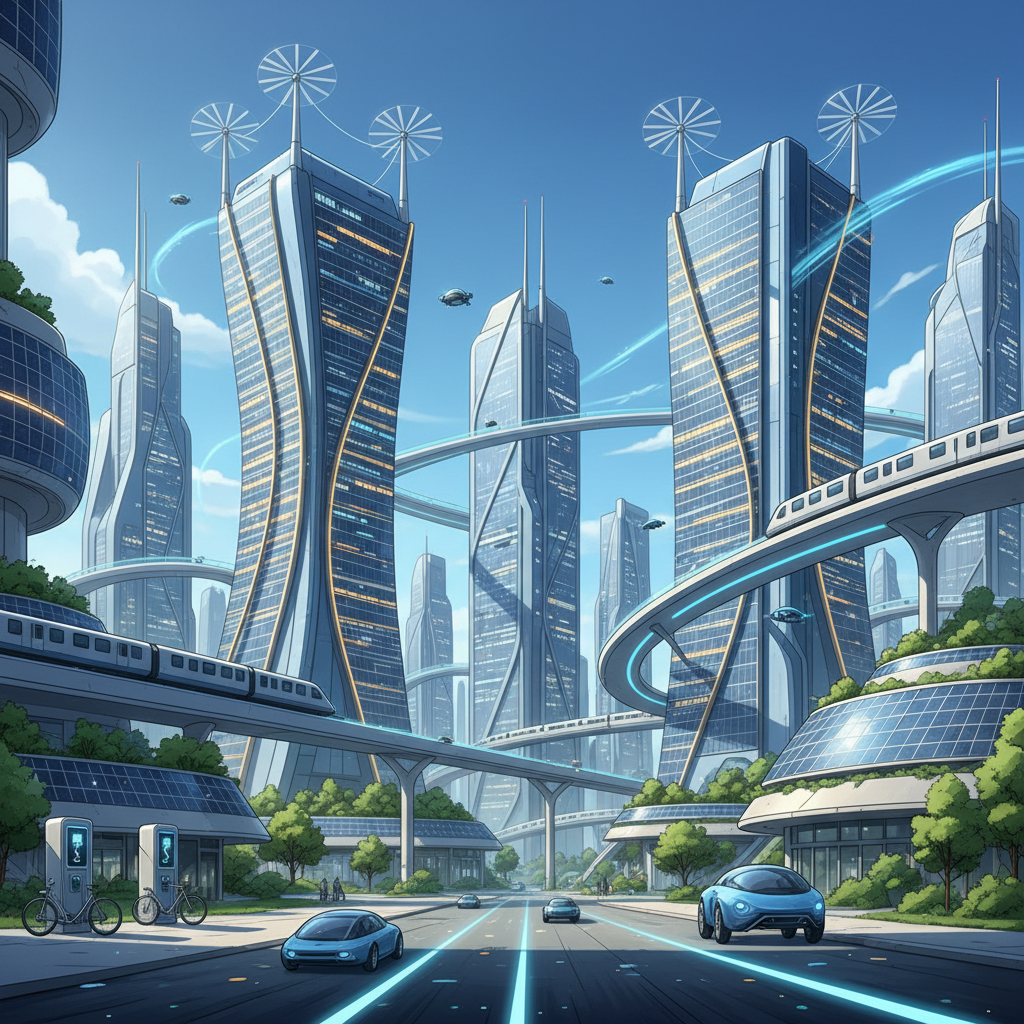 ⚠️ This picture may have spelling mistakes. Trust the words in the lesson.
Examples of Green Tech:
- Renewable Energy: Solar panels that turn sunlight into electricity, wind turbines that harness wind power.
- Electric Vehicles: Cars and buses that run on electricity instead of gasoline, reducing air pollution.
- Energy-Efficient Devices: Computers, refrigerators, and light bulbs designed to use less power.
- Recycling Technology: Machines that can sort and process waste more effectively to turn it into new products.
The future of technology isn't just about cool gadgets; it's also about using our cleverness to build a better, cleaner, and healthier world for everyone.
Looking Ahead: Your Role in the Future
These trends—AI, VR/AR, Robotics, IoT, and Green Tech—are just some pieces of the amazing puzzle that is our future. As you grow up, these technologies will become even more common. Understanding them now means you'll be better prepared to adapt, innovate, and even contribute to shaping the world you'll live in.
The future isn't something that just happens; it's something we build together. So stay curious, keep learning, and get ready to be a part of creating an incredible tomorrow!
Keep learning, free
Create a free Syllabax account to unlock practice questions and games for this topic.
Visual Learning Enhanced! 🚀
To help you master this topic, we use Advanced Syllabax AI to generate detailed diagrams and visual models.
Note on Visuals: The AI sometimes makes spelling errors in image labels. Please refer to the lesson text for the correct terminology.