Substitution method [Algebraic Operations]
Watch this topic in 60 seconds
Free preview · Lesson 1
Understanding Substitution method [Algebraic Operations]
Algebraic Operations: The Substitution Method (Grade 6 - Foundational)
Welcome, young mathematicians, to the exciting world of algebra! Today, we're going to unlock a super-useful tool called the **Substitution Method**. Think of it as being a detective, but instead of solving mysteries with clues, we're solving math problems by swapping things out! It's like a secret code or a magic trick that helps us find unknown numbers.
What is Algebra?
Before we dive into substitution, let's quickly remember what algebra is. Algebra is like a playground for numbers where we use letters (called **variables**) to represent numbers we don't know yet. For example, instead of saying 'a number plus 3 equals 7', we can write it as x + 3 = 7. Here, 'x' is our secret number, our variable! Algebra helps us solve for these unknown numbers.
What is Substitution?
Now, let's talk about substitution. Imagine you have a favorite toy, let's say a red car. Your friend has a blue car. If your mom says, "Can you bring me the toy car?", and you both have toy cars, she might get confused. But if she says, "Can you bring me the red car?", you know exactly which toy to grab! You're substituting the general word "car" with the specific word "red" to make it clear.
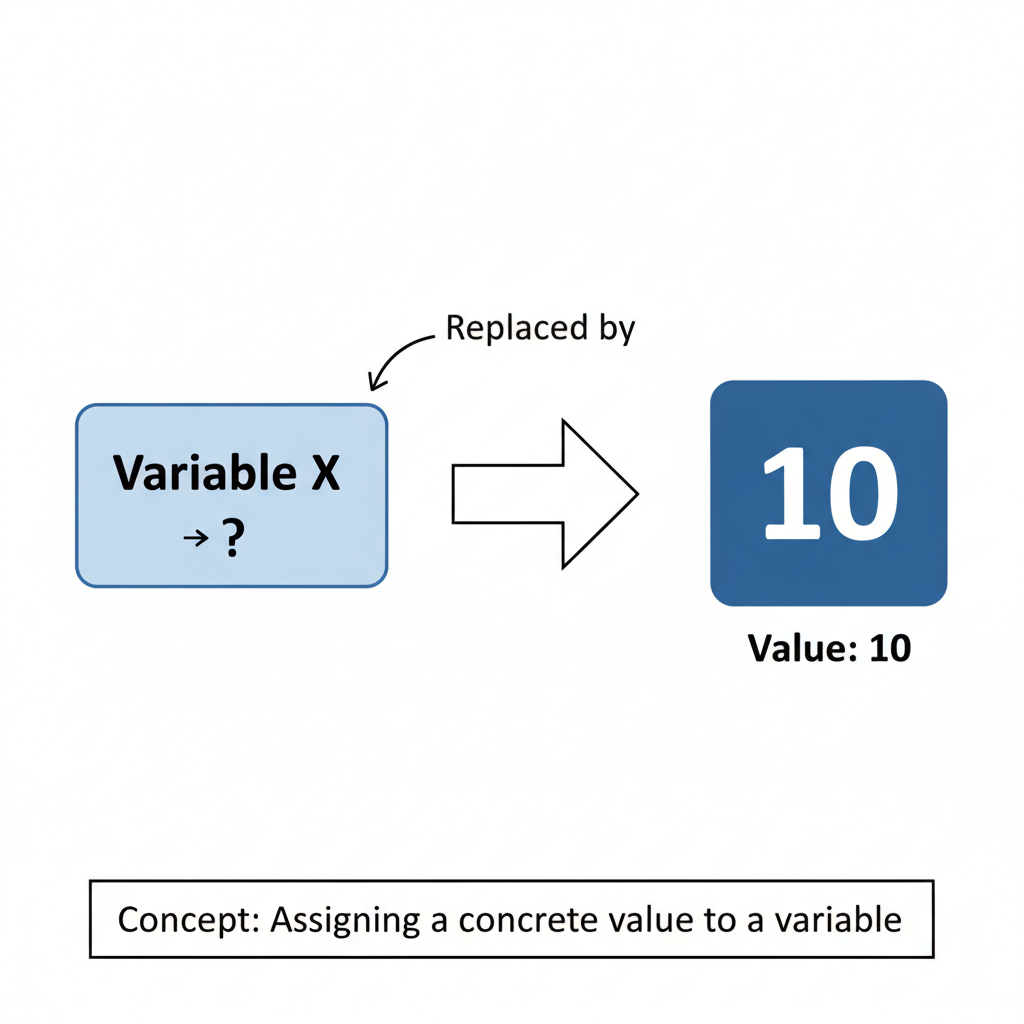
In math, substitution works in a very similar way. When we substitute, we are replacing one thing with another equivalent thing. In algebra, this usually means replacing a variable with a number that we know it equals, or replacing an expression with something that has the same value.
The Substitution Method in Algebra
The Substitution Method is a powerful technique used in algebra to solve equations, especially when we have more than one equation. For foundational understanding, we'll focus on using it with a single equation first. The main idea is:
- Find the value of a variable: Sometimes, a problem will tell you the value of a variable directly.
- Replace the variable: Take that known value and "substitute" it into an equation wherever you see that variable.
- Solve the equation: Once you've replaced the variable with its number, you'll have a simpler equation that you can solve.
Analogy Time! The Mystery Box
Let's use an analogy. Imagine you have a mystery box (that's our variable, say 'm'). You know that this mystery box contains exactly 5 shiny marbles. So, m = 5.
Now, let's say you have a recipe for cookies that says:
Number of Cookies = 2 * (Number of Marbles) + 3
Instead of just "Number of Marbles", we know our mystery box 'm' has 5 marbles. So, we can substitute the value of 'm' (which is 5) into the recipe:
Number of Cookies = 2 * (5) + 3
See what we did? We replaced "Number of Marbles" (or 'm') with the number 5. Now, the recipe is easy to follow!
Let's solve it:
Number of Cookies = 10 + 3
Number of Cookies = 13
So, with 5 marbles in our mystery box, we can make 13 cookies!
Another Analogy: The Secret Ingredient Swap
Think about baking a cake. You have a recipe that calls for "sweetener". You also know that you have a special jar labeled "Honey" which is exactly the same amount of sweetness as the "sweetener" the recipe needs. So, you can substitute the "Honey" from your jar for the "sweetener" in the recipe.
In math, if an equation says y + 7 = 15, and you are later told that y = 8, you can substitute 8 for 'y' in the equation:
(8) + 7 = 15
Now you can check if it's true! 8 + 7 is indeed 15. So, it works!
The substitution method is like having a key that unlocks the value of a variable. Once you have the key (the value), you can open the lock (substitute it into the equation) and see what happens!
Let's Practice with Simple Equations
Here's how it looks in a simple equation:
Problem: If a = 4, what is the value of a + 5?
Solution:
- We know that a is equal to 4.
- We want to find the value of a + 5.
- Let's substitute the number 4 wherever we see the letter 'a' in the expression a + 5.
- So, a + 5 becomes (4) + 5.
- Now, we just solve: 4 + 5 = 9.
Answer: The value of a + 5 is 9.
Problem: If b = 10, what is the value of 3 * b?
Solution:
- We know that b is equal to 10.
- We want to find the value of 3 * b.
- Let's substitute the number 10 wherever we see the letter 'b' in the expression 3 * b.
- So, 3 * b becomes 3 * (10).
- Now, we just solve: 3 * 10 = 30.
Answer: The value of 3 * b is 30.
See? It's like replacing a placeholder with the actual item! The variable 'a' or 'b' is the placeholder, and the number we're given is the actual item.
Why is Substitution Important?
The substitution method is a building block for more advanced math. It helps us:
- Simplify complex expressions: By replacing unknown parts with known values, we make problems easier to handle.
- Solve systems of equations: In later grades, you'll use substitution to solve problems with multiple equations and multiple unknowns.
- Understand how variables work: It reinforces the idea that a variable can represent different values, and we can work with those values.
Think of it as a key skill for unlocking mathematical challenges. Keep practicing, and you'll become a substitution superstar!
Keep learning, free
Create a free Syllabax account to unlock practice questions and games for this topic.
Visual Learning Enhanced! 🚀
To help you master this topic, we use Advanced Syllabax AI to generate detailed diagrams and visual models.
Note on Visuals: The AI sometimes makes spelling errors in image labels. Please refer to the lesson text for the correct terminology.