Electrons, protons, neutrons[CHEMISTRY]
Watch this topic in 60 seconds
Free preview · Lesson 1
Understanding Electrons, protons, neutrons[CHEMISTRY]
The Invisible Building Blocks: Protons, Neutrons, and Electrons
Have you ever wondered what everything around you is made of? From the air you breathe to the chair you're sitting on, and even you yourself, everything is constructed from incredibly tiny particles called atoms. Atoms are the fundamental building blocks of all matter in the universe. But here's an even more fascinating secret: atoms themselves are not solid, indivisible balls! They are made up of even smaller, fundamental particles. Think of an atom as a miniature solar system, with a central 'sun' and tiny 'planets' orbiting around it.
In this lesson, we're going to dive deep into the heart of the atom and meet its three most important residents: protons, neutrons, and electrons. Understanding these three particles is like learning the alphabet of chemistry – once you know them, you can start to understand how everything in the universe fits together.
The Atom: A Tiny Universe in Itself
Imagine shrinking down to an unbelievably small size, small enough to peer inside an atom. What would you see? You'd find a dense, heavy center, like a tiny marble in the middle of a huge sports stadium. This center is called the nucleus. And zooming around this nucleus, at incredible speeds, would be even smaller particles, almost like tiny gnats buzzing around the stadium's stands. These are the electrons.
Let's break down the three main subatomic particles that make up this tiny universe:
1. Protons: The Identity Givers
Think of protons as the 'ID cards' or the 'captains' of the atom. They are located right in the heart of the atom, within the nucleus. Here's what makes them special:
- Charge: Protons carry a positive electrical charge. We often represent this as +1. Imagine them as tiny magnets with a 'plus' side.
- Mass: Protons are relatively heavy. They have a mass of approximately 1 atomic mass unit (amu). To give you an idea, this is about 1,836 times heavier than an electron! So, if an atom were a car, the proton would be like the engine block – heavy and central.
- Location: Always found in the nucleus, the atom's central core.
- Role: This is perhaps their most crucial role: the number of protons determines what element an atom is! Every atom of Hydrogen has 1 proton. Every atom of Helium has 2 protons. Every atom of Carbon has 6 protons. If you change the number of protons, you change the element entirely! It's like changing the type of fruit; an apple is an apple because of its specific 'proton count' of apple-ness. This number is so important, it even has a special name: the Atomic Number (Z).
2. Neutrons: The Stabilizers
If protons are the captains, think of neutrons as their 'bodyguards' or 'peacemakers'. They also reside in the nucleus, right alongside the protons. Here's their profile:
- Charge: Neutrons are neutral, meaning they have no electrical charge at all. They are neither positive nor negative (we represent this as 0). They're like Switzerland in the world of atomic particles – completely unbiased!
- Mass: Just like protons, neutrons are also relatively heavy, with a mass of approximately 1 atomic mass unit (amu). They are almost identical in mass to protons. So, in our car analogy, if protons are the engine block, neutrons are other heavy parts of the engine, right there with them.
- Location: Also found in the nucleus, the atom's central core.
- Role: Their main job is to help hold the nucleus together. Protons, being all positively charged, naturally want to repel each other (like trying to push the 'plus' ends of two magnets together). Neutrons act as a kind of 'nuclear glue' or 'buffer', separating the protons just enough to reduce their repulsion and keep the nucleus stable. Without neutrons, many nuclei would fly apart!
3. Electrons: The Busy Bees
While protons and neutrons are snug in the nucleus, electrons are the busy, energetic particles that whiz around the outside. Think of them as tiny, super-fast 'runners' or 'scouts' constantly circling the central headquarters (the nucleus).
- Charge: Electrons carry a negative electrical charge. We often represent this as -1. They are the opposite of protons.
- Mass: This is where electrons are vastly different from protons and neutrons. Electrons are incredibly, incredibly light! Their mass is so tiny (about 1/1836th of a proton's mass) that we often consider it negligible when calculating an atom's overall mass. If an atom were a basketball court, the nucleus would be a tiny pea at the center, and the electrons would be like dust motes floating around the entire court – barely there in terms of weight, but occupying a vast amount of space.
- Location: Electrons are found orbiting the nucleus in specific regions called electron shells or energy levels. Imagine them like planets orbiting the sun, each in its own distinct path or 'orbit'. They don't just fly randomly; they occupy specific energy levels around the nucleus.
- Role: Electrons are the rock stars of chemical reactions! Because they are on the outer edges of the atom, they are the ones that interact when atoms meet each other. They determine how atoms bond together to form molecules. Gaining, losing, or sharing electrons is the basis of all chemistry and how different substances are formed. They are like the 'hands' of the atom, reaching out to connect with other atoms.
Putting It All Together: A Model of the Atom
So, to recap: the atom has a tiny, dense, positively charged nucleus in its center, made up of protons (positive) and neutrons (neutral). This nucleus contains almost all of the atom's mass. Whizzing around this central nucleus, in vast amounts of empty space, are the incredibly light, negatively charged electrons. These electrons occupy specific energy levels or shells.
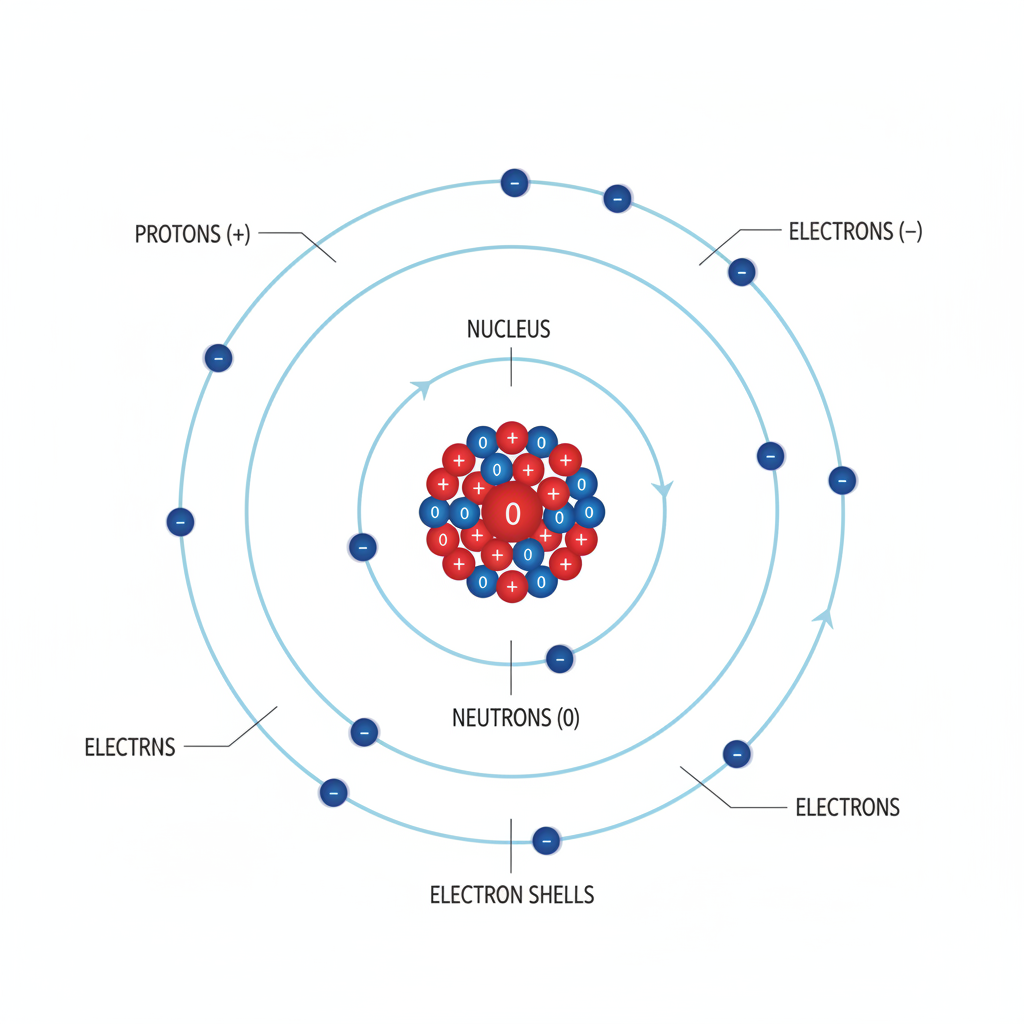 ⚠️ This picture may have spelling mistakes. Trust the words in the lesson.
Key Concepts to Remember:
- Atomic Number (Z): This is simply the number of protons in an atom. It's the unique identifier for each element. For example, all atoms with 6 protons are carbon atoms.
- Mass Number (A): This is the total number of protons + neutrons in an atom. Since protons and neutrons are the heaviest parts, the mass number gives us a good estimate of an atom's total mass. (Electrons are so light they don't contribute significantly to the mass).
- Neutral Atoms: In an electrically neutral atom (meaning it has no overall charge), the number of protons always equals the number of electrons. The positive charges from the protons cancel out the negative charges from the electrons, resulting in a net charge of zero.
- Ions (A Glimpse): Sometimes, atoms can gain or lose electrons. When this happens, the balance of positive protons and negative electrons is upset, and the atom gets an overall electrical charge. These charged atoms are called ions. But that's a story for another day!
Why Do These Particles Matter?
Understanding protons, neutrons, and electrons is fundamental to all chemistry:
- Protons tell us *what* element we are looking at.
- Neutrons affect the *stability* and mass of the atom (and give rise to interesting variations called isotopes).
- Electrons determine *how* an atom behaves, its chemical properties, and how it will interact with other atoms to form molecules and compounds. They are the ultimate determinants of chemical reactions.
So, the next time you look at anything, remember that it's all made of these three tiny, amazing particles, working together to create the incredible diversity of matter we see around us!
Keep learning, free
Create a free Syllabax account to unlock practice questions and games for this topic.
Visual Learning Enhanced! 🚀
To help you master this topic, we use Advanced Syllabax AI to generate detailed diagrams and visual models.
Note on Visuals: The AI sometimes makes spelling errors in image labels. Please refer to the lesson text for the correct terminology.