Odd & even numbers (Patterns in Numbers)
Watch this topic in 60 seconds
Free preview · Lesson 1
Understanding Odd & even numbers (Patterns in Numbers)
Understanding Odd and Even Numbers: Spotting Patterns in Numbers!
Hello, young mathematicians! Get ready to explore a super fun and important idea in math: odd numbers and even numbers. These aren't just random numbers; they have special patterns that make them behave in unique ways. Think of them like secret codes that numbers use!
What are Even Numbers?
Let's start with even numbers. Imagine you have a box of cookies, and you want to share them equally with your friend. If you can give your friend exactly the same number of cookies as you keep, then the total number of cookies you had is an even number.
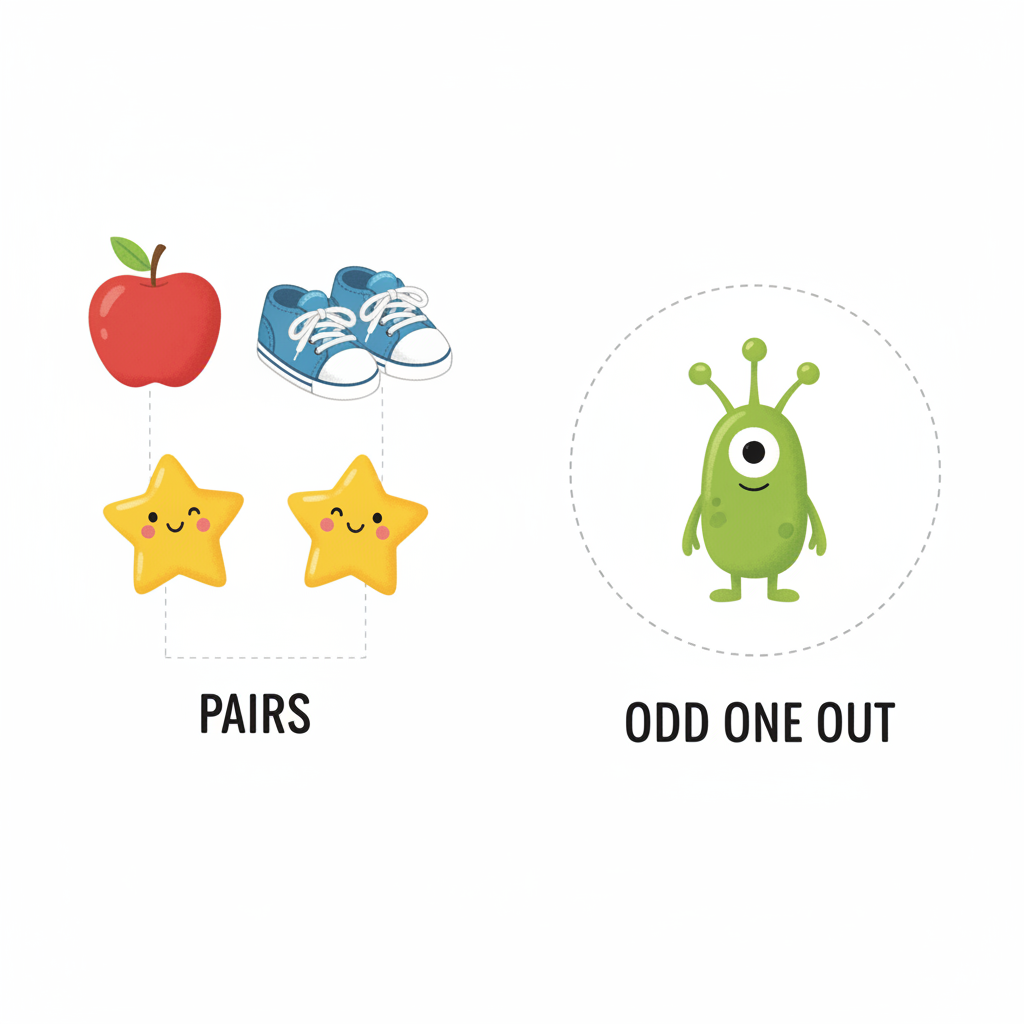
Another way to think about it is pairing up. Even numbers love to be in pairs! If you can group objects into pairs with none left over, that's an even number. For example, if you have 4 apples:
- Apple 1 and Apple 2 make a pair.
- Apple 3 and Apple 4 make another pair.
See? All the apples are in pairs! That means 4 is an even number. What about 6 ducks?
- Duck 1 and Duck 2 form a pair.
- Duck 3 and Duck 4 form a pair.
- Duck 5 and Duck 6 form a pair.
Again, all paired up! So, 6 is also an even number.
The Big Clue for Even Numbers: A super easy way to tell if a number is even is to look at its last digit (the digit all the way on the right). If the last digit is 0, 2, 4, 6, or 8, the whole number is even!
Let's look at some even numbers:
- 2 (ends in 2)
- 10 (ends in 0)
- 24 (ends in 4)
- 38 (ends in 8)
- 102 (ends in 2)
- 566 (ends in 6)
Even numbers are like perfectly balanced scales – everything can be divided equally.
 ⚠️ This picture may have spelling mistakes. Trust the words in the lesson.
What are Odd Numbers?
Now, let's talk about odd numbers. Imagine you have a bag of candies, and you try to share them equally with your friend. If, after sharing as equally as you can, there's always one candy left over that you can't share, then the total number of candies is an odd number.
Odd numbers don't like to be perfectly paired up. There's always one left out!
Let's try with 5 balls:
- Ball 1 and Ball 2 make a pair.
- Ball 3 and Ball 4 make another pair.
- Ball 5 is all alone!
Because there's one ball left over, 5 is an odd number. What about 7 smiley faces?
- Smiley 1 and Smiley 2 form a pair.
- Smiley 3 and Smiley 4 form a pair.
- Smiley 5 and Smiley 6 form a pair.
- Smiley 7 is left by itself!
One smiley face is left out, so 7 is an odd number.
The Big Clue for Odd Numbers: Just like with even numbers, look at the last digit. If the last digit is 1, 3, 5, 7, or 9, the whole number is odd!
Let's look at some odd numbers:
- 1 (ends in 1)
- 13 (ends in 3)
- 25 (ends in 5)
- 37 (ends in 7)
- 101 (ends in 1)
- 569 (ends in 9)
Odd numbers are like a group of friends where one person always ends up standing alone!
Putting it all Together: The Pattern!
Let's look at the numbers in order. Do you see the pattern?
- 1 (Odd)
- 2 (Even)
- 3 (Odd)
- 4 (Even)
- 5 (Odd)
- 6 (Even)
- 7 (Odd)
- 8 (Even)
- 9 (Odd)
- 10 (Even)
- 11 (Odd)
- 12 (Even)
The pattern is simple: Odd, Even, Odd, Even... It just keeps going back and forth!
This pattern helps us know about any number, no matter how big!
Why is this Important?
Knowing about odd and even numbers helps us in many ways. It's like having a secret key to understanding numbers better. You'll use this idea when you learn about:
- Adding and subtracting numbers (sometimes adding two evens makes an even, or adding an odd and an even makes an odd!).
- Grouping things in math problems.
- Understanding measurement and patterns in the world around you.
So, keep an eye out for those odd and even numbers – they're everywhere!
Keep learning, free
Create a free Syllabax account to unlock practice questions and games for this topic.
Visual Learning Enhanced! 🚀
To help you master this topic, we use Advanced Syllabax AI to generate detailed diagrams and visual models.
Note on Visuals: The AI sometimes makes spelling errors in image labels. Please refer to the lesson text for the correct terminology.