How sound travels (Sound)
Watch this topic in 60 seconds
Free preview · Lesson 1
Understanding How sound travels (Sound)
How Sound Travels: A Journey Through Vibrations!
Hey there, young explorers! Have you ever wondered how you hear your favorite song, your teacher's voice, or even the crunch of your morning cereal? It's all thanks to something amazing called sound! Let's go on a super cool adventure to discover how sound travels from where it's made all the way to your ears.
What is Sound? (It All Starts with a Wiggle!)
Imagine you pluck a guitar string. What happens? It wiggles, right? Or if you tap a drum, the drum skin shakes. These fast back-and-forth movements are called vibrations. Think of it like a tiny dance! Sound is made whenever something vibrates.
Analogy Time! Think about a spring toy, like a Slinky. If you stretch it out and push one end, you see a wiggle travel all the way to the other end. That wiggle is like a vibration, and the way it moves is similar to how sound travels!
Sound Needs a Helper: The 'Medium'
Now, here's a very important secret about sound: it can't just float around all by itself. Sound needs something to travel through, like a path or a road. We call this path a medium. A medium can be a solid, a liquid, or a gas.
1. Sound Traveling Through Air (A Bumping Party!)
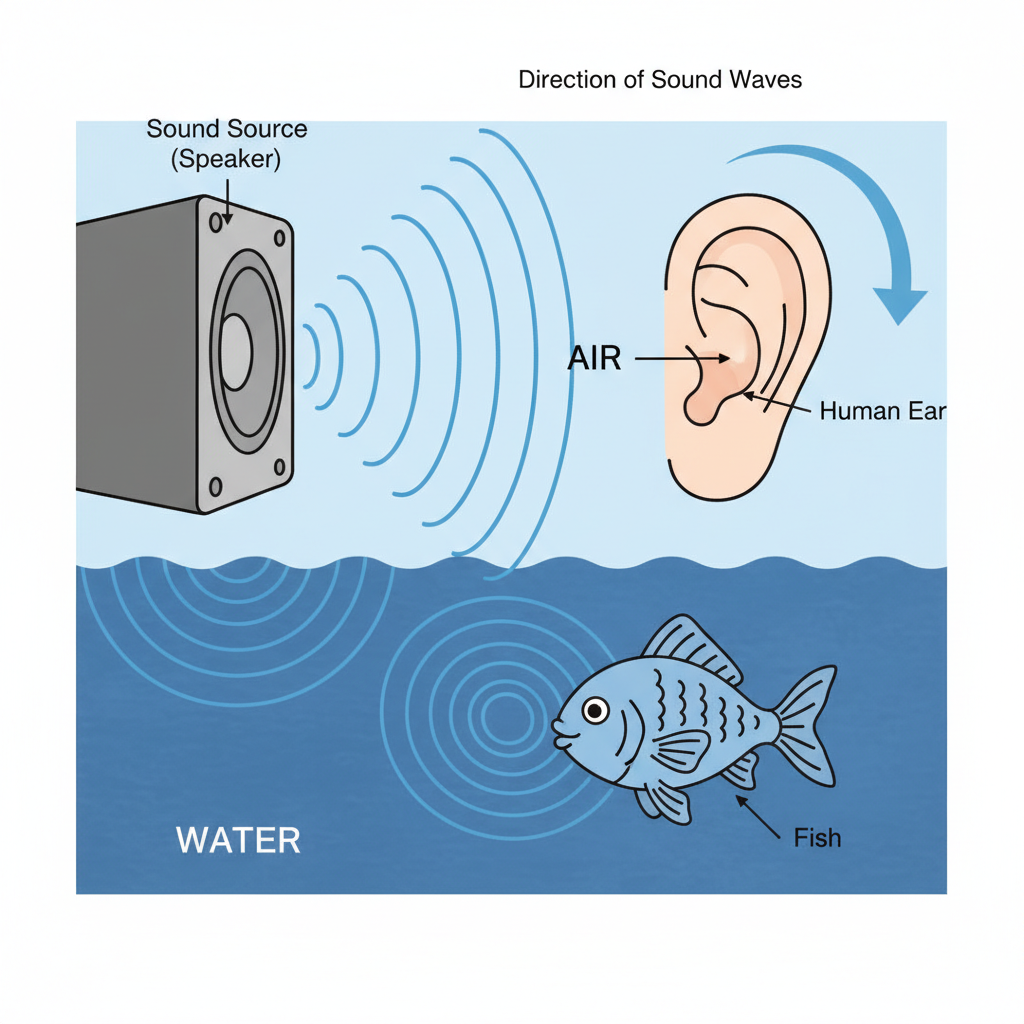
Most of the sounds we hear every day travel through the air around us. Air is a gas, and it's made up of tiny, tiny things called molecules (too small to see!). When something vibrates, like your vocal cords when you talk, it pushes the air molecules right next to it.
Analogy Time! Imagine a long line of dominoes. When you push the first domino, it falls and bumps into the next one, which bumps into the next, and so on. A wave of falling dominoes travels down the line, even though each domino only moves a little bit. That's exactly how sound travels through air! Your vibrating vocal cords are like the first domino, and the air molecules are all the other dominoes. Each molecule bumps into its neighbor, passing the sound energy along until it reaches your ear.
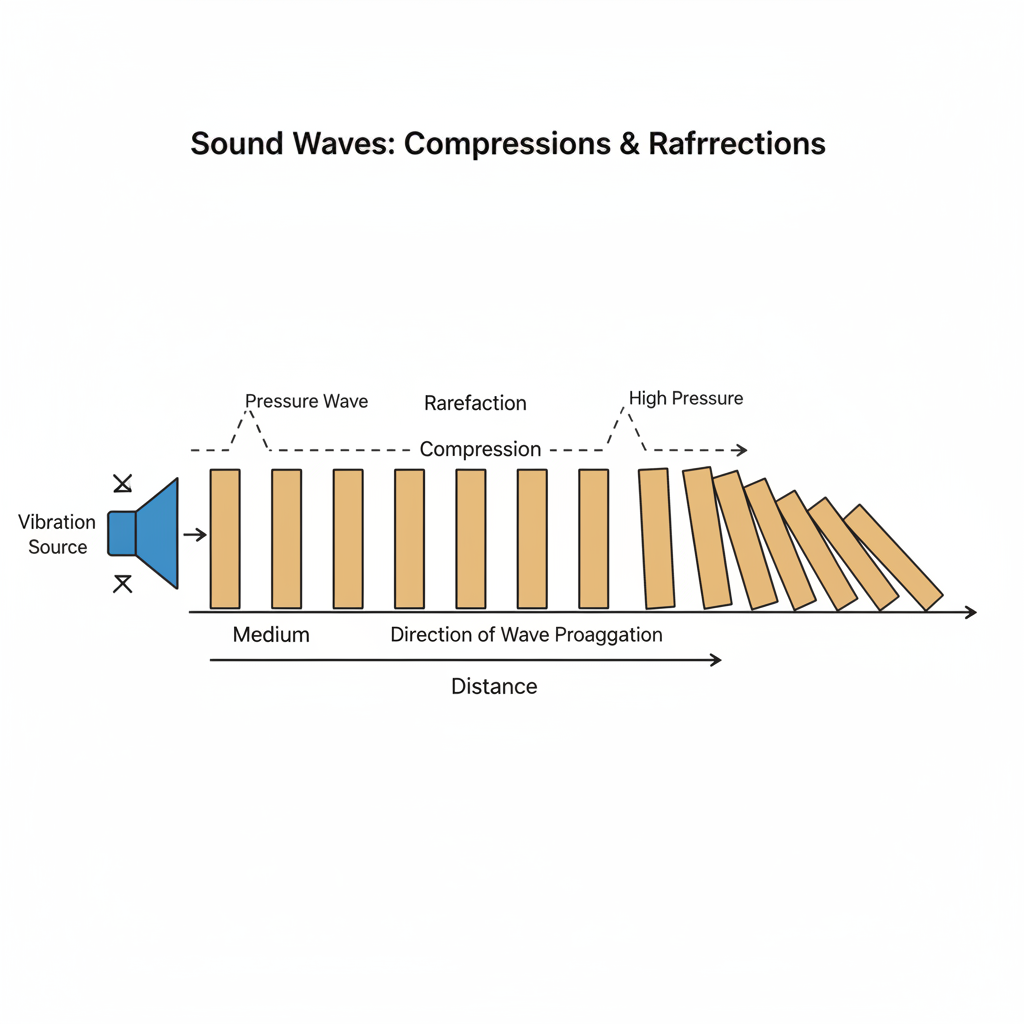 ⚠️ This picture may have spelling mistakes. Trust the words in the lesson.
2. Sound Traveling Through Solids (Super Fast!)
Did you know sound can travel through solid objects too? In fact, it often travels much faster through solids than through air! Solids are things like wood, metal, or even the ground.
Analogy Time! Try this: put your ear gently on a wooden desk. Have a friend lightly tap the other end of the desk with their finger. You'll hear the tap! Now, lift your head and have them tap again. The sound you heard with your ear on the desk was probably louder and clearer, right? That's because the molecules in a solid are packed much closer together than in air. They're like people standing very close in a crowded room. When one person pushes, the push quickly passes through the whole crowd. This means the vibrations can pass from molecule to molecule much more quickly and efficiently.
3. Sound Traveling Through Liquids (Underwater Concerts!)
Sound can also travel through liquids, like water! If you've ever been swimming underwater, you might have heard muffled sounds from above or even other sounds underwater. Whales and dolphins communicate over long distances using sound traveling through water.
The molecules in liquids are closer together than in gases (air), but not as tightly packed as in solids. So, sound travels faster through liquids than through air, but usually not as fast as through solids.
Where Sound CANNOT Go (No Sound in Space!)
Since sound needs a medium – something to vibrate and pass the energy along – what happens if there's no medium at all? Like in outer space?
There's almost no air or anything else in space. It's mostly an empty space, which we call a vacuum. Because there are no molecules to bump into each other, sound cannot travel in space! If a huge star exploded in space, you wouldn't hear a thing, even if you were close enough to see it shine brightly.
Analogy Time! Imagine you're trying to send a message by whispering to a friend. If your friend is right next to you, it's easy. If they are across the room, it's harder. But if they are on a different planet, with nothing in between you and them, how could your whisper ever reach them? It can't! Sound needs a bridge, and that bridge is the medium.
How We Hear It
When sound vibrations travel through a medium and reach your ear, they cause a tiny part inside your ear, called the eardrum, to vibrate. Your brain then turns these vibrations into the sounds you recognize and understand!
Quick Recap!
So, sound is made by vibrations, and it travels by making the particles in a medium (like air, water, or a solid object) bump into each other, passing the vibration along. No medium? No sound!
Keep learning, free
Create a free Syllabax account to unlock practice questions and games for this topic.
Visual Learning Enhanced! 🚀
To help you master this topic, we use Advanced Syllabax AI to generate detailed diagrams and visual models.
Note on Visuals: The AI sometimes makes spelling errors in image labels. Please refer to the lesson text for the correct terminology.