Solids, liquids, gases (Matter Around Us)
Watch this topic in 60 seconds
Free preview · Lesson 1
Understanding Solids, liquids, gases (Matter Around Us)
Understanding Matter: Solids, Liquids, and Gases
Hello, young scientists! Have you ever wondered what everything around you is made of? The chair you're sitting on, the water you drink, and even the air you breathe – it's all made of something called matter. Matter is anything that takes up space and has weight. Think about it: a big rock takes up a lot of space and is heavy, and even a tiny puff of air, though you can't see it, takes up space and has a little bit of weight! Today, we're going to explore the three main ways matter shows up in our world: as solids, liquids, and gases.
1. Solids: Things with a Firm Shape
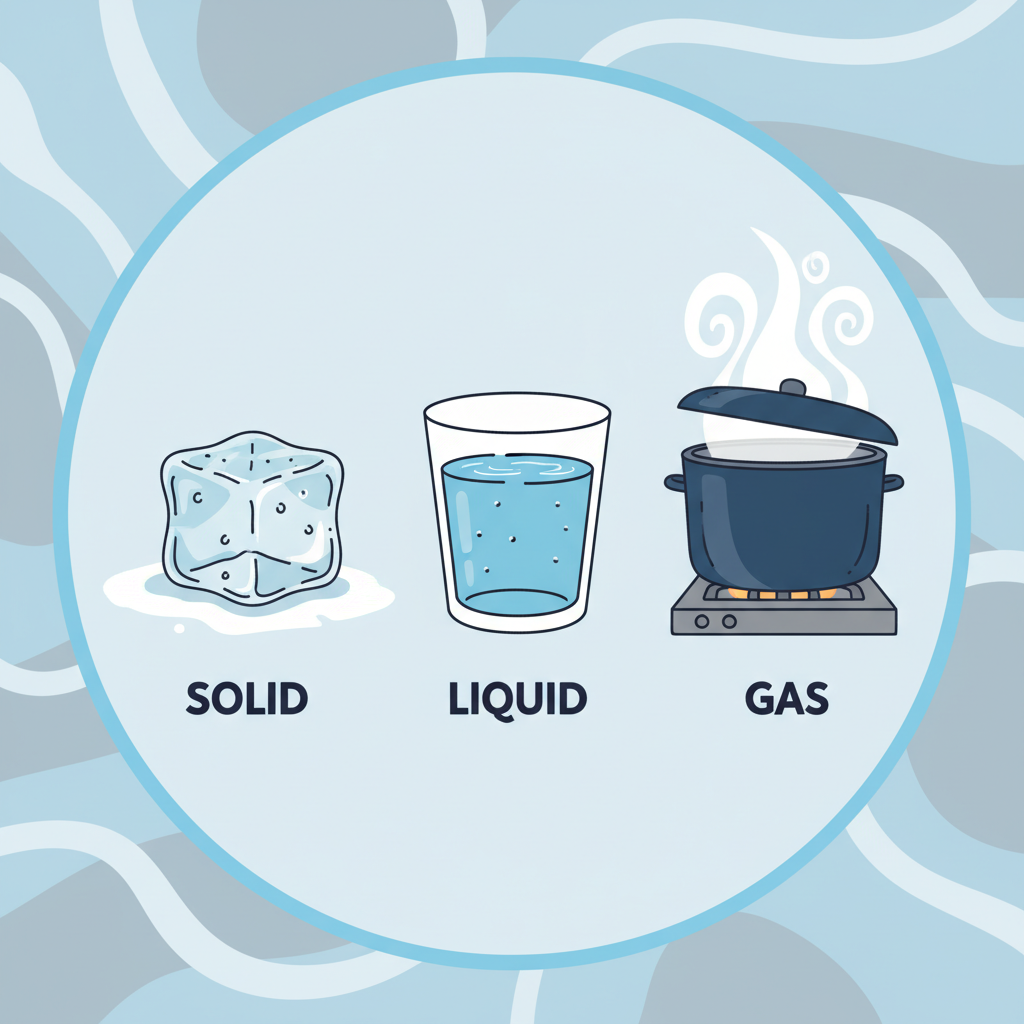
Imagine your favorite toy block. If you put it on the table, does it change its shape? No! If you pick it up, does it suddenly get bigger or smaller? No! That's because the toy block is a solid. Solids are types of matter that have a definite shape and a definite volume.
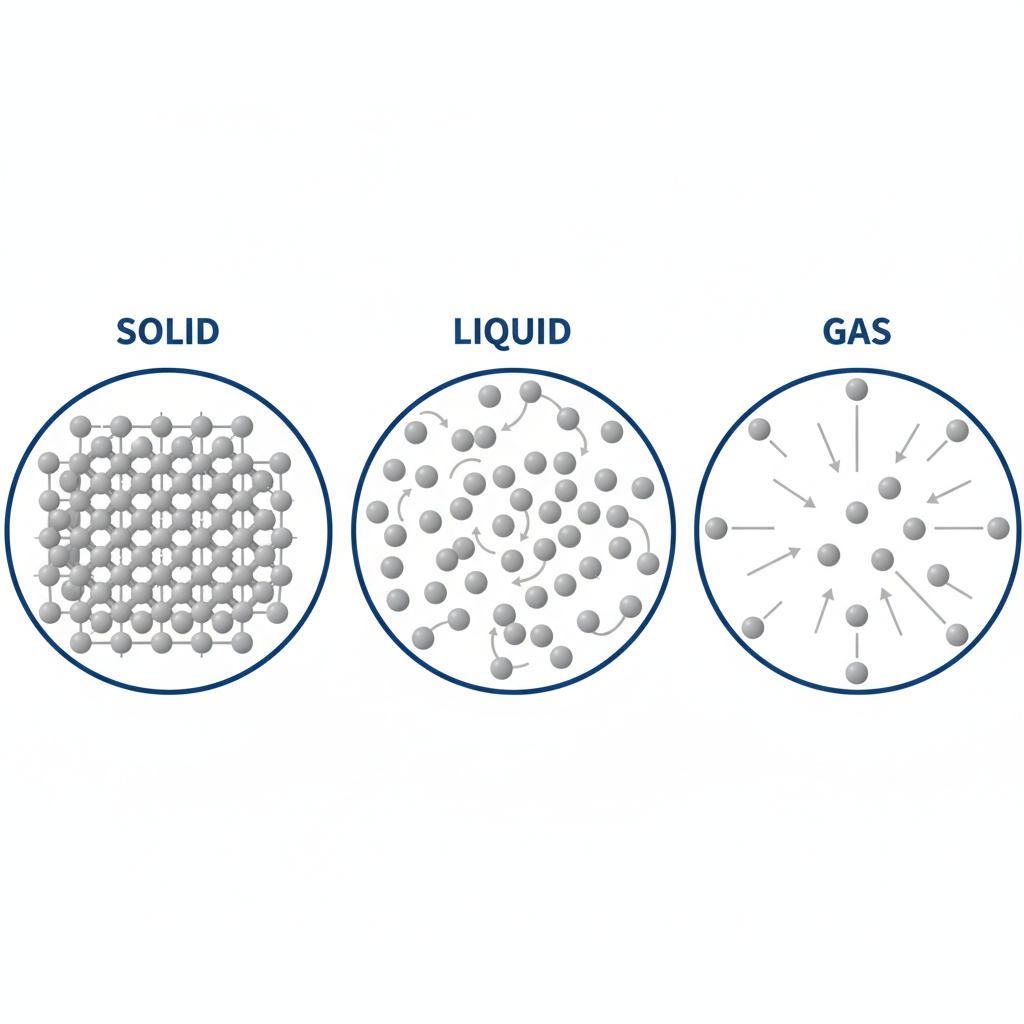
Think of it like this: if you have a team of friends and you all hold hands very, very tightly, you form a solid group. You can't easily move past each other, and your group keeps its shape. Inside a solid, tiny, tiny pieces called particles (they are too small to see!) are packed very close together. They are like our friends holding hands tightly. They can wiggle and vibrate a little bit in their spots, but they can't move past each other easily. This is why a solid keeps its own shape and doesn't spread out.
What makes a solid a solid?
- Definite Shape: A solid keeps its own shape. A brick always looks like a brick, whether it's on the floor or on a shelf.
- Definite Volume: A solid takes up the same amount of space no matter where you put it. A toy car doesn't get bigger or smaller if you move it from one room to another.
- Examples: Ice cubes, rocks, books, desks, pencils, your shoes, a baseball, a slice of bread, a chocolate bar (before it melts!).
- Feel: Solids are usually hard and firm, though some, like a sponge or a pillow, can be squishy, but they still have their own shape.
If you put an ice cube (a solid) into a cup, it keeps its cube shape. It won't suddenly turn into a sphere or fill the entire cup unless it changes into a liquid first. That's the power of solids!
2. Liquids: Matter That Flows
Now, think about a glass of water or a carton of milk. If you pour water from a pitcher into a glass, what happens? The water takes the shape of the glass, right? If you pour it into a bowl, it takes the shape of the bowl! Water, milk, and juice are all examples of liquids.
Liquids are types of matter that have a definite volume, but they do not have a definite shape. They always take the shape of the container they are in. They like to flow and move!
Let's go back to our friends analogy. Imagine your team of friends holding hands, but this time, you're holding hands loosely. You can still stay together as a group (that's your definite volume), but you can slide past each other, walk around, and change the shape of your group to fit into different spaces, like a small room or a long hallway. The particles in a liquid are like this: they are close together, but they can slide and move past each other. This is why liquids can be poured and flow.
What makes a liquid a liquid?
- No Definite Shape: A liquid changes its shape to fit the container it's in. A puddle of water on the ground has one shape, but water in a tall bottle has a different shape.
- Definite Volume: A liquid still takes up the same amount of space. If you have a cup of water, it's still a cup of water whether it's in the cup, a bowl, or spilled on the floor (oh no!).
- Examples: Water, juice, milk, oil, soda, honey, melted chocolate, shampoo, rain.
- Movement: Liquids can be poured, splashed, and they flow.
When you drink juice, it flows down your throat. When you wash your hands, the water flows over them. Liquids are always on the move!
3. Gases: Matter That Spreads Out
Now, for our third type of matter: gases! Can you see the air around you? No, not usually! But you know it's there. You can feel the wind, and you can breathe the air. The air we breathe is a mixture of different gases.
Gases are very different from solids and liquids because they have no definite shape and no definite volume. Gases will spread out to fill absolutely any container they are put into, no matter how big!
Think of our friends again. This time, imagine your friends are playing tag in a giant park. Everyone is running freely, zooming past each other, bumping into things, and spreading out all over the place. They don't stay in one group, and they don't hold hands. The particles in a gas are like these friends: they are very far apart and move very fast in all directions. This is why a gas will spread out to fill any space it can find.
What makes a gas a gas?
- No Definite Shape: A gas will take the shape of its container, no matter how weird or large that container is. If you spray air freshener in a room, the scent (which is tiny gas particles) will spread out to fill the whole room.
- No Definite Volume: A gas will also fill the entire volume of its container. If you release a tiny puff of air into a very big empty box, that tiny puff of air will spread out and fill the whole box!
- Examples: The air we breathe (oxygen, nitrogen, carbon dioxide), helium in a balloon, steam from a hot shower, the scent of popcorn, clouds (which are tiny water droplets mixed with air, a gas).
- Movement: Gas particles are constantly moving very quickly and are very spread out.
Have you ever seen a balloon deflate over a few days? The tiny gas particles slowly escape through tiny holes in the balloon's skin and spread out into the room. That's a gas filling its container!
Changing States of Matter
The cool thing about matter is that it can change from one state to another! For example, an ice cube is a solid. If you leave it out in the sun, it will melt and turn into water, which is a liquid. If you boil that water, it will turn into steam, which is a gas!
- Melting: Solid to Liquid (Ice to Water)
- Freezing: Liquid to Solid (Water to Ice)
- Evaporation/Boiling: Liquid to Gas (Water to Steam)
- Condensation: Gas to Liquid (Steam turning back into water droplets on a cold window)
These changes happen when matter gets hotter or colder. Adding heat makes particles move faster and spread out, while taking heat away makes them slow down and get closer together.
Putting It All Together
So, everything around you, from the tiniest dust speck to the biggest mountain, is made of matter. And this matter can be a solid, a liquid, or a gas! Each state has special ways its tiny particles behave, which gives it its unique properties.
Next time you see a toy, drink some water, or feel a breeze, remember that you're experiencing matter in one of its amazing forms!
Keep learning, free
Create a free Syllabax account to unlock practice questions and games for this topic.
Visual Learning Enhanced! 🚀
To help you master this topic, we use Advanced Syllabax AI to generate detailed diagrams and visual models.
Note on Visuals: The AI sometimes makes spelling errors in image labels. Please refer to the lesson text for the correct terminology.