Climate zones, monsoon pattern -Indian Geography
Watch this topic in 60 seconds
Free preview · Lesson 1
Climate zones, monsoon pattern -Indian Geography (Foundational)
Climate Zones and Monsoon Patterns in India
Welcome to the foundational lesson on climate zones and monsoon patterns in India. This lesson will cover the basics of India's climate and the factors that influence it.
What are Climate Zones?
A climate zone is an area with similar average weather conditions. India experiences a diverse range of climates due to its vast size and varying topography. These climate zones are largely influenced by latitude, altitude, and proximity to water bodies.
Climate Zones of India
Based on the Köppen climate classification, India can be broadly divided into the following climate zones:
- Tropical Wet Climate: Found in the southwestern coast and Assam. Characterized by high temperatures and heavy rainfall throughout the year.
- Tropical Wet and Dry Climate (Monsoon Climate): Most of the peninsular India experiences this climate. It features a distinct wet season (monsoon) and a dry season.
- Subtropical Humid Climate: Found in the northern plains. Characterized by hot summers and cool winters.
- Desert Climate: Found in western Rajasthan. Experiences very high temperatures and very low rainfall.
- Semi-Arid Climate: Surrounds the desert climate. Receives slightly more rainfall than the desert climate but is still relatively dry.
- Mountain Climate: Found in the Himalayan region. Temperatures decrease with increasing altitude, and precipitation varies with elevation.
Understanding the Monsoon
The monsoon is a seasonal reversal of wind direction. In India, the monsoon winds bring heavy rainfall during the summer months (June to September). These winds originate from the Indian Ocean and Arabian Sea, bringing moisture-laden air towards the subcontinent.
The Indian Monsoon Pattern
The Indian monsoon is primarily driven by differential heating of land and sea. During summer, the land heats up faster than the ocean, creating a low-pressure area over the Indian subcontinent. This low-pressure attracts moisture-laden winds from the high-pressure area over the Indian Ocean and Arabian Sea. These winds, known as the southwest monsoon winds, bring rainfall to most of India.
The monsoon season is vital for agriculture in India, as it provides the majority of the water needed for crops. However, excessive rainfall can also lead to floods, while deficient rainfall can cause droughts.
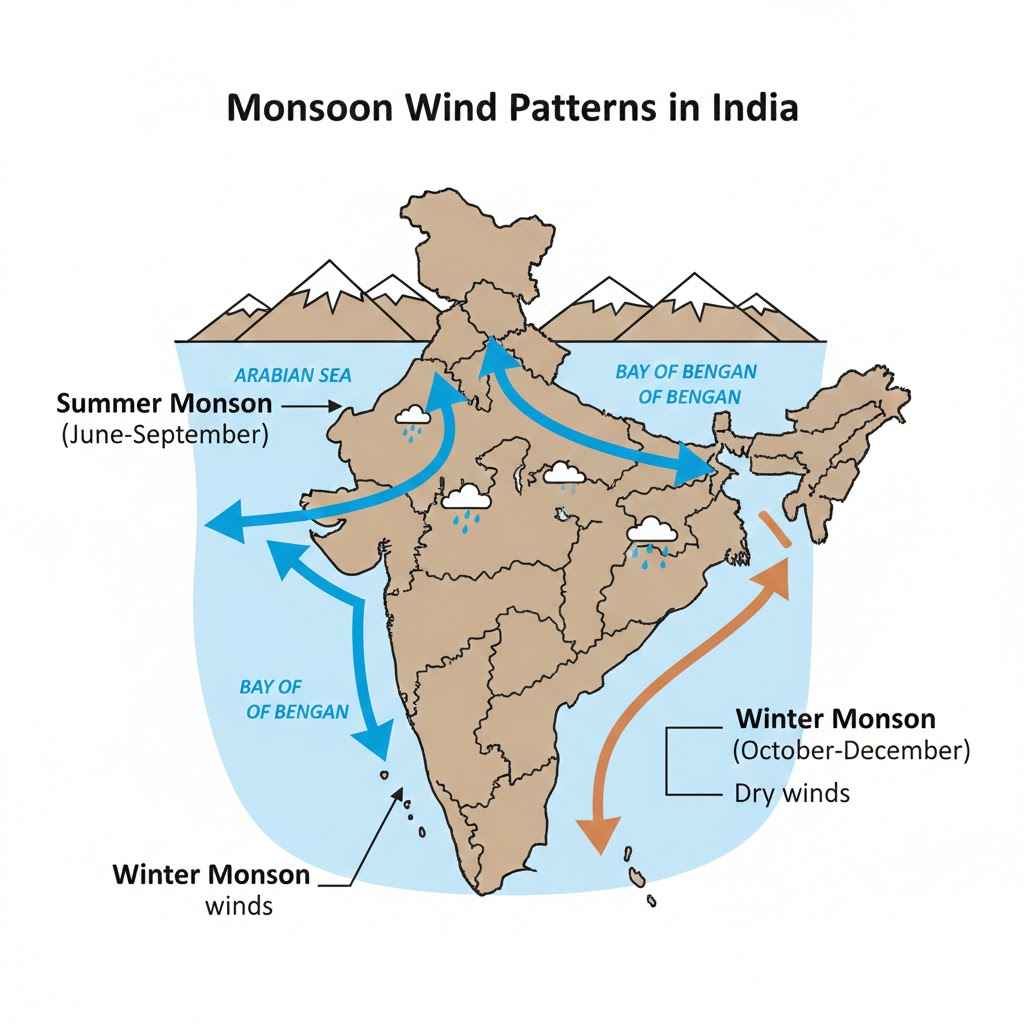 ⚠️ This picture may have spelling mistakes. Trust the words in the lesson.Factors Affecting the Monsoon
Several factors influence the timing and intensity of the monsoon, including:
- The Intertropical Convergence Zone (ITCZ): A low-pressure zone where the trade winds converge. Its movement influences the onset of the monsoon.
- El Niño-Southern Oscillation (ENSO): A climate pattern in the Pacific Ocean that can affect the monsoon's intensity.
- Tibetan Plateau Heating: The heating of the Tibetan Plateau creates a strong thermal low, attracting monsoon winds.
Keep learning, free
Create a free Syllabax account to unlock practice questions and games for this topic.
Visual Learning Enhanced! 🚀
To help you master this topic, we use Advanced Syllabax AI to generate detailed diagrams and visual models.
Note on Visuals: The AI sometimes makes spelling errors in image labels. Please refer to the lesson text for the correct terminology.