Sources of water[CHEMISTRY]
Watch this topic in 60 seconds
Free preview · Lesson 1
Understanding Sources of water[CHEMISTRY]
Sources of Water: Where Does Our Water Come From?
Water is essential for all life on Earth. We use it for drinking, cooking, cleaning, growing food, and so much more. But have you ever stopped to think about where all this water comes from? It doesn't just magically appear when we turn on the tap!
The Big Picture: Earth's Water
Imagine Earth as a giant playground covered in water. About 71% of our planet is covered in water! But, there's a catch: most of this water is saltwater found in the oceans. Only a tiny fraction of Earth's water is freshwater, the kind we can actually use for drinking and daily needs. Think of it like having a huge swimming pool full of salty lemonade – you can't really drink it! We need to find the parts that are like clean, fresh juice.
Where Does Our Usable Water Come From?
The freshwater we use comes from two main places:
1. Surface Water: The Water We Can See
Surface water is exactly what it sounds like – water that sits on the surface of the land. Think of it as the water that's easily accessible and visible. These are our:
- Rivers and Streams: These are like the highways for water, flowing from higher ground to lower ground, often ending up in lakes or the ocean. Imagine a tiny stream as a small road, and a big river as a multi-lane highway carrying lots of water.
- Lakes: Lakes are like big, calm ponds. They collect water from rivers, streams, and rainfall. They are like large reservoirs that nature has made.
- Ponds: Ponds are smaller than lakes, like a puddle that's a bit bigger and lasts longer.
- Reservoirs: These are often man-made lakes. We build dams across rivers to create them. Think of a dam as a giant plug that stops the river's flow, allowing water to build up behind it. This stored water is then released when needed.
Surface water is great because it's easy to access and collect. However, it can sometimes get dirty from pollution (like litter or chemicals) or natural things (like mud after a heavy rain). That's why we often need to clean it up before we drink it.
2. Groundwater: The Hidden Water
This is the water that's hidden beneath the Earth's surface. It's like a secret underground supply! How does it get there?
- Rainfall and Snowmelt: When it rains or snow melts, some of the water soaks into the ground. Think of the soil as a sponge. The water goes through the tiny spaces in the soil and rocks.
- Aquifers: As water seeps down, it collects in layers of rock and soil called aquifers. An aquifer is like an underground sponge that holds water. These can be shallow or very deep.
We access groundwater using wells. A well is like a deep straw that we poke into the ground to suck up the water from the aquifer. Groundwater is often very clean because the earth itself acts as a natural filter, cleaning the water as it passes through the soil and rocks. It's like the water is being strained through a super-fine sieve!
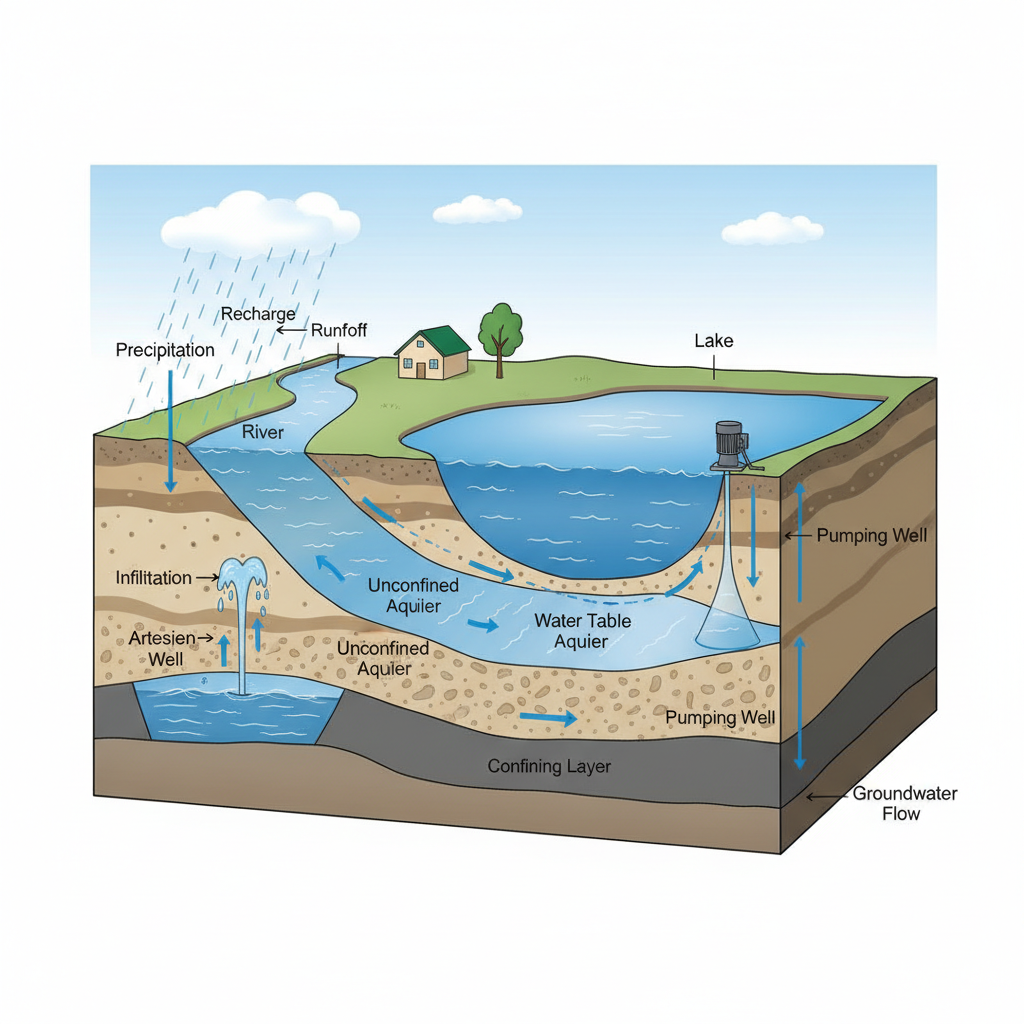
The Water Cycle: Nature's Recycling System
⚠️ This picture may have spelling mistakes. Trust the words in the lesson.Even though we use water, it never really runs out. Why? Because of the amazing Water Cycle! The water cycle is like nature's own recycling system for water. It's a continuous journey that water takes:
- Evaporation: The sun heats up water in rivers, lakes, and oceans, turning it into an invisible gas called water vapor. This is like when you see steam rising from a hot cup of tea – the water is turning into a gas and floating away.
- Transpiration: Plants also release water vapor into the air through their leaves. It's like plants are breathing out water!
- Condensation: As the warm, moist air rises, it cools down. The water vapor turns back into tiny liquid water droplets or ice crystals, forming clouds. This is like when you see tiny water droplets form on the outside of a cold glass of water on a warm day.
- Precipitation: When the clouds get too full of water droplets, the water falls back to Earth as rain, snow, sleet, or hail. This is like a sponge that gets so full, it starts to drip!
This fallen water then collects in rivers, lakes, and oceans, or soaks into the ground, and the cycle starts all over again. It's a never-ending process that keeps our planet supplied with water.
Summary: Key Water Sources
So, remember, the water we use comes from:
- Surface Water: Rivers, lakes, ponds, and reservoirs.
- Groundwater: Water stored deep underground in aquifers.
And the amazing Water Cycle ensures that this water is constantly being renewed!
Keep learning, free
Create a free Syllabax account to unlock practice questions and games for this topic.
Visual Learning Enhanced! 🚀
To help you master this topic, we use Advanced Syllabax AI to generate detailed diagrams and visual models.
Note on Visuals: The AI sometimes makes spelling errors in image labels. Please refer to the lesson text for the correct terminology.