Collecting Data: Surveys
Watch this topic in 60 seconds
Free preview · Lesson 1
Understanding Collecting Data: Surveys
Collecting Data: Surveys - Asking the Right Questions!
Have you ever wondered what your classmates think about the school lunch? Or what kind of music most people listen to? When you want to find out what a group of people thinks or does, you're looking for information, or as we call it in the world of data, 'data'!
Think of it like being a detective. A detective collects clues (data) to solve a mystery. In our case, we're collecting clues (answers to questions) to understand opinions, preferences, or facts about a group of people. One of the most common and powerful tools for collecting this kind of information is a survey.
What is a Survey?
At its heart, a survey is a method of collecting data by asking a set of questions to a group of people. It's like taking a poll or asking your friends for their opinions. For example, if you want to decide what game to play with your friends, you might ask each person, "What game do you want to play?" That's a mini-survey!
Surveys can be done in many ways: through written questionnaires, online forms, phone calls, or even in-person interviews. The goal is always the same: to gather information directly from individuals.
Why are Surveys Important?
Surveys are super useful! They help us make informed decisions, understand trends, and get feedback. Imagine if a company wanted to design a new video game. Instead of guessing what players might like, they could conduct a survey to ask potential players about their favorite game genres, features, and characters. This way, they can create a game that people are more likely to enjoy and buy.
- Schools use surveys to find out what students think about new programs or school rules.
- Restaurants use surveys to get feedback on their food and service.
- Governments use surveys to understand the needs of their citizens, like what services they need most.
- You might use a survey (even informally) to decide which movie to watch with your family!
They are like a voting system, but instead of just one vote, you get detailed opinions!
Key Terms in Surveys
Before we dive into creating questions, let's learn two very important terms:
1. Population
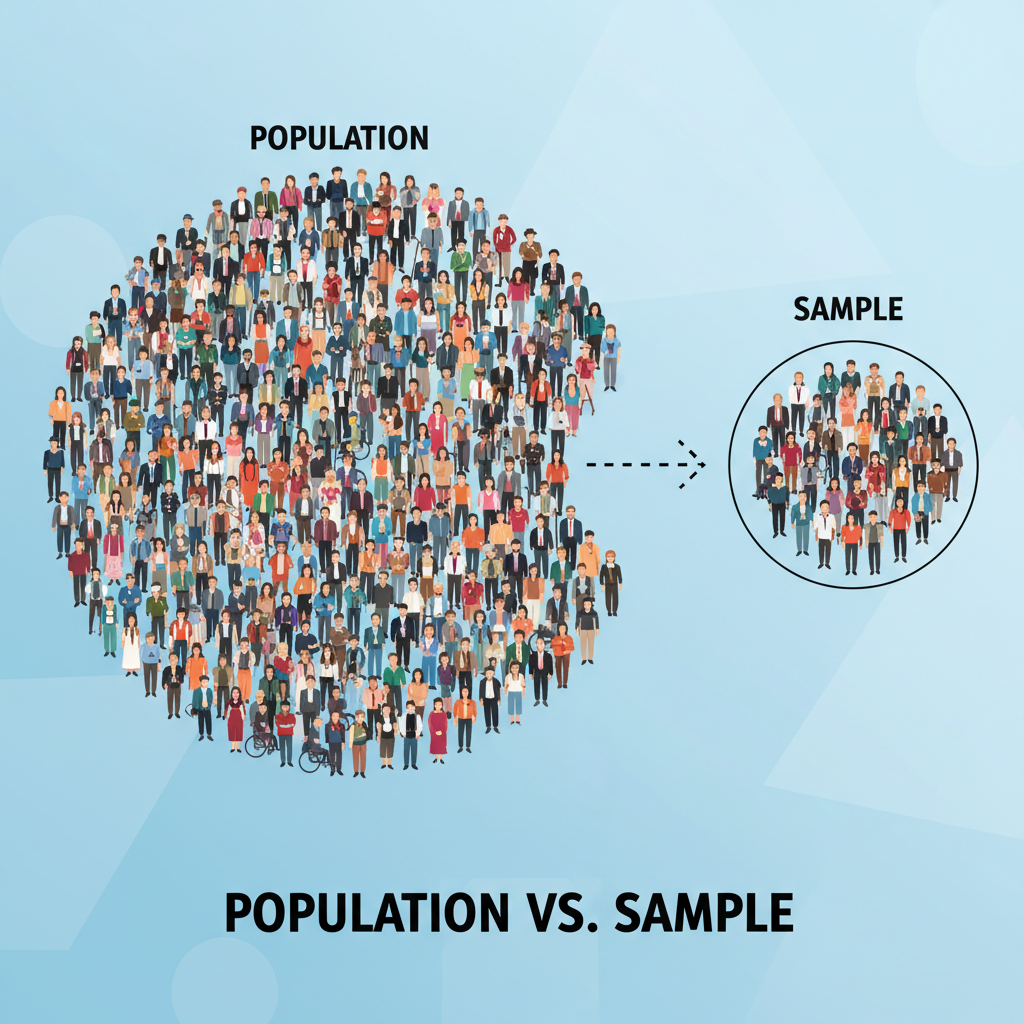
The population is the entire group of individuals you want to learn about. It's the whole pie, the complete set. If you want to know what all 8th graders in your school think about science class, then all 8th graders in your school are your population.
Analogy: If you want to know how tasty a whole batch of cookies is, the entire batch of cookies is your population.
2. Sample
A sample is a smaller, carefully chosen group from the population that you actually survey. It's a slice of the pie. Why use a sample? Because often, surveying an entire population is too big, too expensive, or too time-consuming. Imagine trying to ask every single person in your state what their favorite ice cream flavor is! That would be nearly impossible!
So, instead, we choose a sample that we hope represents the larger population. If the sample is chosen well, its opinions and characteristics should reflect those of the entire population.
Analogy: Going back to the cookies, instead of eating the whole batch, you might just eat one cookie (your sample) to see if they're good. If that one cookie is yummy, you'd assume the rest of the batch is too! The key is that the sample cookie should be just like the others – not a burnt one or one with extra chocolate chips if you want to know about the average cookie.
Types of Survey Questions
The questions you ask are the heart of your survey. There are two main types:
1. Open-Ended Questions
Open-ended questions allow respondents to answer in their own words, providing detailed and unique responses. There are no predefined choices.
- Example: "What do you like most about your neighborhood?"
- Example: "How can our school cafeteria improve its menu?"
Analogy: These are like an empty notebook page where you can write anything you want. You get a lot of information, but it can be harder to organize and compare all the different answers.
2. Closed-Ended Questions
Closed-ended questions provide respondents with a limited set of choices from which to select their answer. These are easier to analyze because the answers are standardized.
- Example (Yes/No): "Do you enjoy reading?" (Yes/No)
- Example (Multiple Choice): "Which is your favorite season? A) Spring B) Summer C) Fall D) Winter"
- Example (Rating Scale): "How would you rate the taste of the school lunch today? A) Excellent B) Good C) Fair D) Poor"
Analogy: These are like choosing an item from a menu at a restaurant. You pick from the options provided. It's easy to count how many people chose 'pizza' or 'salad'.
Designing Good Survey Questions: The Golden Rules!
The quality of your survey results depends heavily on the quality of your questions. Here are some golden rules:
1. Be Clear and Simple
Use language that is easy to understand for everyone taking your survey. Avoid jargon (specialized words) or complicated sentences. People should know exactly what you're asking.
- Bad Question: "Do you concur with the proposition that extracurricular scholastic endeavors augment pedagogical outcomes?" (Too complicated!)
- Good Question: "Do after-school activities help you learn better?" (Clear and simple!)
Analogy: Imagine giving directions to a friend. You wouldn't use complex street names they don't know. You'd use simple landmarks and clear turns.
2. Be Unbiased (Don't Lead People!)
A good question doesn't push people towards a certain answer. It should be neutral. You want honest opinions, not answers that respondents think you want to hear.
- Biased Question: "Don't you agree that our amazing new school library is the best improvement ever?" (This question pushes you to say 'yes' and 'best'.)
- Unbiased Question: "What are your thoughts on the new school library?" or "How would you rate the new school library? (Excellent/Good/Fair/Poor)"
Analogy: A fair judge in a competition doesn't tell the audience who to cheer for. They present the options equally and let the audience decide.
3. Be Specific
Vague questions lead to vague answers. Be precise about what you're asking.
- Vague Question: "Do you like sports?" (Which sports? How much? What aspect?)
- Specific Question: "How many hours per week do you spend playing organized sports?" or "Which of these sports do you enjoy playing: Basketball, Soccer, Tennis, Swimming?"
Analogy: If you're baking, you need specific measurements (1 cup of flour, 2 eggs), not just "some flour" and "a few eggs." Specificity gets better results!
4. Ask One Thing at a Time (Avoid Double-Barreled Questions)
This is a common mistake! A double-barreled question asks about two different things at once. People might agree with one part but disagree with the other, making it impossible to give a clear answer.
- Double-Barreled Question: "Do you think the school should have longer lunch breaks and more healthy food options?" (What if I want longer breaks but don't care about healthy food, or vice versa?)
- Corrected Questions (Two separate questions):
- "Do you think the school should have longer lunch breaks?"
- "Do you think the school should offer more healthy food options?"
Analogy: You can't ask someone to both run a mile AND solve a complex math problem at the exact same second. You need to ask them to do one thing, then the other.
Conclusion
Surveys are a fantastic way to gather information and understand the world around us. By understanding what a population and a sample are, and by crafting clear, unbiased, specific, and single-focus questions, you're well on your way to becoming a data-collecting expert! Remember, the better your questions, the better your answers, and the better your understanding!
Keep learning, free
Create a free Syllabax account to unlock practice questions and games for this topic.
Visual Learning Enhanced! 🚀
To help you master this topic, we use Advanced Syllabax AI to generate detailed diagrams and visual models.
Note on Visuals: The AI sometimes makes spelling errors in image labels. Please refer to the lesson text for the correct terminology.