Long/Short Vowel Sounds
Watch this topic in 60 seconds
Free preview · Lesson 1
Long/Short Vowel Sounds (Foundational)
Long and Short Vowel Sounds: Let's Explore!
Hi there, word explorers! Today, we're going to learn about something super important for reading and writing: long and short vowel sounds. Vowels are the letters A, E, I, O, and U (and sometimes Y!).
What are Vowels?
Vowels are the sounds we make with our mouths open! They're the building blocks of spoken words. Remember, the vowel letters are: A, E, I, O, U.
Short Vowel Sounds
Short vowel sounds are the sounds vowels make when they say their name in a small or short way. Think of it like a quick burst of sound!
- Short A: Like in the word apple or cat (sounds like /ă/)
- Short E: Like in the word elephant or bed (sounds like /ĕ/)
- Short I: Like in the word igloo or pig (sounds like /ĭ/)
- Short O: Like in the word octopus or dog (sounds like /ŏ/)
- Short U: Like in the word umbrella or bug (sounds like /ŭ/)
Long Vowel Sounds
Long vowel sounds are easy because they say their name! When you hear a long vowel sound, the vowel sounds exactly like its letter name.
- Long A: Like in the word cake or ape (sounds like /ā/)
- Long E: Like in the word bee or eat (sounds like /ē/)
- Long I: Like in the word ice or bike (sounds like /ī/)
- Long O: Like in the word boat or rope (sounds like /ō/)
- Long U: Like in the word cube or mule (sounds like /ū/)
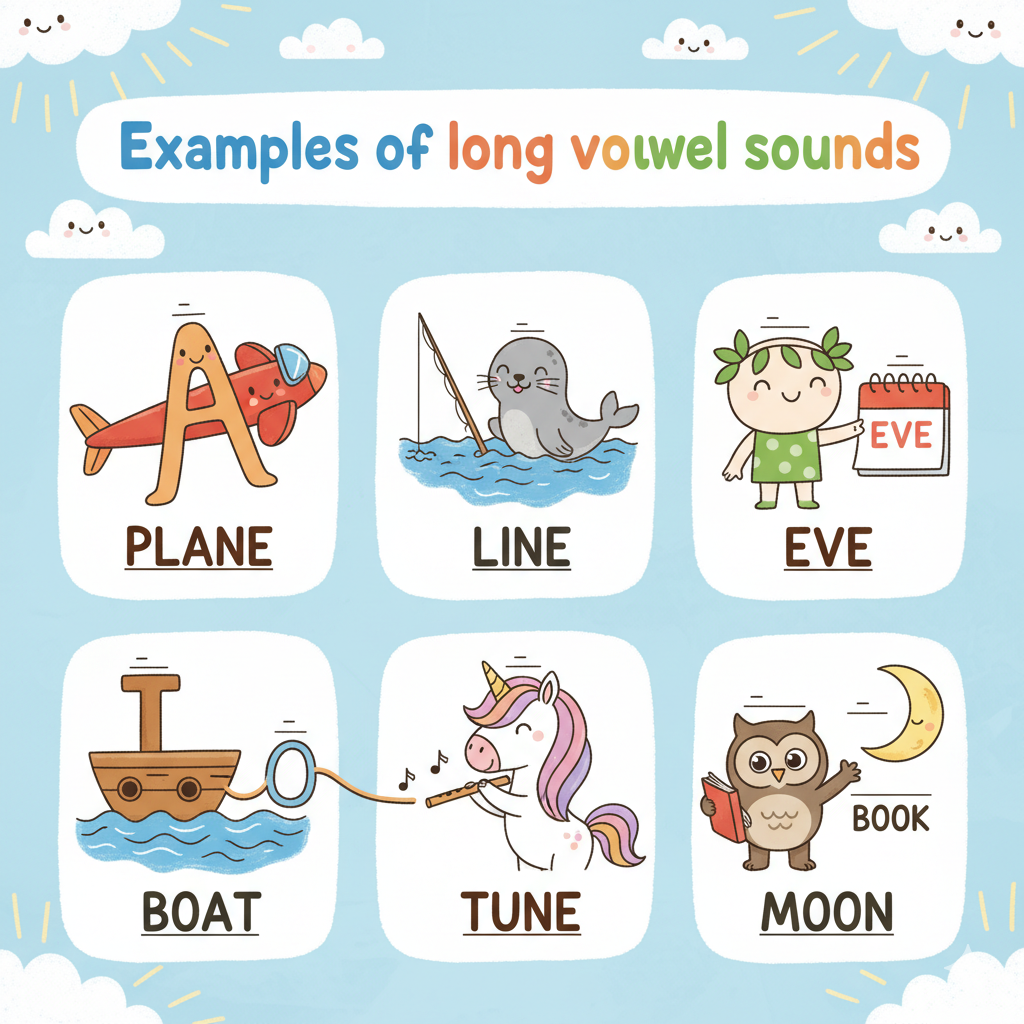 ⚠️ This picture may have spelling mistakes. Trust the words in the lesson.How to Tell the Difference
- Listen Carefully: Pay attention to the vowel sound in the word. Does it sound like the vowel's name, or does it sound shorter?
- Silent E: Many words with a silent 'e' at the end have a long vowel sound. For example, 'cake' has a long 'a' sound because of the 'e' at the end.
Keep practicing, and soon you'll be a vowel expert!
Keep learning, free
Create a free Syllabax account to unlock practice questions and games for this topic.
Visual Learning Enhanced! 🚀
To help you master this topic, we use Advanced Syllabax AI to generate detailed diagrams and visual models.
Note on Visuals: The AI sometimes makes spelling errors in image labels. Please refer to the lesson text for the correct terminology.